Matthew Lang avatar

Personal Practices

Habits, routines, and the systems I use to get things done.

Resetting outside of the calendar

I’m resetting my systems right now. It’s a chance to review a few of the tools I’m using and decide what works and what doesn’t.

Why now? Goals can wait for a date. A year gives you a clean line to measure against. Tools can’t. A broken system costs you something every day it stays broken, and there’s no reason to keep paying that cost until the calendar says it can change.

My experience with digital tools hasn’t been great. I find they add friction instead of removing it. So, what’s mostly changing is a switch from digital to analogue.

I’ve been using a loose version of bullet journaling for my workday for most of the past two years, and it’s worked quite well, so it makes sense to expand it into my own side projects and a few other things.

Fix it when it’s broken. Not when the calendar says you’re allowed to.

Using the daily plan bar again

For the last few weeks, I’ve been using Mike Rohde’s daily plan bar for my work notebook.

Initially, I started using a weekly plan bar over a year ago. Still, in the last few weeks, I’ve needed to tie my notes to that same day, so I’ve started using the daily plan bar again.

Auto-generated description: A dotted notebook shows a vertical timeline numbered from 8 to 1 on the left side in orange ink.

Nothing fancy, just a bar representing my day, split into 15-minute segments going from my usual hours of 8 to 5. If I am starting earlier in the day, it can go from 7 to 4 instead.

My daily plan bar is always on the left-hand side of the left-hand page of my notebook. The rest of the two-page spread is for notes and anything else that comes up that day.

It’s been a good change moving to the daily plan bar. Scoping out my day is much easier, and adding last-minute meetings and changes is easy.

In the future, I may reduce the bar to just eight hours and use the extra space for a single goal for the day.

Swamped with work and other commitments over the last two weeks. I need to create some downtime for myself and keep it as a regular thing.

Joan Westenberg explains why goals might not be what you should aim for and the power of adopting constraints instead.

A goal is a win condition. Constraints are the rules of the game. But not all games are worth playing. And some of the most powerful forms of progress emerge from people who stopped trying to win and started building new game boards entirely.

— Smart People Don’t Chase Goals; They Create Limits

I’ve been flying under the radar for the last couple of weeks due to circumstances beyond my control. Now that everything is settling back to normal, I can follow my usual plan and get a few things back on track.

Spring, the planning season

A recent trend in my RSS feeds and newsletters is that March is a month for preparing and planning and is the start of a seasonal way of implementing those plans.

Seth Godin recently blogged about March being the strategy month.

But March? Around the world, March can be a chance to get down to the work we committed to do.

Invest 31 days into outlining, discussing and fleshing out the strategy you want to bring to your career or your project. It doesn’t matter how fast you’re going if you’re headed in the wrong direction.

Mike Vardy also wrote in his newsletter that if you feel left behind, don’t worry.

If you’ve been feeling behind, let me be clear: you’re not behind—you’re right on time. This is your moment to decide—what do you want this year to really be about?

Finally, Austin Kleon also discussed living seasonally in his newsletter. Now is the time to plant those ideas for the year ahead. Austin Kleon’s newsletter got me thinking about how March is the month for starting a new one—not with resolutions, but with plans.

New Year’s resolutions used to be a thing for me, but I never saw them through. I would get a few weeks in every year, and my resolutions would fall by the wayside. After a time, I gave up on the notion that January would be the start of something new.

The problem with resolutions is that they are decisions that are attempted at the change of a day, and they are made when most of us are getting over the last of the holidays. It can be challenging to make adjustments and see decisions through. You need more time to prepare and see those decisions through.

March is traditionally a time for planting in the garden. Just last weekend, we started planting our tomato and chilli seeds. Next weekend, we’ll look to start planting flowers and herbs. I also have some plans to put a permanent greenhouse in the garden instead of the plastic ones I have been using.

Next weekend, I will start building a base for the greenhouse to sit on, and hopefully, by April, I’ll have a more permanent place for growing through the summer.

While our plans for the garden will take time, they will yield results with time and care throughout the summer and into the autumn.

I’ve got other plans for this year outside of the garden. These plans will take time, but using the year’s seasons is a better way of planning for the year ahead. I will use the next few months to get some plans in place, both for in and outside the garden.

I’ve managed to walk during my lunch hour three days in a row.

I have a meeting tomorrow at lunchtime though, so I may need to reschedule my walk for the morning instead.

A peaceful rural landscape with a grassy field, distant hills, and a partially leaf-covered tree under a clear sky.

Planning for the month ahead is enough for me

It is that time of year when many are drawing up changes and plans for the year ahead. A new year brings the opportunity to start over and improve again.

Individually, I’m just planning for the month ahead. Planning to work towards goals for the year is too big a step for me and one I usually fail on. Sure, I’ll list what I would like to do in the new year, but these are not resolutions that I must complete. They’re more like things I would like to do, and that’s enough for me.

Planning a month at a time means I can adapt over the year and change tracks if needed. If things aren’t working out, I can switch up my plan for the month ahead. No big commitment means that I can stay flexible.

Joan Westenberg suggests giving yourself 5-year timeframes. I love this. It gives you enough time to work on something, even tear it down, and start again.

Why 5 years? Because it’s the perfect amount of time to marinate in the quiet dread of potential failure, without fully descending into the loud panic of inevitable failure. Five years is enough time to tenderize the soul. You could go from a nobody to a legend, or from a nobody to a nobody with five years of extremely detailed regrets. Either way, you’re richer for the experience.

— I Work On A 5 Year Time Frame. Anything Less Is A Loss.

Cal Newport with some advice on dealing with election day anxiety.

Here I have a suggestion that I think could be healing for all points of the political spectrum: use the stress of this election to be the final push needed to step away from the exhausting digital chatter that’s been dominating your brain.

— After You Vote: Unplug

Although I am not voting, I am slightly anxious about what the electoral map will look like by tomorrow. With the timezone difference though, I won’t have any issues following Cal’s advice. By 10pm tonight I will likely be out for the count.

I am starting to get in the habit of copying and pasting the responses that ChatGPT gives me into my Bear Notes and then adding any changes I want to make there. Trawling through the ChatGPT history is a bit of a pain, but then it’s not really supposed for long-term storage, I suppose.

Skipping next year's Techo

I’m almost entirely sure that I won’t be buying a Techo for next year.

This year’s Techo is mainly blank. Despite many attempts at using it daily, it’s mostly just been gathering dust on my desk, with only a dozen pages filled in at best. Last year’s Techo was also the same, largely blank. In fact, I remember binning last year’s Techo around November time after believing there was no point in holding onto a largely blank planner for the year.

This is just one of a few things I used to do but don’t anymore. Reading and sketching were two things I did almost daily a couple of years ago. I haven’t finished a book in a long time or sketched for nearly a year.

I would like to say it’s frustrating, and I would love to kickstart doing these things again. However, I look back at how long it’s been not doing them and decide it’s probably not worth starting if I’m just going to stop again.

Working from the garden this afternoon was somewhat more productive than I thought. Fresh air, a single screen, and only enough space on the table for my laptop, mug, and notebook. I think I’ll be doing this more often!

After a few minutes of keeping a log in Obsidian for my work day, I’ve decided to switch back to bullet journaling. I find it a lot easier to keep a bullet journal updated. Also, it’s a welcome break from the screen for my eyes.

This is a good reminder by Nicholas Bate of the power of a list.

The list remains the most powerful task management tool: a simple, accessible and visible flight deck. One thing: use it not only to capture what you have to do but also what you wish to do. Don’t simply be reactive; be proactive.

— Nicholas Bate

Patrick Rhone’s plan for measuring his days in the future is definitely something I can get on board with.

One day, I hope not to measure my days in minutes or hours, but in miles walked and pages read.

— Patrick Rhone

And on that note I finished a book this morning and just finished an hour walk with Jennifer through the trees where we live. A great day so far by any measure.

Rebecca's restart

Rebecca Toh has restarted her newsletter and in it’s first edition, Rebecca suggests accepting that we’ll never do everything perfectly and to enjoy more what we love to do.

Instead of working to make things perfect, why don’t we spend our energy instead on enjoying the things we love to do and getting utterly lost in them?

Maybe that is the true art we’re here to learn - to go deeper and deeper into the things that draw us in for no good reason, and to find true, lasting, simple joy in that.

— Rebecca Toh

The productive influence of others

After reading Nicholas Bate’s latest powerful productivity post, I thought I would share a few of the people and apps that have influenced me.

  • Patrick Rhone - Patrick’s dash/plus system has been part of my own processes since I read about it.
  • Nicholas Bate - I’ve been reading Nicholas Bate’s blog for over 15 years. I’ve been using his master list idea for some time.
  • Ryder Caroll - Creator of bullet journaling, the only productive process that I have stuck with recently. It also works for me because of it plays nice with Patrick’s dash/plus system and Nicholas Bate’s master list. The fact that it’s also analog is a huge benefit to me. I spend enough times on screens. The last thing I need is another app just to stay organised.
  • 37 Signals - Over the years I’ve long been a fan of the way the 37 Signals company work. All of their books are recommended, but the real changers for me were Rework and Remote are great books that really do make you question the traditional methods of working. Short, sharp and straight to the point.
  • Trello - Although I use pen and paper most days, there is times when you need a digital tool to manage a project. I’ve flip-flopped between Things, Todoist and Trello over the years. While freelancing I used Trello for managing client projects, but when I returned to full-time employment I started using Todoist and Things to manage projects. I’m back to using Trello now. It’s the visual aspect of the app that really helps me.

I could have probably added another dozen or so people and apps that have influenced how I work over the years, but these five are the ones the I keep going back to.

Who influences your productivity?

Finding the path again

Over the last couple of months, I’ve started to make some progress on many of the habits that I fell away from a few years ago. I’m reading again, I’m working on more side projects, and I’m starting to find myself blogging more again. Feels good that I have found my path again. I hope that it continues.

A study shows that full absenteeism from social media is good for you.

Digital Minimalism and Deep Work author Cal Newport, highlights a new paper shows that taking a prolonged and full break is good for you.

The researchers further found that they could obtain smaller, but still significant improvements in depression and anxiety by having users simply reduce the time they spend on Twitter and TikTok. The biggest effects, however, came from full abstention.

— Taking a Break from Social Media Makes you Happier and Less Anxious

This is something that I need to do more often. The endless scrolling is a terrible habit of mine. When this happens, I sometimes start to sense that feeling of negativeness creeping in as I am scrolling. At this point I just put my phone down and find something else to do. Maybe I should just delete the Twitter app from my phone?

How I am using different tools and themes to seperate my work from my home.

It’s always good to use good tools for the job. In my case, I’m back to using a Macbook Pro and macOS as my development machine and operating system. It’s also great that I am working with Ruby and Rails once again.

The downside to using the tools is that they are the same tools I use to write web applications in my spare time. I enjoy hacking on ideas for web applications and using them for my own use, but I’ve noticed that the lines have started to blur when I use other tools.

Take for instance, source code management. I’m now using the same source code management tool for both work and my own projects. With source code management being a big part of my workday, I don’t enjoy using it the same way now for my own projects.

If I’m to continue enjoying hacking on my code after then, I want it to be an enjoyable experience. While I have no complaints about my job, it’s not a part of the day I want reminded of when it’s the evening or the weekend. I’ve been exploring different options for source code management over the last couple of weeks. I have decided to try out Gitlab for this over the next few months. It’s free, has similar processes to my current source code management tool, and integrates well with the hosting company I use for my web apps.

I’m also looking into other ways of using different tools or using the same tools differently. iTerm and Visual Studio Code are two tools that I use both at work and at home but finding alternatives to these is tricky when I use these tools really well. So instead of changing these tools to something else, I’m just changing how these tools look.

For iTerm, I have different looking terminals for work and home. It’s not much of a change, but the look definitely changes the dynamic of being at work and being at home.

I’ve also done the same with Visual Studio Code. I’m not going to look for a new text editor when I already use this quite proficiently. Instead, I am using the toggle extension in Visual Studio Code to change the theme and font settings for when I am at work and when I am home. A simple keyboard shortcut is now all it takes for me to change my interface from work to home.

Setting these boundaries between these contexts is essential as it creates a space for both. While I use many of the same tools, I do like to feel that I am in the correct mindset at the right time. That means using the appropriate tools for each and being able to distinguish between each. If the same tool has to be used for both, then a simple change of how that tool looks is all it takes for me to determine which context I am in.

I made a wee decision over the weekend, that should see me gaining a bit more time back for myself and the family starting from the end of the summer. Good times ahead.

The increasing costs of going back to the office and why it's not possible for everyone.

Now that we can all go back to the office, people are now realising that perhaps they would rather continue to work from home. This is due largely to the rising cost of living.

But there’s a problem. Employees who haven’t had to budget for train tickets, takeaway coffees or new office outfits for the past two years are now acutely aware of how much it costs to spend a day at your desk. And, worse, these costs are growing. Petrol prices are at an all-time high; transport fares have increased, and food and other essentials are on an upwards trajectory. That means an office day can hit the wallet hard.

— The sky-high cost of returning to the office by Sophia Epstein (BBC)

I’m a long-term work from homer. I’ve been doing it for the best part of the last 15 years. It’s simply what I prefer. As a slightly introverted person, I enjoy being able to get my head down and get on with the work. Don’t get me wrong, I do enjoy face-to-face meetings with people and I get that you need that time to meet and chat with co-workers. I would just prefer that there were other genuine benefits to going to the office.

Progress update for my side-projects

At the start of the year, I chose “build” as my word for the year. The single word strategy is the idea that you choose a word that will direct what you do for the year. Having not done this for a couple of years I wanted to go back to doing this so that I could at least focus on something for the year.

It’s mid-way through January and now seems as good as any to review what I’ve been building over the last two weeks and what I will be building in the near future.

My Twitter List Banner Maker (a mouthful I know) is now public on my GitHub profile. It’s far from complete but it’s working and with a few tweaks here and there can be used by others for their own lists. While building this I did learn a couple of things. Mainly, authentication with the new Twitter API, and also I improved my knowledge of RMagick by learning how to merge images together to change how they look.

In the background, there’s also a number of other things I’ve been building up.

  • I am continuing to post to my blog during the weekdays to build an audience up again. I’m not looking to build an audience of thousands, just more people that like what I am writing.
  • I am building a single document that will act as my playbook if you like for the day. A template for the day if you like. It’s been working well for me but it still needs some refining.

Looking ahead, over the next few weeks I am going to start building an application using the Blitz.js framework. A fellow developer from Glasgow put me onto this framework a week ago and I’m intrigued by the comparison to Rails but also that it’s a JavaScript framework and that’s one language that I am keen to build up my knowledge of in 2022.

The application won’t be too complex, a single-page application with a form that does validation and uses an external resource to look up information based on the data provided by the form. It was the simplest idea I could think of at the time and could be done within the next few weeks.

I’ll also continue to tweak the Twitter List Banner Maker so that it formats avatar images into a layout that is determined by the number of members on the list.

That’s enough for this month’s update. The next one will drop in mid-February.

There's no good time to start other than now

In the last few years, I have realised that there’s no best time to start a new habit. The critical thing to remember is that anytime is the best time to create a new routine.

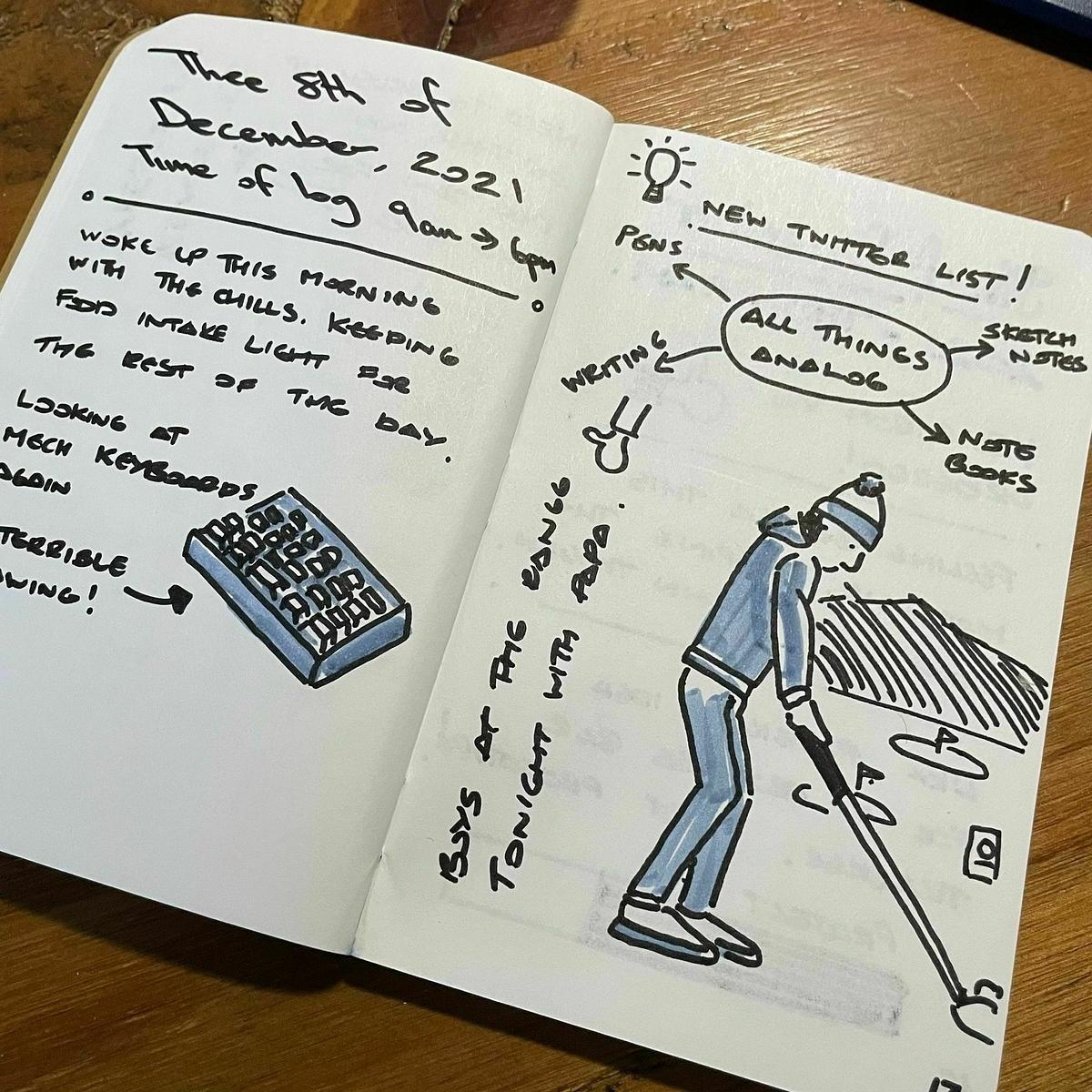
I started keeping a small notebook and filled it with sketch notes of things that happened during the day. I started doing this at the start of December. The plan was to get to the end of the week without missing a day. I managed that quickly enough. The next goal was to get to the end of the notebook without missing a day. I managed that a few days before Christmas. I kept going, and today I hit the halfway point of my second notebook doing this.

Now, I don’t doubt I wouldn’t have managed the same exercise had I started on the first of January, but starting on the first of December allowed me a bit of time to get used to the habit and build it up during a time when I knew I would have many distractions. Had I started this exercise on the first of January, I would have had to contend with the kids being off school, taking the decorations down for Christmas and getting the kids ready to go back to school. Chances are, I would have missed one day. 

The point to this is that there’s no point in waiting for the right time to start a new habit. Why wait until New Year when you can start something in December? Why wait until Monday when you can start something on Friday?

There’s no single best to start a new habit. Anytime is the best time to start.

A gradual change

I wrote yesterday about how my New Year resolutions never work and why that is the case. One reason is the amount of time I set aside to prepare for my New Year resolution. You can’t just change from one day to the next, maybe some of you can, but for most of us, we need a bit of time to adjust.

Making broad sweeping changes on the 1st of January seldom works as many of us are still in some form of recovery mode. Expecting to make a successful change from the 1st of January onwards is a challenge that I frequently fail. Instead of one sudden change in direction, would it not be better if we gradually changed our direction?

We’re starting to move out of the dark winter months in the northern hemisphere. This move is slow, but it’s enough to allow us to plan for what I view as the best time of year to implement change, around March.

Instead of making a New Year resolution, I tend to view the next few weeks as a proving ground for change. Sure, I want to make a change in the New Year. Still, I know that I can’t make the switch overnight, which is why over the next few weeks, I’ll explore a few things that I want to do different and see which changes are feasible to make and sustain.

During this time, I’ll outline some goals for the current year and break down what’s involved in achieving those goals. It might take a small change, or it might take a more considerable change. Whatever is involved, I’ll use the next few weeks to see what I need to do to achieve those goals. This might come in the form of changes to my day, what tools I use, reading, writing. Anything really to make these goals and changes clear. I can gradually implement these changes over the next few weeks to see what works and what doesn’t.

When we finally get to March, I’ll know what changes will work and what doesn’t, and I’ll stick with the working modifications for the remainder of the year to meet my goals.

I’ll also have recovered enough from the festive period that I’ll be back in a routine at home and work. I will be able to make better decisions on what is right for me. Being in a pattern make implementing changes more straightforward, as they are easier to schedule. I don’t know about you, but trying to make these changes on the 1st of January is a whirlwind. 

This gradual change is slow, but it’s more effective than the sudden change of direction that a New Year resolution offers. By giving myself time to recover and adjust, I can see better what will work for me for the rest of the year.

Why I don’t make New Year resolutions

Another year, another chance to start over again. How many of us have pledged to make a change in 2022? More to the point, how many of us will fail in these New Year resolutions? Probably most of us.

When it comes to new year resolution’s, we often fail to meet these resolutions within the first few weeks. I’ve lost track of the number of times I have been unable to follow through with my resolutions past the end of January. I don’t think I can remember a year when I followed through with a New Year resolution. It just never happened for me.

A few years ago, I decided that making a New Year resolution wasn’t for me. I noticed a couple of things about making new year resolutions over these last few years.

My resolution wasn’t focused enough

For me, making a new year resolution usually entailed a single statement for the year. For example, many of us would like to lose weight. What does that involve, though?

It involves eating healthier and doing more exercise. Eating healthier means changing what we cook, which means planning meals ahead of time. In turn means buying the right ingredients for these meals, which might mean budgeting the right amount of money for the month for these ingredients. That’s a lot to unpack in itself, and that’s only the diet part of my resolution. We haven’t even touched on the exercise part.

My New Year resolution was too broad. It wasn’t focused enough.

I didn’t prepare enough

We find ourselves starting the New Year by telling ourselves that we would like to change ourselves in a big way for the new year. However, that change won’t happen overnight. We’re all creatures of habits, but we’re probably more creatures of bad habits than good habits. We don’t adapt quickly; it takes time to change. And it’s for that reason; I always failed in my New Year resolutions.

December for me usually involves indulging a bit more than I should. We indulge a bit more in things like food and drink. We might also spend a bit more time on the couch in front of the television. Justifying this action as it’s a holiday and a break from work.

However, the problem is that switching from these traits in December to new ones in January isn’t easy to do. I frequently struggled with it, so my new year resolutions failed.

I needed more time to prepare for my new year resolution, and that was hard to do as the holiday season drew to its climactic end.

It’s just not for me

For me, making a New Year resolution is a practice that invariably led to defeat and made me question why I even bothered to start them in the first place. After wondering why I failed it often, I could see why it never worked for me.

If you are making a New Year resolution, I wish you all the success in 2022.

Another week, another thing I forgot to put in the calendar and completely forgot. It’s official. I need to write more stuff down. In fact, I probably need to write almost everything down.

The humble checklist

Adam Keys reminds us of the effectiveness of the humble checklist.

Checklists are great because they are an easy way to get my brain thinking about the details. They force me to think about all the things that need to happen. They force me to think in time and sequence: this needs to happen before that and this other thing will take a while so that’s probably another checklist. Checklists force me to think about dependencies and who is going to do what part of a project. For example: Bob has access to all the welding tools, so he needs to do all the metalwork which means Alice and Chris are stuck with all the woodwork and painting.

— The unreasonable effectiveness of checklists

I love a good checklist, especially when I’m going through a process that I’m not familiar with. You have the steps to go through, and if the checklist is well written, each step validates the previous step.  If something goes wrong, it has to be in the previous step or two.

A word for 2021

Niklas Göke’s word for 2021 is “matter”. He’ll use this word as his theme for the year to centre all his thoughts and actions. More of a guide for the year than a goal.

A theme is a baseline ideal, one that you use to guide your actions and decisions. It isn’t worried about tomorrow, nor does it care what happened yesterday. With a theme, all that matters is what you do today. It turns happiness into an attainable, daily standard that’s based on your behavior, not your accomplishments.

— How To Set a One-Word Theme for 2021

I’ve always liked the idea of themes, whether they be daily, weekly, monthly or even yearly. I must admit though, I haven’t done a yearly goal for a couple of years. I have definitely wandered off my intended path over the last couple of years.

I think I have a word in mind for this year, but I’ll just keep it to myself if you don’t mind.

The first step

I’ve been putting off starting what I know will be a long-running item of work. I’m putting it off because I haven’t taken that first step. And that first step is essential. Not the most critical step mind you, but necessary all the same. That first step could the first of hundreds, maybe thousands. Whatever it is, it’s that first step.

The first step doesn’t need to be a grand gesture, either. It doesn’t mean planning the next hundred things you need to do. It means just writing down what you need to do next and then maybe follow it up with the following two after that. Once those steps are complete, move onto the next few.

Whatever it is you want to do, take that first important step and see where it takes you. I’ve lost count of the number of things I haven’t done because I didn’t take that first step.

Morning routines for the rest of us

Curtis McHale offers an important reality check when it comes to emulating the routines of the successful.

It’s important to remember that many of these famous people are entirely divorced from anything resembling the reality of the rest of us. At one point before they were successful they didn’t have this routine and had to rush through the laundry at 5 am so they had clean pants in the morning. Yoga and cryotherapy weren’t even a thing they knew about and wouldn’t have cared about if they had heard of it.

— The morning routines we idolize are often from people divorced from reality

My morning routine isn’t anything to write home about at the moment. Wake up at 5:30 am, spend a few minutes doing some stretches to loosen my back, shower and get ready. Have a quick breakfast and then head out the door to work.

It’s not the ideal morning routine that I would like to have, but I’m prepared to take the hit in the short term.

Action versus motion

Standing on the platform waiting for the train this morning l, I opened up my Kindle app and started reading through another chapter of James Clear’s Atomic Habits.

In the chapter that I was reading James clarifies the difference in behaviour that leads to habits. There’s motion which is a behaviour that doesn’t yield a result and an action that does produce a result.

Outlining a handful of articles I want to write is motion but writing a single piece is an action. Actions are steps towards a defined outcome. Not only did I find this insightful for building habits but also how I categorise tasks.

Much of the coding work I am doing just now can be put in the action category. I implement a feature or a bug fix, and I deploy it. Deploying the change is the result of the action.

Then there’s the marketing work that I am preparing. I say preparing because that is all I seem to be doing right now, preparing. This is motion. While I am planning out something, I’m not getting any closer to the desired outcome.

The difference between the two is clear now, and it sheds new light on what I need to do to move forward.

Still, have to try

Curtis McHale has some words of wisdom when it comes to deciding to work towards something more than just a 9 to 5 job.

The things we want are hard, we may fail.

That doesn’t mean we shouldn’t bother trying.

— Good Things Are Hard and Have High Failure Rates, We Should Still Try

I enjoyed working for myself. In faact I loved working for myself. But it came with a risk. The risk was that I focused on long term contracts with fewer clients, so while the long term looked good, I found it difficult to maintain that run of long term client work. Eventually I found myself unable to sustain the work and I started looking for full-time work.

Now, two years later, I’m building a product on the side for a market that I have some knowledge of. There’s no guarantee that my product will be a success though.

Every week I spend a half hour going through some RSS feeds and a Twitter list of organisations that are the target market for my product and a Twitter list of competitors. The market is healthy and there’s plenty of worldwide opportunities for my product, but there are times when I doubt myself and I think the product will fail to take off.

It usually lasts for a couple of days and then I find myself shaking off the thoughts of risk and I through myself into the backlog of work I have to do for the product.

I have to at least give it a try.

I’ve started using Todoist again.

Bullet journaling on its own doesn’t cut it and Things is limited by the fact that it’s only available on Apple devices. I’ve only been using Todoist for a few days but it’s like I never stopped using it.

Are your inboxes making you anxious?

CJ Chilver’s reminds us that we can reduce our anxiety by reducing the number of inboxes that we have.

There’s a lot of productivity advice out there about what to do to organize and process your many inboxes. But the best rule is often forgotten: have as few of them as possible.

— Eliminate Extra Inboxes

I still use Feedbin on a daily basis to filter for the important stuff, and I even follow a few accounts on Twitter using it.

The biggest benefit I get from using Feedbin is that I’m in control over what I choose to see and read. That’s a big positive in a time where platforms are pushing algorithms that decide for us what we should read.

A larger company might afford better long term prospects with it being more secure and more stable. However, being a company of one puts you in control of ensuring your company is secure for the foreseeable future. I much prefer the idea of the one being in control rather than taking a backseat.

There’s nothing more I miss about freelancing than being a company of one. Setting your own work, your own hours, your own workplace, your own day. Someday I hope to return to this work.

Sleep deprivation on the rise

It seems we now need naps at work.

A recently published study from Indiana’s Ball State University, which examined self-reported sleep duration of 150,000 people, found the numbers of respondents who got seven hours of sleep per night or less rose to 35.6% in 2018 from 30.9% in 2010. About half of the respondents who were police officers and healthcare workers reported not getting enough sleep.

— Should workers be allowed to nap at work?

Is there more to this story?

Are there any other causes of sleep deprivation? Perhaps mobile phone use? The rise in sleep deprivation since 2010 is eerily close to the rise in mobile phone use, especially with the increased use of social media.

How many times do you find yourself surfing on your phone in bed?

It’s a terrible habit that I’ve been trying to break to give myself more sleep. Not only that, but I’m trying to set a good example for my kids. They need their sleep even more than I do.

Even so, if sleep deprivation is not related to this, there’s another argument. If you are allowed to nap at work, then why not offer employees a small reduction in hours so that they can get the right amount of sleep?

We all have to take responsibility for getting the right amount of sleep. However, in this age of always on technology, there has to be a way in which we can get the work-life balance right so that people shouldn’t need to nap at work.

Rebooting ... again

It seems that every once in a while I need to do a personal reboot. A chance to start over again with a few things and correct the mistakes I’ve made in the past.

Over the next couple of weeks, I’m hoping to start over on a few projects and try to build up some good habits again.

This morning started well with some early morning exercises, making a list of tasks for the day and reading a new book on the train to work.

I’ve got a half-hour set aside tonight for a spot of coding and writing as well.

A good start.

Clearing the home screen

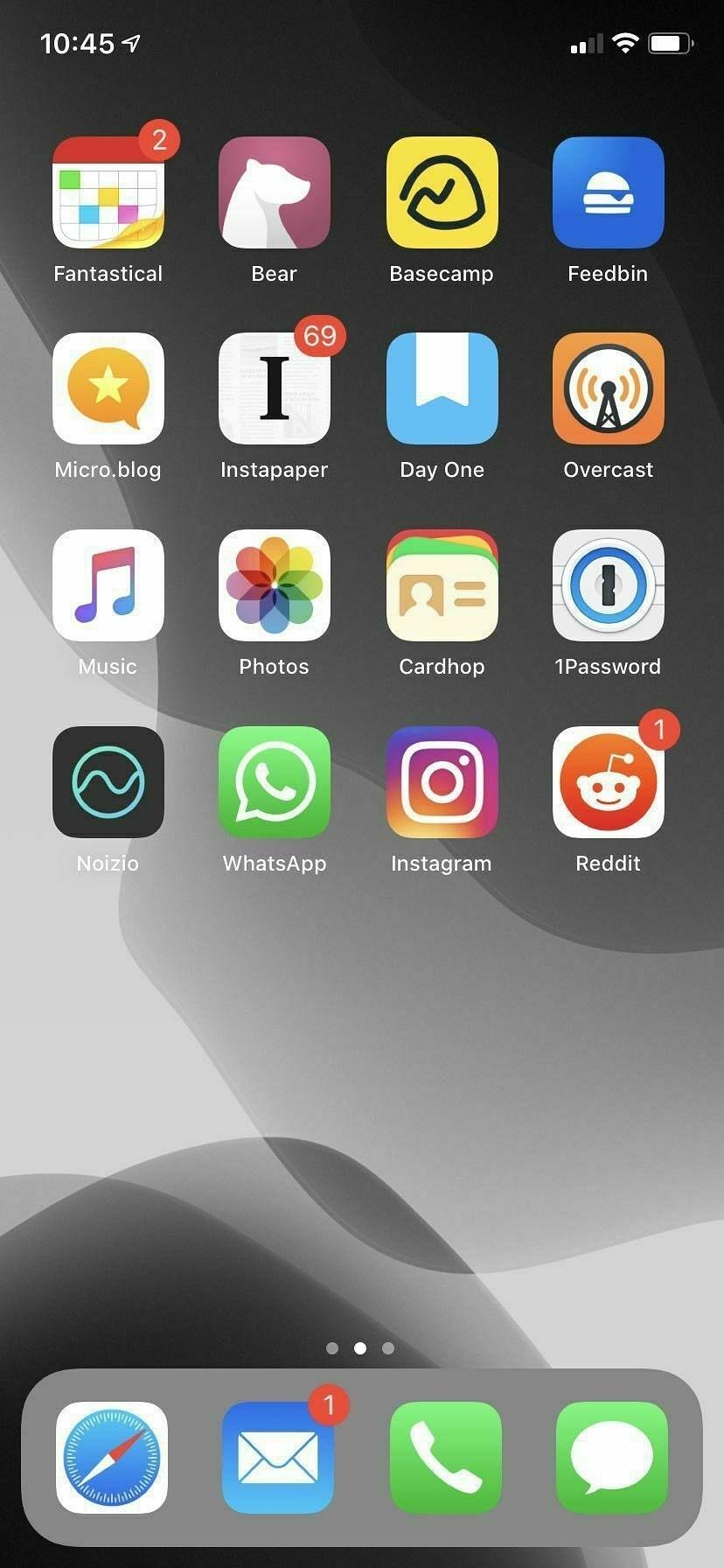
Spurred by this post on digital minimalism, I’ve decided to do a little clearing of the decks on my iPhone.

Gone are some Twitter clients, a few news apps and a 2FA app.

I’ve replaced the Twitter clients with the web interface on Safari, and I’m glad to see that I can now log into multiple Twitter accounts. I’m still not a big fan of Twitter, but accessing it on Safari is handy.

The news apps were never really used, and I can also read the news on Safari.

I’ve been meaning to move to 1Password’s two-factor authentication for accounts for some time, but I’ve been simply putting it off.

The home screen is starting to look a little more sane again.

Second day on the new job.

Another day of online courses, health and safety training and getting myself up to speed with the organisation.

God, I miss freelancing.

Bullet journaling again

I’m bullet journaling again.

To be honest, I didn’t really stop. I’ve kept a light bullet journal in a pocket notebook for the last few months. It’s hard to break a habit.

During this time, I also tried using a digital task manager, but it turned out to be a failed experiment. I just can’t keep a to-do list in an app anymore. It feels too constrained, and it usually feels like there’s a workflow to each type of app—a way it wants you to do things.

I just don’t get that with bullet journaling. The basic ideas are there, but I put my own little spin on them. It feels unique to me, and that’s maybe why I enjoy it so much.

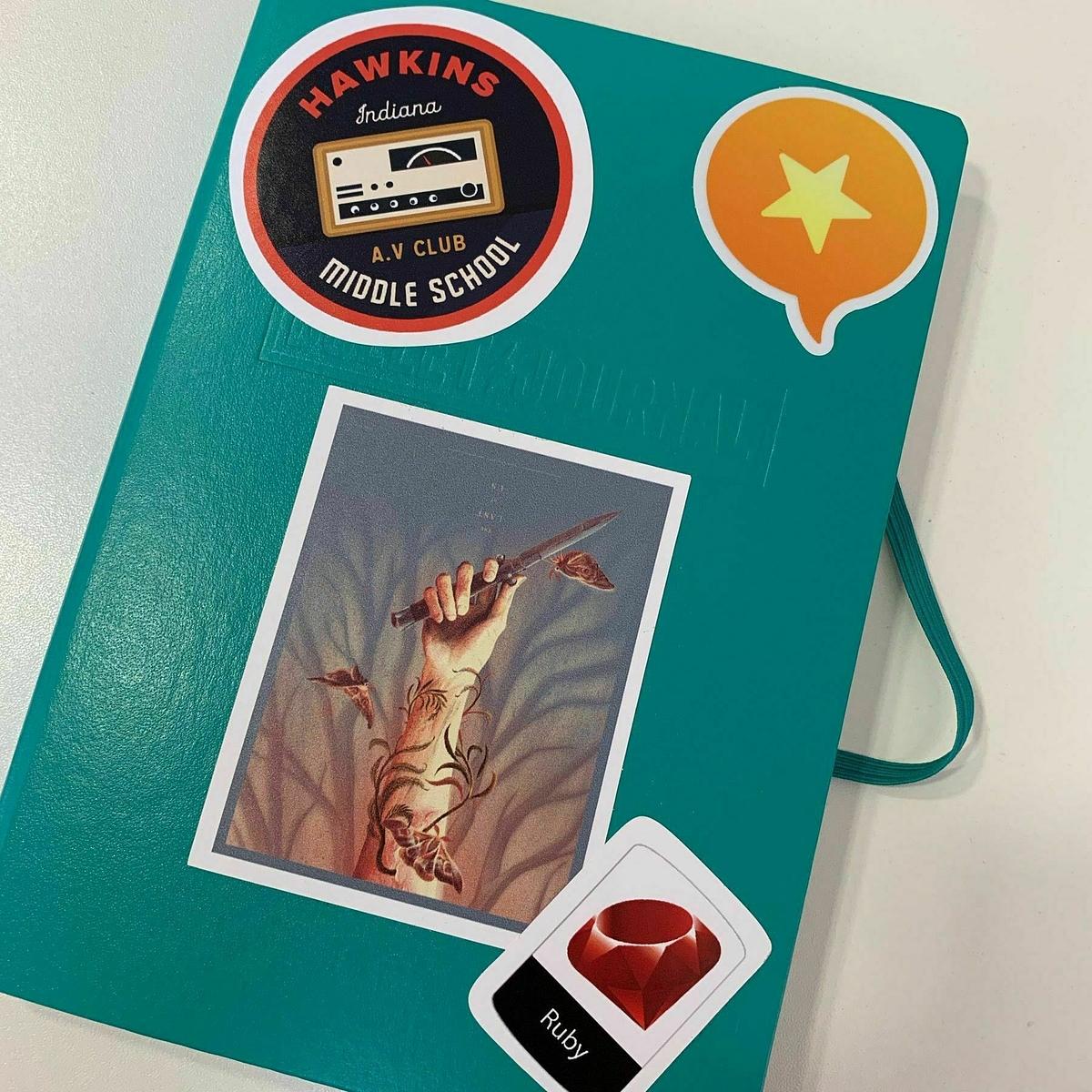
As with each bulletin journal, I like to make it my own with a few stickers of stuff I like. I have a Micro.blog sticker, obviously, a Ruby sticker, and a couple of nods to The Last of Us and Stranger Things.

I’m still missing a golf-related sticker, though.

I was hoping for a week free of fire-fighting, but I’ve been at my desk two minutes and guess what? There’s fires that need putting out. Sigh.

Part-time career?

Personally, I do think working fewer hours makes me more productive. But that’s not why I do it. The real reason is that I have other things I’d rather do. An hour that I don’t spend working (and I work hard, believe me, and like what I do), is an hour sitting on the couch with my kids, reading a science-fiction novel and pausing intermittently to chat about their video games or YouTube favourites. It’s an hour cooking a meal, going for a walk or doing volunteer work. It’s when I can act as one node in the lively neighbourhood web of parents, grandparents and afterschool programmes for kids, organising hangouts and snacks. It’s also when I pay bills, run errands, execute minor home repairs, and hire others to tackle major ones – so neither I nor my husband have to do that stuff on weekends.

Part-time work is humane and should be respected and encouraged

Just imagine what you could so with a few hours extra a week. Home cooked meals, helping the kids with homework before dinner, time to enjoy more of the daylight through the darker months, the chance to fit more in during the evening. Deifnitely something I would like to see happen, for all these reasons and more.

Installed Things 3 on my phone this afternoon. I’ve been struggling to make bullet journaling work since I stopped freelancing. I’m already finding it easier to consolidate a few different things under one roof now.

The context switching curse

It’s taken me such a long time to find my way back to what I was doing yesterday.

Some things are easier to find your way back to, but other things can take longer. I usually find that the bigger the task I was doing, the longer it takes to get back on track. It can get frustrating, especially when you’re making steady progress with something.

I’m starting to wonder though if by focusing on smaller tasks as well as keeping a log for the day, that I can begin to reduce the time it takes me to get back on track again.

Deep work and goldfish

A study commissioned by Microsoft found that since the year 2000 – or about when the mobile revolution began – the average human attention span dropped from 12 to 8 seconds, which places us just below a goldfish, which tends to stay focused for an entire 9 seconds at a time.

— Slack Is Not Where ‘Deep Work’ Happens

Wow. In almost 20 years we’ve become less focused than a goldfish.

I get ticked off by Slack as a platform, but not for what it is, but how it’s used. Instead of restricting channels to specific actions or topics, Slack allows any channel to be openly used and abused without user’s even knowing that they are distracting others. Why have one firehose channel when you can have ten?

I do miss the days of freelancing where I could get in a few hours of deep work in the morning and then catch up with clients and meetings in the afternoon.

The kettle is on, notebooks are out and I’m about to kick off a weekly planning session.

I’m already having to change the plans for today. Ethan’s golf coaching has been cancelled and there’s no way it looks like we’ll get out for a few holes either today thanks to the rain.

Benefits of the daily diary

Good advice from Derek Sivers on keeping a daily diary:

It works best as a nightly routine. Just take a minute and write at least a few sentences. If you have time, write down everything on your mind. Clear it all out. But if you miss a night, make time the next morning to write about the previous day.

— Benefits of a daily diary and topic journals by Derek Sivers

I also like his idea for topic journals.

For each subject that you might have ongoing thoughts about, start a separate “Thoughts On” journal. Whenever you have some thoughts on this subject, open up that file, write today’s date, then start writing.

— Benefits of a daily diary and topic journals by Derek Sivers

The four-day work week is good for gender equality

Another benefit to the four day work week.

A four-day week, such as that proposed by Wellcome, could have a profound gender effect. Women at the company who have children will be free to spend one day a week with them and, crucially, remain on the same footing as the rest of their colleagues. And the radical change could extend beyond the Trust’s own staff: Men with kids at the company would be able to commit to a day of childcare as well, meaning that their partners would be freer to make their own choices about part-time vs full-time work.

— The four-day work week is fantastic news for gender equality by Cassie Werber for Quartz

Good news across the board it seems, however, the four day week is a hard-sell to many companies. I think it will be a long time before we see this gain traction across the wider global workforce.

I’m clearing the desk, sorting out notebooks, reviewing app subscriptions, getting a list of books to read and considering what to focus on for 2019. I’ve been all over the place the last few years, time for some deep focusing.

Dealing with distractions

I’ve been trying to reduce my screen time on my phone. It hasn’t been easy and I’ve tried a number of different strategies to do this.

Copyblogger has a little gem of advice though when it comes to dealing with daily distractions.

Take some time away from the usual flood of news and notifications to think about your daily intentions. Document them somehow — any way that works for you — and make sure you see them through.

— What’s Actually Stunting Your Productivity (It’s Not Multitasking)

I wonder if my daily intentions is something that I can include in my DailyMuse email each morning? Something along the lines of Mike Vardy’s themed days.

Staying productive with side projects

I’m in the process of moving back to full-time employment, but the step away from being self-employed doesn’t mean that I am abandoning any of the side projects that I have been working on. I’m putting a few ideas together for DailyMuse, and there’s another more significant project that is a work in progress. Working on these in my spare time can be difficult especially when I have to consider other important things in life.

In the last few weeks though, I’ve been making smaller sprints for my side project, and instead of scheduling big blocks of time, I’m picking up the work when I want to work on it.

Zach Holman’s post on staying productive as a solo founder puts it in a better way.

There’s something to be said for focus, of course, but life’s too short to constantly throw yourself at the wall day in and day out. If you really believe in your product and think that generally, it’s something that can get you stoked, then taking a break for a while is usually worth it, and is more productive in the long run. It’ll draw you back in again in the future; don’t worry about it too much.

— Staying Productive as a Solo Founder by Zach Holman

As a programmer I know I’ll always have the itch to be building stuff on the side. From experience, I’ve learnt that working on side projects when I want to is a much more effective way of working on them than consistently plugging away at them and getting depressed about them.

It’s a clearing the decks kind of day. Both mentally and physically. It’s always feels good to get things in their right place on my desk, but it’s also great to get thoughts in their right place as well.

I’ve been trialling Things on my iPhone and iPad for the last few weeks. This morning though, I deleted the app from both devices.

It is a great task manager and it does do lots of things (sorry 🤭) really well, I just can’t get on board with a dedicated task manager app anymore.

I’ve been bullet journalling now for well over a year and I find it a much more effective way of managing my day to day work.

Also I tend to write a lot of software, so I’ve been sticking with task management tools that tie in with my software development process. This means using issue tracking on GitLab or GitHub and using Trello for bigger client projects.

I think it’s fair to say that I’m well and truly done with task management apps.

Started using Aloe Bud to remind myself to take breaks through the day.

Particularly important for me as I tend to forget to get up and move about for a bit, which doesn’t do my back any favours.

The rule of three

I love this idea of picking the best three shots from a day-trip or an event.

So, I’m going to do what I can to temper my happy shutter finger the next time. I’m going to pretend that I only have three shots available to me. Three shots to tell the story I’m trying to tell and help me remember the three most important moments.

— Three Shots by Patrick Rhone

I must admit though, I would be hard-pressed to pick my favourite three. I may have to extend it to four or five, but definitetly no more than seven.

Nicholas Bate’s tools of excellence series continues.

Sometimes an idea is bubbling. A plan, a product, a solution, a breakthrough. You need somewhere to articulate and develop that seed of an idea. That’s when you grab the back of an envelope from the small stack on the corner of your desk.

Important things

Michael Wade provides another gem of being productive.

One important thing today, that will put this day far ahead of days when you hoped to achieve much but scattered your focus on trivial matters.

— If You Do … by Michael Wade

Me? I’m just looking to complete that one important thing a day.

Staying on Track

When it comes to planning the day with bullet journaling, there’s one aspect of it that frequently throws me. Knowing when a block of work should finish, and a new block of work should start.

I’ve been using plan bars (both daily and weekly) to plan out my day. When it comes to working through the day though, I usually find myself losing track of time and working through a block of the day that I had reserved for a particular task.

The first and obvious solution here is to use a calendar with reminders to let me know when I have to switch tasks, but if I’m using a calendar app then what is the point in using the bullet journal?

Also setting up a calendar like this requires a lot of clicking and typing, which I’m not keen on doing.

The best idea that I’ve come up with this for this problem is to split the day into blocks and have recurring alarms set for the start of each block. This alert will give me the nudge I need to look up and switch tasks if I need to. Most days the blocks will start and end at the same time, but there will be days where blocks will change from the usual times during the day. The Reminders app on macOS comes to mind, but I’m wondering if there’s something even more straightforward than that that I could use.

If anyone else has any other ideas for staying on track through the day with bullet journaling, then I would love to hear them.

Benefiting from the Constraints of Pen and Paper to Tame Tasks

In the last 18 months, I’ve moved from using a task manager application to using pen and notebook and a technique called bullet journaling. The transition to this method hasn’t been without its challenges, but there’s one thing that it provides that I don’t get with any task manager application that I’ve used. And that is constraints.

Task management applications like to sell lots of benefits like being able to go with me wherever I go, work wherever I am and manage anything I throw at it. That last advantage is quite interesting because it’s here that I find that task management applications work quite well for me for a while, but I usually end up over-committing with a crazy list of tasks sometimes running into hundreds.

Thanks to improvements in technology, we have these little portable devices in our pockets that can potentially hold thousands (perhaps even millions) of tasks. These same devices also make it simple to add more tasks with the ability to type, speak or automate the process of creating new tasks. There are very few constraints in creating new tasks other than perhaps losing the wi-fi signal or running out of battery. These are not big constraints given that the world is more connected than ever and we have portable chargers to keep our devices topped up.

I keep all my tasks together at the back of my notebook. Written by hand and double-spaced. Sounds labourious right? Bear with me.

With each new task added, I often find myself questioning the value of the task and whether it is even worth writing down. I also look at the number of tasks I have decided if I need to focus on those first before adding anything else.

When it comes to moving tasks from one page to another, again I question the value of the task and whether it is worth moving.

My master list of tasks is usually about three pages long. Take into account that the notebook is smaller than A4 and my writing is double-spaced, that’s not a lot of tasks to do. The constraints of time to write a task and the effort in maintaining it when using paper mean that my complete list of tasks is manageable.

You can enforce these constraints on your favourite task management application, but I’ve often found that this is difficult to do given how easy to use these types of applications are.

Now, I’m not saying that bullet journaling is the silver bullet solution to all productivity hacks; it isn’t. However, the constraints of notebooks are why I find that bullet journaling works so well. It allows me to manage a smaller and more focused list of tasks and that in turns stops me from over-committing.

My Three Words for 2018

I’ve already written about how I use habits rather than resolutions for the year. Resolutions are doomed to fail, but practices can be iteratively built on over the year and eventually form a set of good habits.

How do you stay focused on these habits though?

Well, one way I’ve been able to build on these habits over the last couple of years is using Chris Brogan’s three words. It’s a simple idea.

You pick three words for that will guide your actions through the year. Through the course of the year, your efforts should align with these three words so that anything that you do is working towards them. The words themselves are goals, but not specific ones. Just parts of your life that you want to make better.

Last year my words were habit, health and hustle. I’m chuffed to say that at the end of 2017 I had lost a bit of weight and I’m now more active through the work week to stop myself getting any more back pain.

This year’s words are less of a focus on health and work and more about content and delivery.

Bootstrap - For too long I’ve had a little email product running that has been running quietly in the background. It’s time to bring it to the masses and bootstrap it from being merely just a product that people use to one that people rave about. Of course, I’m talking about DailyMuse. I want to expand this product so that it becomes more of a featured revenue stream than something I merely allow to run. DailyMuse isn’t the only product in the pipeline though. I’m intrigued about a numberless analytics idea, and I’m interested in exploring a niche market for my web development skills that could help end the feast and famine cycle that is always at the back of my mind as a freelancer.

Blog - I remember the great days of blogging every day. It didn’t matter what day it was. I punted something out anyway. This single word over the last two weeks has prompted me to write and publish more often already this month and look set to complete one week with a post a day.

Budget - When it comes to time, we only have so much of it. For 2018 I want to budget my time and energy through the week so that I’m not idling away my time in front of the television or on my phone. This isn’t a call to budget every minute of every day. Scheduling my day in this way doesn’t work for me. The plan is to spread my time, focus and energy over the week, rather than blitz everything in the one day. One way of doing this is to theme each day around a particular product or project.

I wouldn’t say that 2017 was a significant success using this technique, but I did make some gains. I’m aiming to do better with my three words for 2018.

No Resolutions, Just Good Habits

I’m not making any resolutions for the year ahead.

In my experience, it’s a self-defeating exercise that always ends up with me not seeing it through to the end of the year.

If you’re thinking along the same lines, then what’s the alternative to making improvements without failing?

Have you ever noticed how bad habits stick like watching television, sitting on the couch, and mindlessly thumbing through timelines on social media? These are not good habits to get into, but the thing about them is that they’re easy to do. They just don’t require any thought whatsoever.

What if we could just as quickly get into good habits rather than bad habits?

Well, this is what worked for me when I first started building good habits.

I started with just one habit.

I started getting into the habit of writing every day. To help remind myself to write, I set the alarm on my phone to give me the nudge to start writing. When my phone went off, I would then start writing. That’s all I did for a whole month. A habit built up every day. And it worked. It’s still working. I’m writing this, aren’t I?

The following month I added another alarm on my phone to do something else the next month and kept it going through the year. By the end of the year, I had built up some good habits that helped me through the day.

The problem many people face with new year resolutions is that they try to do too much at once. It’s like trying to lift weights at the gym. You just can’t bench press 100kg unless you’ve trained your body to get into the habit of being able to bench press 100kg. To achieve such a weight, you need to start with a smaller load and then gradually build up to the target weight.

Habits are the same.

You start small (ideally with one) and then build them up.

Tracking your habits is a great way to build them up. I’ve tried some habit tracking apps over the last year, but the one that works for me is Productive. It was the first habit tracking app that I tried, and nothing else I’ve tried has been as easy to use.

The good thing about tracking apps is that they give you a sense of success when you’ve reached a significant milestone like completing the habit for a week or even a month. Productive and other habit tracking apps have reminders built in as well, so it keeps all your habit building needs in the one place.

So, forget the new year resolutions and set yourself a short-term habit to achieve for the next few days. Once you’ve completed a few days with it, extend the practice for a few more days and keep at it. In no time you’ll find that you’ve been able to get into your intended habit daily and by the end of a period of a few weeks it will become more of something that you just do.

For the last couple of years I’ve been writing every day through a practice called morning pages. It involves writing three pages of anything. Now, I know I’m not a writer. Not even close, but I use this practice to not just write anything, but to draft blog posts, collect thoughts and write up ideas. My morning pages became a time to write before I started doing any programming work.

The problem with this practice though is that very few of this writing will ever see the light of day. The original idea of writing your morning pages isn’t to publish what you write. With a full day of work ahead though, I needed sometime in the day to some writing and I figured that using these three pages would be the best time to do this. As I finished each set of pages though, I would usually choose not publish anything from those pages. Not exactly a productive habit and so I decided I need to change my morning pages practice.

For a start I’m returning to publishing a blog post every day. I did this a few years back on this blog. I published every weekday and left the weekend’s free. The topics varied from day to day but I’m aiming to keep posts grouped around a theme each week.

To keep my posts consistent and in a good size for reading, I’m aiming to publish in the region of 500 words a day. Some days might be less, some days might be more. There’s no strict rule to post length other than it needs to be around the 500 words in length.

Posts will be structured around a theme or topic each week. Now the posts themselves won’t form a particular series or even follow on from one another, but what they will have in common is that they will all relate to a single topic. Doing this allows me to plan posts ahead and structure what I need to write about everyday.

This little habit is called my morning stories. A chance to spend some time writing and get myself into a better habit of not just writing, but publishing what I write as well.

Mindful giving

It’s the time of year for giving and there’s lots of ways you can do it.

Small organizations often need help with administrative tasks — website design, donor management, marketing materials. On the ground opportunities may provide more Instagram-worthy photo ops, but helping staff inside the office may be more valuable to the team.

— Tips on mindful giving by Michelle Welsch for Project Exponential

The value of silence

There’s value to be had in silence you know.

Late at night. A quiet office. No phone calls. No interruptions. The work can be broken down into small tasks and each task approached with an attention that respects its value. The big picture can be pushed into the distance and scrutinized later. This is the time for craftsmanship.

— The Quiet Times by Michael Wade

It’s that time of year again! Next year will be my third year using a Techo. It’s proven to be so popular at home that Jennifer has ordered one as well! 👍

Simple rules

I often fall into the trap of complicated systems.

A simple rule works because I can have one of those completely mindless days and still stick to it. And let’s be real: I have as many mindless days as I have mindful days. Complicated systems ruin both, actually. On mindless days, when it’s a struggle to focus and my head feels like its on backward, following a complicated system requires more concentration and willpower than I can muster.

— Simple rules, again by Annie Mueller

Rebooting the morning routine

The morning routine of reading, writing and planning is nothing more than a distant memory these days. I once used to start the day with some writing, some articles from my reading list and a last check that everything was in it’s place for the day.

These days I’m sitting down at my desk with a coffee, opening Slack and Trello and picking up the next card of work for the client. Before I know it, it’s 5pm and the troops are walking in the door hankering for their door.

It’s time reboot the morning routine and get back a sense a of order in the morning.

Slow down

Execupundit reminds us to slow down.

I find that I get more work done by slowing down. “Mindfulness” becomes a signpost. Taking pleasure in small achievements provides a flow of motivation.

— Slow Down by Execupundit

7) If you have to do any kind of work for your freelance business, keep it light. Admin work, review your website. That sort of thing.

Observations ...

… from our man in Arizona, Michael Wade.

  1. The best way to create magic is never to rely upon it.
  2. Be wary of those who think everything is driven by money.
  3. The most important conversations are those that are never held.
  4. Think more of your habits than of your plans.

— A Few Observations by Michael Wade

Click through the rest of the list.

Weekly plan bars

I’ve been having a successful run with the bullet journal and implementing Mike Rhode’s daily plan bar but as a weekly view rather than a single day’s view. Daily plan bars go on the left while a list of tasks for the week goes on the right. I’ll do a better write up of this in time complete with a more annotated description.

A lesson in building habits

It’s that time of year where people are starting to tail off on their new year resolutions. Let’s face it, for most of us new year resolutions are nothing more than pipe dream. I don’t do new year resolutions but what I do believe in are habits.

Habits are easier to build than new year resolutions and once they’re part of your routine, you’ll find that don’t need to spend as much time building that habit again if you break it. This also makes your goals (or resolutions) much more achievable.

Ethan’s golf has been progressing nicely over the past year. He’s comfortable with his new clubs, he’s familiar with his local course and he’s getting to know more and more people through different levels of coaching and playing. His handicap didn’t fall much last year, but he’s adamant that this year it will come down and he’s set himself the target of being at a handicap of 20 or less by the end of this year.

Rather than getting him to focus on the long term goal of reducing his handicap though I started him on something more manageable.

Building the habit of practicing every day for 20 minutes.

It doesn’t matter what part of his game he practices on, it could be his swing, chipping, putting or playing out on the course.

He started off well. He needed reminders to practice in the first week, but he managed to get there. After a couple of weeks, his calendar now looks like this:

16 days of daily practice and all without a break in the chain.

I don’t need to remind him to practice anymore. He just does it. He takes a look at his calendar and puts in the practice so that he can keep put the next ‘X’ in and keep the chain going.

The habit is now part of his daily routine but Ethan is still a long way away from that goal. Once the golf season starts in earnest he should see better scores on his scored cards and start to see that handicap fall.

Clearing the decks

With the new year just around the corner, it’s always a good time to clear the decks and start afresh. A few things I’ll be doing today:

  • Organising my desk
  • Preparing my new Hobonichi Techo
  • Planning out January in my bullet journal
  • Reviewing clients and their products
  • Reviewing my digital footprint
  • Reviewing my now page

If you’re at a loose end today, clear the decks. It’s as good a time as any to start getting ready for a fresh start.

The future adds a zero

Except that messages now travel 50 times faster than they used to, sent to us by 100 times as many people as we grew up expecting. Except that we’re spending ten times as much time with a device, and one-tenth as much time reading a book.

Here it comes. The future adds a zero.

— Times 10 by Seth Godin

Level up

There comes a point in your career when you can no longer coast along just punching in and out and doing a day’s work. Nobody tell’s when that time will come. It can be in the first few days of your job or after years of working for yourself.

When that time comes to level up, you can do two things.

  1. Ignore the opportunity and keep coasting along doing the same thing you do every day. Eventually though the opportunity will reveal itself again.
  2. Use the opportunity to level up and start making improvements in your career and your prospects.

While I’ve been doing client work for five days a week for the last two years, the chance to level up has presented itself on a number of occasions. Each time though I’ve used the excuse that I don’t have the time to make improvements or start learning something new, and while that is a poor excuse, it’s what I did.

I’m paying the price for it now though. I’m still busy working for clients and next year’s schedule is looking great. I can’t always bank on having the same clients though in the next five years. They may no longer be using the web frameworks that I specialise in, they be looking for alternatives that I am not well versed in. They might even want to take a look at something completely new.

When clients want to level up, you need to be ready to level up with them. Whether it’s technology, tools or processes, you need to be able to have enough knowledge to level up with them. To make this transition as easy as possible it helps if you can be the one that levels up first. Then your party of clients can follow.

So when the opportunity presents itself to learn something new, do yourself a favour. Don’t ignore it.

Nicholas Bate reminds us that Mondays are for those who take action.

Are simply there to sort the leaders from the followers, the serious from the not-so-serious and those who are taking action from those who are waiting. Love your local Monday.

Why Notebooks Work For Me

This week I’ve highlighted the three notebooks I am using to replace my task manager app.

The reason that I find that notebooks work so well is because while notebooks are more versatile, they also need input and I don’t mean of the mouse and keyboard kind.

Digital task managers have a number of features that allow you to take shortcuts. I took these shortcuts as a way of avoiding planning and reviewing my next block of work. I simply let my task manager do it for me using features like lists and tags.

I can’t take shortcuts with a notebook. I can’t quickly filter out a subset of tasks. I can’t move a group of tasks in a few seconds. Given time I could do these but just not quickly. And that’s the reason I find that notebooks work so well.

Managing your tasks using notebooks means that you need to spend more time planning, reviewing and making decisions about what’s important.

They need that little bit of extra work. Work that I think is worth putting in.

So far, everything is going well. The only significant change was the introduction of the bullet journal, but I’ve already have plenty of use through my other notebooks to make the switch to the bullet journal easy.

To find out more follow Patrick Rhone and Belle Beth Cooper who are real notebook aficionados. Both update their blogs on a regular basis and feature posts around notebooks and how to use them. Patrick also has a website called The Cramped that you might revolves around analog writing.

When it comes to getting things done the focus is always on what needs done and when you can do it. Without these two you would end up with the wrong task getting done at the wrong time. You’ll eventually find yourself just getting nowhere fast.

These two task variables are important but just as important is the time you spend looking at the progress you have made. In order to do that you need look past more than just the tasks you done.

I look to the tasks that fall into two categories:

  1. The difficult tasks that presented problems but were eventually done.
  2. The tasks that I enjoyed doing and that made a significant impact.

It’s these groups of tasks that make up the bulk of my final notebook in the process, the logging notebook. When it comes to looking back what you’ve done, you need to filter out the important tasks so that you know you are making progress. This is what I use the logging notebook for.

I’m using a Hobonichi Techo planner as my logging notebook. Persuaded by Patrick Rhone and Mike Rohde I bought one at the end of last year.

The notebook itself is fairly small and the paper although thin, is of superb quality. This makes it ideal for a broad range of writing instruments. I mostly use a Lamy Safari for this notebook, although I have done a few sketches with other pens.

Rather than using it as a planner, I record the big wins for the day and the tasks that I finished that made a real difference. Those “Yay me!” moments when it’s more than just another task done, it’s a significant amount of progress made.

The year is drawing to a close and I’m glad to say that the Hobonichi Techno planner has been a great investment as I use it daily. Next year’s is already sitting on my desk waiting to log the next set of wins .

You can use any notebook as your logging book. The most important thing is to log the wins. It adds a much clearer view of the progress you’ve made and also has the benefit of providing a much needed boost when you feel you have been slacking.

Bullet journalling has been around for a few years now, but it’s only now that I’ve decided to start a bullet journal of my own. The bullet journal is the idea of Ryder Carroll. He wanted something easy to use and over a period of time, he tweaked what we now know as the bullet journal.

The bullet journal isn’t the notebook itself, it’s the conventions used in the notebook that make it a bullet journal. There are a number of different pages to a bullet journal:

  • Future log - A two-page spread listing what you need to do over the next six months.
  • Monthly log - A single page listing the month ahead and what you planned for each day.
  • Daily log - A page with tasks and notes listed for each day.
  • Collection - A single page comprising of a number of related tasks.
  • Index - A number of pages with references to any future logs, monthly logs, collections and any other page you need to remember.

I’m using it in much the same way as the method on the website with the exception of the bullets. I’ve been using Patrick Rhone’s DashPlus system for few years now for my notebooks for capturing and so I’m sticking with that.

I keep a list of recurring tasks that I must do each week and month. Every week I have admin work to do, invoices to review and marketing tasks to get done. I keep these tasks under two pages. The first is weekly and the second is monthly. Any recurring tasks get listed here and then migrated to the month log or daily log when I need too.

It’s fairly easy to pick up and that’s one of the reasons why I like it so much. Even the simplest task manager apps on the market have a degree of complexity about them. With the bullet journal everything is there to see. Nothing to hide.

The immediate benefit is that you’re away from the screen for periods at a time through the day. Modern technology is great and makes us more productive, but there comes a point where even modern technology becomes counterproductive and we end up needing something to reinforce what’s important to do next.

For me the big benefit is the need to spend more time reviewing and planning my tasks in the journal rather than simply seeing what my to do list has scheduled in place for me to do that day. Now that I spend more time planning my day and week I’m more aware of what I’m doing and the time I’m spending on each task.

Moving To An Analog Task Management System

A few weeks ago I decided to take the plunge and stop using Todoist as my task manager. As you know I’m a big fan of Todoist and it wasn’t easy making that decision. My frustrations came from the fact that I needed something more intentional than another app on my phone, another task list in the ether of the Internet. I need something that requires a bit more work to manage than just bashing in a few words with my keyboard or frantically clicking my mouse.

CJ Chilvers’ post about ditching your to do list had been on my mind for a few days before making the decision to stop using Todoist.

I’ve slowly become a convert to the idea that we need to concentrate on our calendars a whole lot more to achieve what we want in work and life. If you want it done, it must be scheduled. If it’s not scheduled, it’s just another item on your wishlist that will never be completed.

— Kill Your To Do List by CJ Chilvers

Investing time in the task manager isn’t the priority, it’s investing the time in the calendar that makes the difference.

So, do I need Todoist? Well, I’ve been without it for over a month now and I’m still working, still busy and still making an income. Clearly working from your calendar is a good thing.

However, that leaves me without some form of tracking and managing tasks. I wanted something that didn’t have me sitting on my phone first thing in the morning, something that required a bit more effort to use and finally something that I could just pick up and start using regardless of where I am.

I’ve been using pocket notebooks to capture stuff through the day like notes, messages, tasks, ideas, books to read and so on. Being able to stop, write, and then carry on working gives me a little break from the screen through the day but it also got me thinking about using more notebooks to manage my tasks.

I might have killed my to do list on Todoist, but I still needed some form of task management. And that’s what this week’s posts are about. So tune in tomorrow for the first post on the humble pocket notebook.

Stoking the Creative Fire

It’s time to get out there.

“If you get out of your daily routine—which for most of us is being on social media, or your laptop and phone—and you get out with a pencil, pen, or whatever tool you prefer and just start looking around,” says Kulik, “something you’re trying to solve in one part of your life might be solved by using your creative brain.”

— This One Simple Technique Will Stoke Your Creativity Every Day by Fast Company

I’ve been rebooting a few habits and processes over the last few weeks and one emerging trend from all this is that I’m going back to basics.

Instead of putting my tasks in Todoist, I’m capturing them in a pocket notebook. I don’t need a another task manager app. I can capture the task in my notebook just fine.

Instead of using a 3rd party calendar app on macOS I’m using Calendar. I don’t need another calendar app. I can outline my day in the macOS Calendar app just fine.

Instead of writing everything in Ulysses, I’m writing this post straight into the Ghost editor. I don’t need another editor to write it in. I can write it in the Ghost editor just fine.

When you see the tools that are available to you, it can be easy to make yourself jump through hoops to justify the use of these surplus tools. All we’re doing though is adding extra layers to get one thing done. When you remove those layers, it can be surprisingly simple to do just that one thing. And that’s just fine.

Start small

Start small. Start with just the smallest version of your idea and a way to manually make it happen. You can automate later. You can add more to it later. You can test the waters without a massive investment of your time or your money, and see what happens when people start buying it from you. That’s actually a much smarter way to launch.

— Define your “need to haves” vs “want to haves” by Paul Jarvis

I love this. Sound advice for anyone looking to turn their idea into something real.

Time to breathe

A little reminder that we all need time to breathe.

One of my favourite words has always been ‘desultory’ as coupled with the idea of pottering about and doing things for pleasure.

— Breathing Space by Steve Hodgson

When was the last time you gave yourself some breathing space?

And yes it’s on the playlist too.

Cut-off

Turning my ideas into reality is what I want the most out of life. So that’s what gives me the deepest happiness.

Then I realized that all the best, happiest, and most productive times in my life, were when I was completely cut-off.

— Disconnect by Derek Sivers

Do the Work

There are no shortcuts.

There’s no substitute for hours put in. Good work requires commitment and emotional investment. You can try to make shortcuts, but your audience will know. More importantly, you will know.

Do the Work by Project Exponential

Slow and Steady

Wins the race.

This morning, just as a test, move very slowly. Avoid scanning material. Read it carefully. Sense the rhythm of the words. Make all of your actions as precise as possible. Be in the moment, whether you are sipping coffee, writing a note or talking to a customer.

‐ Slow and Precise by Michael Wade

For Patrick Rhone has some wise words on the subject:

Worry is born of desire — desire for change. If worry does not drive the action for change, or if there is no action you can take that will strive for or effect change, then what good is your desire?

— On Worry by Patrick Rhone

It’s funny, you never see “realist” as a required skill in ay job posting.

We need order and flexibility, boldness and humility, caring and detachment, curiosity and wisdom, farsightedness and the ability to see what is lurking within inches. We need the courageous and the discreet, team-players and mavericks, conformists and dissenters; all rolled into one.

— Michael Wade

It Can't Be Rushed

The project is vaguely on your mind. You sip coffee and read a book. You scan the news but with faint attention because you are still sorting out the project. As much as you might like to do so, the process can’t be rushed.

— Nothing But Thinking by Michael Wade

I’m coming off the back of a frantic couple of months of client work and looking forward to a little bit more time spent like this.

What is Art?

I love Tanmay’s definition of art.

Art isn’t just about doing fancy stuff or indulging into painting, dancing etc. Your work becomes art when it changes others for better. When your ideas and insights change the conversations. When you overcome resistance to start, execute and most importantly, finish what you start. When you have the humility to accept what needs to improve and change. When you have the courage to truly ship your work, let it intersect with the context and make a difference. When you bring your humanity into everything you do. When you refine, improvise and evolve your art.

— Craftsman Spririt by Tanmay Voray

For six months now I’ve been writing my morning pages every weekday morning. The idea of morning pages is to write three pages of longhand writing every day. Weekends are precious in our house, so until the boys are more independent in the morning I chose to just write during the week.

So far I’ve been mostly consistent. There has been the odd weekly break every month, and there’s some days I’ve been too rushed to do it. I have written morning pages on more days than not over the past six months though, so I think that’s quiet an accomplishment.

The tools of the exercise are a pen and notebook.

Right now I’m using a Lamy Safari fountain pen and Volant Moleskine notebooks. The Lamy is great for this exercise as I find it comfortable to hold. I choose the Volant notebooks as I wanted a notebook that would last me more than a month but still be comfortable to write in. It does the job well.

Today marks the start of the fourth notebook. I’ll be reviewing my writing over the last few months to see what’s fit for publishing. It’s not all gold, but there’s the odd gem in there, and that’s exactly the whole point of this exercise for me. To get some writing in and find the stuff that’s worth telling the world about.

These are the actions that could change your world.

Forget the bold gesture. Don’t bank on the big project. Focus instead on the little daily actions, the ones that are so small and routine that they are barely noticed.

Those are the actions that are more likely to shape, for good or ill, your future.

— Little Things by Michael Wade

The morning routine is going well since officially embarking on it around November of last year. Here’s what happens.

  • 5 mins - Review the day ahead and ensuring that I don’t have any conflicting work. Use Todoist and Timepage to do this.
  • 10 mins - Scan through my Feedbin subscriptions and then read a couple of articles on Instapaper.
  • 15 mins - Write in my notebook. When I say writing I mean with pen and paper. None of that digital nonsense. I’m on my third notebook and plan to keep it going for as long as I can. I use the time to write drafts of blog posts, private pieces or every now and then try out writing some fiction.

I do this all at the dining room table. Just me, my phone, a pen and a notebook. And maybe a coffee if I’m feeling adventurous.

I have to say, it’s working well for me.

No, not me. It’s an idea proposed by Kurt Harden. And I have to say, it sounds like a great idea.

We ought to sign off on each day. We should take an account of what has been accomplished - cleaned car, solved these four problems, made these contacts, closed this deal, cooked a good meal, read these items - and then sign off.

— Signing off on the day by Kurt Harden

The Essential Eight Returns

A couple of years ago I took the decision to limit my home screen to eight apps. The goal was to limit my the apps I use on a daily basis to just the essential ones.

With eight apps on my home screen I wouldn’t be spending time looking for those apps I rarely use or being distracted by other apps. I would unlock my phone, do what I need to do and then put it down.

It started well but over time, the number of apps on the home screen gradually grew and grew until I had two screens filled with apps.

Since the start of the year I’ve been trying to get the number of apps on my home screen back down to just eight apps. Last weekend I finally got down to my target number. Here’s the list of apps I have now on my home screen:

  1. Timepage
  2. Todoist
  3. Path
  4. Overcast
  5. Day One
  6. Twitter
  7. Instapaper
  8. Instagram

I stick to Apple’s own offerings for communication using Messages, Phone, Mail and Safari. I’ve tried different apps to do each of these, but Apple’s own apps are proven apps that meet all my needs. These sit on the menu bar at the bottom of the screen.

Technology is great, but it can start becoming a hindrance if it isn’t kept under control. For me, eight apps is enough.

Busy or Thinking?

Paul Jarvis writes about the uncomfortable silence that is doing nothing but thinking.

The biggest fear that most of us have now is that our internet will fail or our tiny pocket devices will run out of power and strand us on a desolate island of not being connected to everyone else for upwards of 5–10 minutes at a time.

— It’s safer to be busy by Paul Jarvis

I for one welcome the chance to be stranded and let the world run on for a bit. Just for a bit mind you.

It's Journal Day

My plan for celebrating the day (which, truthfully, I started last night) is to open up past year’s journals, logs, and notes and tease out any ideas that may have gotten lost in the shuffle and see what I might want to put into action the coming year. On August 10, 2014 I noted that my wife and I were a pretty good canoe team after a jaunt out on the lake at our family cabin and that, perhaps, we should go canoeing more often here in town.

— Today is Journal Day by The Cramped

I’m just getting mine ready for the new year.

Nothing Scheduled, Nothing Gained

This blog has been gradually winding down in activity for the last few weeks. You’ve probably noticed. It’s been hard to watch as I used to be a frequent poster. Daily blog posts, links and other trivial things that might interest you the reader.

Truth of the matter is that client work has all but consumed my week. I’ve got two projects on at the moment and I’m splitting my time between them in fortnightly periods. The work is good and it looks like it will carry through to the new year which I’ve no complaints over.

The problem has been dividing my time so that I’m not always hunkered over my desk. My desk is where you’ll find me through the day, usually wrestling with some code, but sitting there outside of my client hours makes it difficult to ‘switch off’. Lately though, once the client work is finished you’ll usually find me playing with the kids until bedtime and then its television for an hour or two before the exhaustion kicks in.

A couple of years ago I had a good routine going. Writing in the morning, 3 periods of client work throughout the day, as well as time to work on new languages and frameworks and working on side-projects. I was getting things done. Not just that, but I was also getting out on the bike and keeping the weight off. Last time I was out on the bike was a few weeks ago with Ethan. I haven’t been out on the bike since.

Last night I took a look at the heat map on my Timepage app for December. Aside from the usual calendar functions, it shows your calendar as a heat map where you’re busy and not so busy. Almost nothing showed up. There’s a day where Ethan has golf coaching and a day for the Star Wars showing. Apart from that there was nothing. It seems I have lost sight of one of the fundamentals of any productivity system. Schedule it.

Client work has become such a big part of my day that I no longer plan for anything else getting done. Without the planning of the day most stuff falls through the cracks. It’s usually the little things like writing and side-projects. They’ve suffered the most.

Out of sight, out of mind. If you don’t see something often enough you tend to forget about it. Like my calendar. I didn’t plan for anything and therefore didn’t see the need to look at my calendar. Everyday was turning into the same work getting done so why bother scheduling anything?

I’ve just proven to myself that there’s nothing gained from an empty calendar. Time to change that.

Another great post by Curtis McHale. This time on what your ideal life would be.

Here’s a hint. It’s not lounging on a beach every day.

There is a problem with that question of how you’d spend your time, even though it’s a good starting point. Money isn’t really a predictor of happiness and an awesome life.

— What is the “ideal life” anyway? by Curtis McHale.

Nicholas Bate sums it up another way which I rather like.

Chase quality of life, not standard of living. The former is what most of us actually want.

— 7x7 Money Management by Nicholas Bate

Kurt Harden has some simple but effective advice for your career.

Show up - Showing up plays a stunningly important role in success. Think of it this way: If you aren’t there, how will you take advantage of the opportunities? Showing up means being there mentally and physically. Being ready when the time comes. As the great James Brown said, “If you stay ready, you ain’t gotta get ready.” Show up.

— Show up. Show up early. Show up often. by Kurt Harden

As a kid, I remember my father at the dining room table in the morning jotting down his to-do list for the day on his mini legal pad as he sipped coffee and took in the busy goings on in our household. I remember his orange or brown or red Paper Mate felt tip pens scratching out instructions to himself in perfect architect block script. My father could make a grocery list look like a precise set of life specifications. But he made lists or, as he told me more than once, it was gone.

— Lists by Kurt Harden

I hope one day my kids make the same observation when they’re older, especially that last sentence. Lists are better at remembering to do things than we are.

Inspired by this post by Leo Babauta, I’ve started to compile a list of articles that I frequently return to for inspiration and motivation.

Breathing Space by Steve Hodgson

A little reminder that we all need breathing space to reconnect.

One of my favourite words has always been ‘desultory’ as coupled with the idea of pottering about and doing things for pleasure. My aim is to allow some breathing space every day by cultivating some or all of these activities every day:

  • Reading for pleasure. Mindfully, as if each book were to be discussed with a fellow-reader or a book group
  • Listening to music
  • Write something (by hand) for pleasure. Perhaps notes or thoughts on a book, one of those rare letters to a friend or an outline for a blog post (as I’m writing this by hand now)
  • Take walks, but with a purpose, even if only to see things in familiar locations.
  • Play with and listen to family members.
  • Regularly enjoy a small glass of something, but slowly and with pleasure.

Consulting by Matt Gemmell

Matt’s 15 minute guide to consulting is required reading for anyone who wants to consult or like me, needs a refresher of what consulting should be.

Being a consultant is about diplomacy. It’s about being a fact-finder for the client’s issues, and an interpreter for their wishes and business goals, and a translator between the domain of a difficulty, and the necessary steps to solve it. It’s also always about being an ambassador for the real stakeholders, which are usually the customers.


A Time for Things by Patrick Rhone

The nudge needed to get those things off the list.

That list of things is a wish list, a someday-maybe list, but it is not a task list until you commit a time for those things getting done. Those are things you hope to do — not things you are going to do. Know how I know you are not “going” to do them? Going is an action verb. It means you are in the act of committing a forward movement. Anything staying motionless on a list is not forward movement. Putting a time on something to be done in the future, then moving towards that time, means going to do something. And you are not going to do any of those things unless you do.


Being Introverted by D. Keith Robinson

I’m glad to see that after Susan Cain’s TED talk there is more of an acceptance of introverted individuals.

I’ve always thought it was kind of strange, my desire to be alone, but as the years went by as I learned more and encountered people even more introverted than I am, I began to realize that it’s not all that strange, and that there is great benefit in this time.


Create Something Every Day by Stef Lewandowski

Stef had a near-death experience before his eyes were opened. Don’t let that be you.

I won’t couch this as some kind of structured process. I decided on a very simple rule. Roughly, every day I’d have created something, and being one of those people who’s okay at lots of things but not amazing at anything I’d go for variety. There’s a simple measure – when you go to sleep at night, ask yourself what you’ve made that day.


Dear Freelancer by Aaron Mahnke

A nice reminder of why I do what I do.

You bet your livelihood, and sometimes that of your family, on your ability to get things done. You talk to strangers, believe that people you’ve never met will send you real money, and abuse substances (namely sugar and caffeine). These are things we teach our kids to never do, but you’ve somehow turned them into an art that generates results.


How To Do A Startup On The Side And Not Lose Your Family by Eric Farkas

Eric’s post is a reminder that although your startup is important, there are other priorities in life that come first.

On a regular basis, leave the laptop on your desk and take your kids out for ice cream, or go for a walk around the neighborhood. Life is short, and you don’t get these years back. Be flexible.


Life Tips 101 by Nicholas Bate

I’ve long been of fan of NB’s blog. His life tips are essential weekly reading.

No piece of technology can yet be as creative as your brain at its best. Look after it.


Take the risk. It’s enough. by David Lewis

The risk is definitely worth taking when it’s a new idea for a book or a product.

You want to make something that impresses your mom, that makes your ex-girlfriends regret dumping you. Something your father shows off to his colleagues. Something that makes your wife blush with pride.


36 Lessons on Habits by Leo Babauta

Habits have to be one of the hardest things to keep going, but I’m finding that Leo’s 36 habit lessons are a great place to start for building a new habit.

Patrick Rhone is back from his personal retreat.

Like Thoreau’s Walden Pond cabin, each hermitage is a small, single room cabin with an attached screen porch. Each one is sparely appointed with just the essentials — a bed, a rocking chair, a small table, a couple of stations for washing and cooking, and a small altar for those who wish to pray. A delicious basket a food is supplied and refreshed daily — a couple of loaves of (oh-my-goodness-so-delicious!) homemade bread, some fruit, some local cheese, and some jugs of water. They have been doing this for years so every amenity is well thought out and centered around reducing any stress or desire.

— Some Thoughts on Solitude by Patrick Rhone

Sounds like the perfect place to disconnect from the digital world.

Yesterday I reached something of a milestone. I filled the Volant Moleskine notebook that I was using for my morning pages. 94 pages of writing. It feels like I’ve finished a warm up to NaNoWriMo. I didn’t write every single day and I didn’t always write 750 words, but on most days I did fill my quota. The notebook itself contains roughly 24 days of writing. Not bad.

When I started this I set myself a couple of guidelines.

  • I only write during the week.
  • I aim for 750 words a day which is roughly four pages worth of writing in the Volant notebook.

Writing during the week is easier than writing at the weekend. At the weekend the kids aren’t at school or nursery and so the mornings become a great chance to kick back and make something decent for breakfast or it’s a dash to get them out the door. Clearly not a great time to write. Now you might also suggest that I get up early on the weekends before these little monsters wake up but to be honest I rather sleep for an extra hour. The time of the writing is working well so it stays the same.

750 words a day is easy. Especially when you’re typing. Hell, I could probably manage 1500 words a day if I was typing, but I’m trying to distance from myself from technology for this exercise. I spend enough time glued to the my laptop that I don’t need to be sitting at it writing for half an hour before putting in an eight hour day in front of it. So I decided to do it the old fashioned way. Pen and paper.

I picked the Volant Moleskine notebooks mainly because they were thick enough to hold a good number of days writing without being too big to write with. I have another notebook that’s 250 pages thick that I started writing with a few months ago. It became rather uncomfortable to write with due to the number of pages in it. At 96 pages thick the Volant notebooks are ideal. I’ve been using a number of different pens for this. I don’t think I’ll ever stick with just the one.

With this notebook then I’ve been able to write about four pages of writing. The length isn’t a huge problem, but I usually start this after doing the school run and before my client work begins which gives me a 30 minute window. Typing 750 words in half an hour is easy. Writing them? Not so much.

So the question I asked myself is this.

Do I want to keep up writing four pages a day at a slightly rushed speed or would I rather write two or three pages at a more manageable pace?

I’ve decided to decrease the number of pages I’m writing to three. Writing four pages is fine when the morning is your own and you can devote a whole hour to this, but I’m using my morning pages to outline and draft pieces. I’m not too worried about fitting a single draft into one day, but I would rather take the time to draft a single piece of writing over a couple of days. Rushing this exercises feels counterproductive to what I want to achieve. Scaling it back to a number of pages that I can manage at a comfortable pace is the better choice because I’ll have the chance to write.

I’m glad to have made it to this milestone and looking back through my notebook there’s a few things in there that may feature in future pieces. Let’s hope the second notebook yields even more writing to use.

Playing The Long Game

Patrick Rhone is playing the long game on goals. Maybe you should too?

The smart players, at best, see such low dips as a buying opportunity — like a retail Labor Day sale. Most just ignore it because 3% off is hardly a bargain to tell your friends about. Nay, the truly market savvy are looking far out into the future. The trends they look for are not measured in days or weeks, but years. “Let’s look at where this stock was at 5, 10, and 20 years ago” they’ll say. Because that’s how true wealth is built and measured. They play the long game.

— Almost Always Bull by Patrick Rhone

Morning Pages Should Be Like Skimming Stones

The morning pages habit trundles on with my Moleskine Volant notebook filling up by the day. Some days it’s easy to get started while other days it seems like a struggle. It shouldn’t be like this.

Every year we visit Jennifer’s family just outside of Toronto. The holiday usually revolves around shopping for the girls and golf for the boys, but on those days where we want to spend the time together as a group we sometimes head down to the lake. It’s a great spot for a picnic and a walk, it lets the kids explore and of course there’s that love of skimming stones. You spend a couple of seconds looking for a good stone and you throw. There’s no concern about the quality of the throw, a few throws is all that’s needed to get better. Also you know that once it’s thrown that stone is gone forever. Well at least until it’s washed back up back onto the shore again.

Your morning pages should be like this. Just writing, seeing where it takes you and never worrying about that writing coming back. It’s an exercise to clear your mind and nothing more. Also it doesn’t matter about the content of your morning pages. It’s all for you. No-one else. Once it’s written it can disappear from the eye of the public forever. Just like your little stone skimming across the water and disappearing, your morning pages can hide forever.

This morning I was stuck for something to write about, so I just started writing. Half a page in and it started to get easier. The next time I start my morning pages it won’t be so hard to get started. I just need to remember it’s just like skimming stones.

Time or Attention?

Loved this. So many times I’ll say I don’t have the time but it’s not actually true. I do have the time, just not the attention.

But really, as I thought about it, I realized I had the time. Every day is the same 24 hour cycle. Every workday around 8 hours. Surely I could have found even 20 minutes a day to work with him. But it wasn’t that. It wasn’t that I couldn’t find the time. I couldn’t find the attention.

My mind fills up with a few key projects and that’s it. I’m absorbed by those. That’s where my attention is. Had I made 20 minutes here and there for him, I’m be physically present in that moment, but mentally I’d be elsewhere. And that’s not fair to either of us.

Time and attention aren’t the same thing. They aren’t even related.

— The difference between time and attention by Jason Fried

And Talking of Japanese Words

… here’s The Art of Manliness with their take on kaizen.

The Kaizen approach to self-improvement completely circumvents the unproductive ups and downs all too common to the quest. By breaking down big, overwhelming goals into super small, discrete pieces, Kaizen encourages action. The small successes you experience with your baby steps feed on each other and start building some momentum, which leads to taking bigger and bigger actions.

— Get 1% Better Every Day: The Kaizen Way to Self-Improvement by The Art of Manliness

I’ve just checked the order on a batch of Pentel pens and refill cartridges I bought from Amazon. It was around sixty days ago. Since receiving these pens from Amazon I’ve tried to build a habit of writing my morning pages on weekdays. Rather than typing like a demon possessed, I’ve used pen and paper for this task. To be honest I’ve skipped a few days, but I’ve fulfilled my daily quota on most of the days.

Yesterday was a bit of a milestone. I ran out of ink. That one pen lasted about sixty days in total. What I was left with was an empty ink cartridge. I’m not sure how many pages I’ve written in my notebooks in total as my morning pages are spread out across two different notebooks and there’s stuff between each set of morning pages. Might be time to dedicate a notebook to this.

Checking back on my writing I’ve looked through what I’ve achieved and been impressed by the amount of words that I’ve written. Most of it will never see the light of the Internet but there’s a few ideas in there for posts and writing projects. Hell, there’s even a few ideas for novels in there.

I’ve popped in a refill cartridge ready to start the process all over again. Around sixty days from now I expect to burn through another cartridge. If I haven’t, then I’ll know I’ve missed out on more than a fair share of writing days.

Repeating the Basics

A tweet by Brian P. Hogan sums up brilliantly what I’ve been doing in the last two weeks to stay sharp.

Whether you’re playing scales, shooting free-throws, or writing a web page, repeating the basics keeps you ready to perform.

— Twitter by Brian P. Hogan
I’ve started using this practice in the last two weeks to help me stay sharp both mentally and physcially.

Mental Practice

In the last couple of weeks I’ve started learning Python. To do this effectively I needed a list of problems and solutions in Ruby that I could compare with Python. I didn’t have anything so I started building Ruby implementations of basic data structures like lists, queues and stacks.

The solutions themselves are not complicated but that practice of writing simple classes and tests is something I’ve been doing almost every day for the last two weeks. What I’m hoping to do is to have a repository of code examples that are easy enough to do in thirty minutes, but can be used a starting point for other programming languages.

So far, I’ve been implementing similar data structures in Python and so far I’ve found the learning process to be much easier than if I had simply just started reading a book in Python.

Physical Practice

They say you never forget how to ride a bike, what they do forget to tell you though is that your body usually forgets rather quickly how much effort is needed to ride a bike.

Over the last twenty years I’ve had gaps in my riding that has sometimes amounted to months. Technically, I’m good on the bike. Shifting weight between the wheels, getting the right gear in place for tricky climbs and maintaining balance on the bike for when things almost grind to a complete halt. These little tips and tricks have been amassed over years of riding bikes. They never leave you. What does leave you though is the rest time that your body needs in between intervals of high intensity cycling.

To combat this physical forgetfulness, I’ve started doing intervals at my local trails to help get my recovery time down. The basics of bike riding are often seen as having the technical chops to guide the bike fast through obstacles on the trail, but you need more than this to keep the momentum of the ride going. The intervals help by reducing the rest time your body needs through periods of high and low intensity riding. After a couple of interval sessions I’m already starting to see improvements.

Repeating the basics can be applied to any profession or activity. Taking the basics of the activity and practicing them regularly help ensure you never go rusty or get out of shape. It’s a small investment in time and effort to stay sharp but it’s an investment I’m willing to make for the benefits in the long term.

Take the Stairs

We end up with needlessly difficult lives because we have trouble recognizing ease when it’s hidden behind difficulty. It’s hard to see, for example, in that difficult moment when you’re about to walk into a gym for the first time, that you are taking the path of greater ease: if you get yourself through that short, difficult experience, your life quickly begins to lose a lot of difficulty. Beyond the gate, your health situation is easier, dating is easier, clothes shopping is easier, and so is virtually any physically demanding task you can think of, possibly for the rest of your life. All of this ease is bought for three hours a week, which themselves quickly (and permanently) become many times easier than they were the first time.

— Life is Easier When You Take the Stairs by Raptitude.com

Where's the Value In Writing?

For the last two weeks I’ve been writing my morning pages. The fact that I have managed to keep this going for two weeks is a good sign and I’m glad to be doing it again. The content of the writing itself isn’t important, well not at the beginning anyway.

What eventually happens though is that I do find something to write about after those first few paragraphs. The writing then becomes more focused and I start to see where my morning pages are going. It doesn’t always become something of value, most of the time it’s just a stream of thoughts on the page but every now again there’s an idea or thought there than can be the basis for a blog post or an article.

In doing this I’ve started to realise something

When we make something easy, we reduce its value.

Writing a word is easy. Anyone can do it, but the value of the word is almost worthless. Without context or surrounding words to form a sentence, the word is nothing but a word. It’s worthless.

Writing a sentence is just as easy for most of us. Even writing a paragraph should be easy for most of us. And that’s when we start to see a glimmer of value. That’s when your writing can become something of value. Beyond this where do we go?

Writing a letter, a blog post, a long form article or even a book. As the number of words needed to fulfil each form of writing is passed, the next form of writing becomes harder and harder to do. At the same time though, the value of that piece of writing increases.

Writing enough words to make a book. That’s real value. Assuming your writing is coherent and is of a high enough quality for someone to take the time out to read it. That’s real value, but it’s also difficult to do and that’s the trick with writing.

If you want your writing to be valuable then it needs to be more than a word, a sentence or even a paragraph. Shorter forms of writing should be difficult to do but not out with your grasp. Anything longer than this will definitely be difficult to do but still possible.

Writing is difficult to do, but that’s what is going to make your writing stand out from the writing of everyone else (or even their lack of writing). You’ve taken the difficult road to writing something of value.

Right Intention, Wrong Store

It happens to me more times than I care to admit. I take my iPhone out of my pocket, fully intending to do something — look up an address or take down a note to capture a thought — and suddenly I find myself minutes later deep into checking my Twitter stream or Facebook feed. And the alarming thing is that I’m not even entirely sure how I got there. The choice to check social media was a semi-conscious one born of habit. It even takes me a few seconds to remember the purpose I took my iPhone out for. It’s more than a bit embarrassing.

— Right Intention by Patrick Rhone

Patrick’s analogy of liking his use of Twitter to a mall is spot on. All too often it feels like I’m visiting the wrong parts of Twitter. Time for a change.

I’m writing again. Trying to get into the habit of writing (not typing) 750 words every morning and keeping a written log of each day as well. Going well so far.

You think the best coaches and players sit near the field of play? Think again.

You always find the best players and coaches in the bleachers. They know all of the right plays and the sharpest moves. They can tell you who should have been traded or kept and can rapidly recite a litany of blunders going back to the Twenties and beyond. They’re especially ready to recall maddening mistakes they’ve been forced to endure while watching games or listening to sports radio.

— In the Bleachers by Michael Wade

Seriously, stop reacting.

Stop checking Twitter, Facebook, email and anything else that’s driven by notifications. In fact just turn off all notifications. Turn them off on your computer, phone and tablet. Notifications are the great reactive intruder that ruins your focus. With notifications turned off, you’ll stop reacting to the outside forces that will destroy your focus.

Stop putting the work aside that should be doing for the work you need to do. Yes there are things we need to do, but we should be smart enough to identify the work we need to do and schedule it in for the appropriate time in the future. It then becomes work we should be doing at the right time. Continually reacting to work that needs to be done shows a lack of planning. Plan ahead to eliminate reactive work.

Stop reacting aimlessly to changes in your life. Aim for a point in the distant future and work towards it. The world will do it’s best to try and push you off track. Changes in family, career, finances and health can be negotiated with a slight detour but you can still arrive at the place that you initially aimed for.

Stop reacting. It can be done.

Kurt Harden continues to deliver life changing lessons from his own experiences.

My old communications professor, Raymond Tucker, explained the Mailbox Effect one day in class: “We, on some level or another, believe that one day we will go to the mailbox, open it, and pull out a letter which reads ‘Congratulations, your problems are solved. Because you are such a deserving person and have waited so patiently, we have enclosed a check for several million dollars and solved all of your problems. You’re welcome.’“

— The Mailbox Effect by Cultural Offering

Why You Turn Up

I love this.

You turn up because of the people around you.

You know, the ones with common interests and sense of ambition.

The ones who want to invent new things and do old things better.

The ones whose distortion of reality present challenges that stretch you.

The ones who give you freedom to do things differently.

The ones you trust not to drop the ball (there are no ball droppers here).

You even turn up for the ones who grate on you (they’re also brilliant).

You turn up because the people around you value what you do.

They believe in you and give you what you need.

Together you create something more than a job.

Don’t settle for anything less.

— Why You Turn Up by Dom Goodrum

via swissmiss

A brilliant post about the increasing world of digital distractions.

Still, I am an optimist. Most nights last year, I got into bed with a book — paper or e — and started. Reading. Read. Ing. One word after the next. A sentence. Two sentences.

Maybe three.

And then … I needed just a little something else. Something to tide me over. Something to scratch that little itch at the back of my mind— just a quick look at email on my iPhone; to write, and erase, a response to a funny Tweet from William Gibson; to find, and follow, a link to a good, really good, article in the New Yorker, or, better, the New York Review of Books (which I might even read most of, if it is that good). Email again, just to be sure.

— Why can’t we read anymore by Hugh McGuire

Remember that the decision to reduce your increasing inbox of digital goodies is down to you. It can be done, it just requires a bit of action and some discipline.

Might start calling my smartphone a dumbphone. It certainly makes me more dumb than smart.

What was the last thing you discovered? I mean really discovered. Not just a link that you found interesting or an article that you thought was moderating intriguing — but a life-interrupting ‘uncovering of knowledge’ that immediately adjusted your lens on the world around you. When was the last time you had one of those discoveries?

— In Praise of Discovery by James Shelley

Curtis McHale knows his limits when it comes to keeping up with the ever changing world of web technology.

It would be super easy for me to longingly dwell on the times when I could devote an entire weekend to learning something new. Really all that would do is make my time with my kids less enjoyable.

Maybe I’d even start resenting them for ruining my perfect weekends of yesteryear.

That’s lame. Instead I just let weekends be what they are and embrace the constrained environment. Because I can no longer dig into new things all weekend or work weekends I have to be more efficient with my time during the week.

— How I Keep Up With Web Technology by Curtis McHale

Faced with the chance of hacking away on my MacBook all weekend or spending time with my family, the latter would win each time. I’m past that stage of my career now where I’m always on the lookout for the next big thing in web technology. I know what’s on the horizon in terms of technology, and for me that’s enough.

How Long To Internalise A Habit?

Caesura Letters today discusses the time it takes to form a new habit.

Habits are not the result of thinking about something hard enough to change it, but transforming your behaviour long enough that you stop thinking about it. Therefore, the best strategy is not to have a specific “timeline to habit achievement” at the forefront of your mind. Instead: just keep doing it until you don’t realize you are doing it anymore. Preoccupation with a deadline only gives you more reasons to think about it.

— 21 Days to Change a Habit? by Caesura Letters

Michael Wade, our resident pathfinder, knows the way forward.

Take your time and as you move down the path, be open to new thoughts. They frequently visit when we’re otherwise engaged.

— Watch the Trail by Execupundit

Managing Your Time Online with Automation and Filters

Left unchecked, you could easily waste away your time online. Posting, bookmarking, pinning, reading, uploading, downloading, torrenting and streaming. We’ve entered into an era of the Internet where there’s growing demand for you to be connected to anything and everything. If it’s not managed properly you could easily get sucked into an almost endless zombie state of clicking, scrolling and swiping. It’s something that I’ve grown more aware of over the years, but with kids in the house, you suddenly become more aware of how much time you spend being connected. I don’t want my kids to remember their parents as “those two with their heads creaking into their phones”.

With this in mind, I’ve started being a little bit more selective of how I manage my time being connected. This doesn’t necessarily mean that I only class the time I’m on the Internet, this can include any form contact with my laptop and smartphone. Cutting back on the this time is the key, but how do we do this?

In the last couple of weeks I’ve made a few changes to the apps I’m using and how I use them, and I’ve found that there’s two key places where you can improve severing that attachment to technology. Automation and filtering.

Automation

Automation is the ability to take a number of manual steps and make them run on their own without any human intervention. Sounds a bit daunting to start with, but there are in fact a number of great services that can make detaching from technology easier.

I’ve used IFTTT for the last couple of years to automate a few things between different services I use. I wouldn’t call myself a power user, but it’s easy to set up recipes means that you can schedule all manner of action between the different channels you might use.

I’ve only just started using Zapier in the last couple of weeks. IFTTT is great but I’ve heard good reviews about Zapier as well. My first impressions of it are good, and while they don’t cover all the same channels that IFTTT does, they do have a vast catalog of services that you can hook into.

Using tools like this can handle the mundane tasks for you, like backing up your photographs to Dropbox or builing lists on Twitter for an event you’re attending. Each step might only take a few seconds to do, but given that you’ll probably end up repeating these steps time and time again, it’s worth looking at tools like IFTTT and Zapier to handle them for you.

Filtering

Filtering is where we want to pick out the signals from the noise. What’s the important stuff? It’s something I haven’t used much in the past, but I’ve finding it to be more and more useful to limit my time online.

Perhaps the first place you might have came across filtering is on a number of Twitter clients. Tweetbot and Echofon allow you to mute keywords in your stream. This comes in handy when you don’t want to see tweets about a particular topic. I recently muted keywords for the Apple Watch event a couple of weeks ago and recently also blocked tweets from the SXSW event. Both topics weren not in my interests and so to stop my timeline being polluted with links to these I muted them in Echofon.

The last place I’ve seen filtering avaialble but haven’t used yet is in the RSS reader application, Feedbin. For each of the RSS feeds you have, Feedbin gives you the option to mute a feed. I haven’t used this yet but knowing this feature is here means that I’m abit more open to subscribing to other RSS feeds. I can mute feeds that are perhaps covering a specific topic over a number of days or weeks and if it’s something I’m not interested in, I can mute for that period of time.

This is just a couple of ways in which I manage the daily onslaught of information. I would be interested to hear of other suggestions that you use to manage and reduce your time being connected to the digital world.
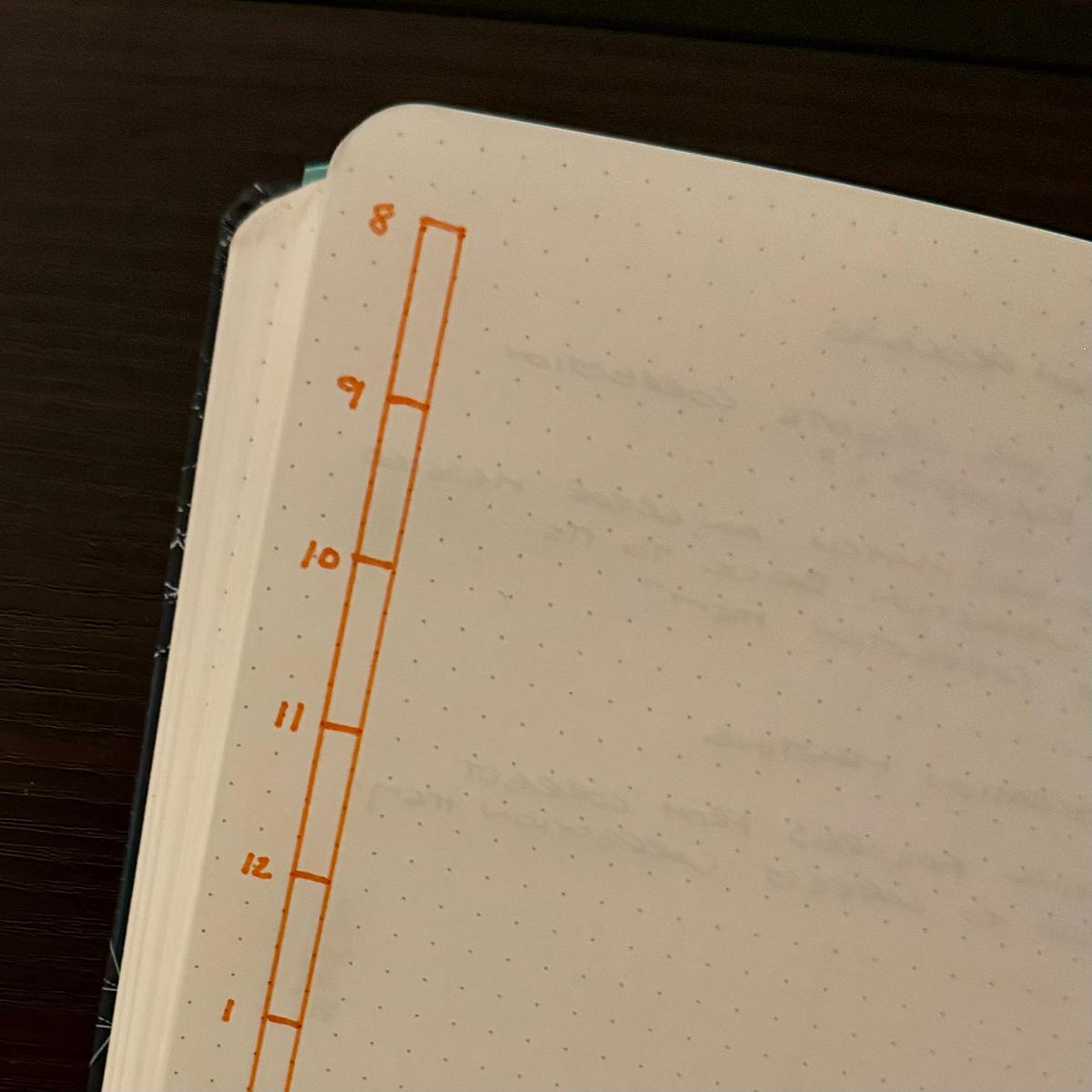
The trick, of course, is to choose the small tasks which Vilfredo Pareto - he of the 80/20 Rule - would designate as among the vital few; i.e. the ones which will produce the greatest beneficial results. If you don’t set such priorities, then your time may be squandered by the successful completion of work which produces relatively little progress or which merely restores the status-quo.

— Small Tasks by Michael Wade

That one is going in my DailyMuse collection.

My Wall Calendar Problem

I would love to have a wall calendar that would give me an at a glance view of what’s coming up the next few months. Here’s the problem though, my office is just a small corner of a larger sitting room we call “the den”. I already have nice pictures on the wall and therefore I would rather not try and squeeze in a wall calendar when I only need to see it when I’m working. So what are the alternatives?

Whiteboard + Wall Calendar

One idea I had was to use a whiteboard to put my chosen wall calendar on and bring it out only when I’m working. The only issue I have with is that the only space where I could put this is behind me and therefore it wouldn’t be within my sight. This is only a minor issue though. It would still be within easy reach to keep updated.

Printable Calendars

A printable calendar might be an option but then I think the main problem I’ll have with this is size. The biggest I can print to is A4 and even printing a calendar across two pages is going to be still too small. Also spreading the calendar across separate pages loses it continuity.

In searching for printable calendars though, I did discover a great calendar by David Seah. Although it isn’t suitable for my needs, I think there might be a few of you who might find it useful.

Desktop Wall Calendar

Right, I know what you’re thinking. This is probably the last place you would want to view a full year calendar. Well, yes and no. Ideally I would like to have something away from my desktop, but I’m pretty limited in choices there so why not explore the possibility of a desktop calendar? My monitor is big enough that I wouldn’t need to squint my eyes to see the details and I run most of my day to day applications full-screen anyway, so why
not?

I’ve tried running Calendar full screen using the year view but this isn’t what I’m looking for. The months are spaced out with white space between them and I already have various calendars populating this. I would rather just see a blank calendar that doesn’t show me my day to day appointments.

I also tried creating a wall calendar using Trello, but with it only showing seven lists on my screen, it’s hard to see the whole year at a glance. This was a long shot to be honest. I knew this might not work but still I gave it a try.

Next I turned to the Internet yet despite the vast volumes of free tools and resources on the web, I couldn’t find a tool or open source library that can do this for me or even come near it.

My next step is to spin up a web page and run it full screen but given my commitments at the moment, it’s probably the last thing I need to be doing. I’ll keeping hunting for a solution in the meantime.

I’ve always been the quiet type, often electing for the quiet corner of the room rather than being the speaker on the platform. Paul Dessert’s guide to getting noticed as an introvert though has me thinking I need to shake up this behaviour if I’m to push my career forward as a freelancer.

Here’s his take on going to meetups:

Seriously, do it. I know what you’re thinking, “screw that, why do I want to talk with a bunch of random strangers? Most people that go to those are greasy salespeople”. Guess what, you’re right. Most of them are filled with people handing out business cards. Ignore them. Find people that are interesting. They don’t have to work in the same industry as you, in fact, I’d suggest seeking out people in industries other than your own. You spend most of your time at work or school associating with like minded people, step out of that bubble and understand the needs and pains of others.

Want to know the secret to a good conversation? Shut the fuck up. Plays right into our wheelhouse, right! People LOVE to talk about themselves. Let them. Just listen and learn. You’ll make new friends and gain a potentially valuable contact you can lean on in the future.

— The introverts guide to getting noticed by Paul Dessert

Less Listening, More Learning

Podcasts and screencasts can eat up a lot of time. I’ve started to see a swing towards listening to podcasts and watching screencasts and less time spent putting what I get from them into practice.

For the last year I’ve been a healthy listener of a variety of podcasts. They are centered around software development, programming and freelancing. Every week I listen to about five or six different episodes on these topics. While they’re entertaining to listen to, I’m starting to see that I’m not getting as much value from them. Sure there’s sometimes a glimmer of programming language knowledge that you didn’t know about, but is it worth putting in a good half hour of your time for that one little morsel of knowledge?

Then there’s the screencasts. I had a few of these going last year, again on the topic of software development. Screencasts definitely need more of your time as you can’t watch them when you’re out on the bike or in the car, they need you to both listen and watch. In terms of getting time to watch these, I simply didn’t have the time available. And then every few weeks I would simply declare screencast redundancy and remove them from my list to watch.

Since removing these from my list of intakes I’m seeing more of a move towards reading online, books and RSS feeds. They can be more easily consumed on the go and using smaller blocks of time. This in turn has allowed me to spend a bit more time learning those things that I only listened to in podcasts or watched in screencasts.

Learning isn’t simply about consuming as much information about the topic that you’re interested in, you need time to apply what you have consumed and seeing if you can in fact you use it correctly. I hope to be doing that a lot more this year and re-address the balance of learning.

Writing is a Habit

I’ve noticed a lull in my posting frequency here. Towards the end of last year, my posting frequency shrank to just one or two posts a week.

Despite attempts to re-ignite the spark, I haven’t been able to return back to that time when I was posting more frequently.

It’s only in the last couple of weeks that I have noticed the source of the problem. It lies in the fact that I define each post I am writing as a single task.

Writing Isn’t a Task

I’ve learned this the hard way. Since collecting all my writing ideas in Todoist, I’ve struggled with writing on a regular basis.

In Todoist I collected ideas as tasks and worked on them when I could. The writing process isn’t simple case of hitting a word count and being done. It is for the first draft of anything you write but self-publication involves a continual loop of writing, reading and reviewing. It only ends when we feel that what we have written is ready to be published.

Instead of using Todoist, I’m going back to using Trello to mange my content funnel for the blog. From a list of ideas, I’m hoping to be able to gradually move cards across my board until they’re ready for the blog. Writing is a process, not a task.

Writing Takes Time

Another hard lesson learned. In the past I would outline posts and write them on the day of publication. That might be okay if you have a couple of hours a day to review what you have written, but I don’t have that time. I’m lucky to get an hour a day set side for this. So I need to use this time in a better way.

Rather than writing one post a day, I’m going to start writing parts of different posts each day. I might work on one or two posts, review another post and ready another post for publishing, but in no way should I be writing, reviewing and publishing in the one day. If I want to get the most from my writing then I need to give ideas and drafts more time to incubate.

Whether you’re writing, reading, reviewing, editing or publishing, it’s all starts with a simple habit of getting those words down on the page.

I’m hoping that by the end of the month, I’ll be back to at least four posts a week. Let’s see what happens.

The De-cluttered Desk

I had been putting it off for weeks, probably months in fact. My desk was slowly becoming a paper-based version of Smaug’s hoard of gold . It was time for a de-clutter.

We don’t have a huge house but it’s big enough for us. My workspace is located in the back of sitting room where my sons tend to congregate in the evening and at the weekend. I’ve got a desk, bigger than probably most people have in their homes but with it being my workspace for the whole day it needs to have space to allow me to be comfortable.

Over the weekend I started organising the top of my desk and moving things about to give myself more room. It took a few iterations but I’m seeing a benefit of the change now as I write this. I have more space on my desk almost all cables are out of sight. Having got this sorted I turned towards the tower of books, magazines, papers and other dead-wood that was accumulating under my desk.

I was glad to see that I managed to get rid of a few programming books that were aimed at more of a novice level. I’ve kept some of these books for years, but having not read one of them in the last year, it was definitely time for them to go. Never a bad thing to throw away the books you have learned from and moved on. Old magazines for healthcare and programming were consigned to the recycle box with a vow to keep only the last month’s magazine.

Lastly it was the turn off the paper. With reams of paper cluttering under my desk, it was time to keep the stuff that needed to be processed and shred the rest.

The de-cluttered desk is now ready for some productive work. It’s amazing the difference that an exercise like this does for your motivation.

Smaller Goals, More Opportunities

Setting a goal for the year is made by many at the start of each year, but people frequently give up or just abandon their goal because it seems too far away. With a little change in tact though, there’s a better way of hitting your goals for the year.

Set Smaller Goals

Instead of focusing on big goals for the year, what about setting smaller goals for throughout the year? Smaller goals are within easier reach, easier to track and it means that if the goal isn’t hit you can try again the next month.

When goals are set for the year, people usually forget to set aside regular checks to ensure they are on the right track. After a few weeks many people simple give up. With smaller goals though, you can set yourself a more manageable and attainable goal that will give you the confidence to succeed on subsequent goals.

Continually Refresh

The start of the new year is traditionally seen as the only and best chance to start afresh but there’s more than one opportunity available in the year to do this. New year, new month, new week or even new day. There’s more opportunities to start afresh than you think.

If you set yourself goals for smaller periods of time then you give yourself more chances to achieve that goal. Right okay, you didn’t do that bike ride in the time you wanted for January. Could you do it in February though?

The chance to start afresh is there every day, every week and every month. You just need to decide what you can realistically achieve in those periods of time.

In this roadmap are many questions. In your journal — whether digital or by hand — you can simply write out the question at the top of the page, and answer as if having a conversation. Don’t worry about formality, how it may sound out loud, grammar, etc. Just write your thoughts. It may seem mundane, but there is a magical quality in writing something down that cannot be fully explained. You just have to trust me and try it out.

— Jumpstart Your Journaling: A 31-Day Challenge by The Art of Manliness

What a terrific idea. A roadmap of journal prompts to build up a journaling habit.

Resolutions rarely affect only ourselves when we make them. Patrick makes a good point of getting those around you to help support your resolutions.

And even those things you think are just for you — to exercise more, to eat better, to meditate — may not be able to be successful without our partners actively supporting those efforts and allowing us the time, space, and resources to achieve them. Accountability helps here too. If those around you know them you are more likely to be held to the goal.
— Resolutions don’t happen in a vacuum… by Patrick Rhone

10x Your Business

If you’re serious about growing your business, I want to challenge you to aim high. Don’t just think what you need to do to grow your business by 20% — or even double your business. As you work on your goals for next year, my challenge to you is to consider thinking big. Can you imagine growing your business by 10X?

— Getting your goals ready for the next year – go for 10x by Curtis McHale

I’ve been following Curtis McHale’s career closely and I would love to see him making this goal. He’s already got me thinking about my convservative goal to increase my income by 25% for next year.

It’s that time of year where you should be thinking about goals and plans for next year. Here’s a little tip. Try measurable goals.

2015 is just around corner. Just over two weeks in fact. For many the setting of goals and plans for next year won’t begin until that period between Christmas and New Year. Right about that time where the over-indulgence of food will probably lead to a planned diet for the length of next year but will most likely only be until the second week of January. I learned a long time ago that setting such goals and plans on the eve of the New Year rarely last beyond January.

Such goals often fall apart simply due to them being set in such a short period of time with little thought to making actual plans to achieving those goals. They also rarely succeed due to the fact that there’s no clear end goal in mind. If your goals are financially related, why not think about the amount of savings you have just now. How much more would you like to have in savings by the end of next year? If your goals are health related, think in terms of improving the numbers you have now. What’s your time for a five minute mile now? How many seconds do you reckon you can take off by the end of next year?

At the end of last year I set myself a few goals. One of them was the total amount of income I wanted from my freelance work. I had a figure in mind that was more than the previous year. A good 25% more in fact. I managed to hit that goal this year with a steady stream of work coming in. Next year I’m increasing that figure again by a further 25%. With the projected work I have for next year, that figure can’t be gained by invoicing clients alone, it will require me to start thinking about income from products and services as well as perhaps re-negotiating my rates before the start of the new financial year in April.

A measurable goal is much more achievable when you define the figure you have now and the figure you want to achieve. It doesn’t need to be a goal for the whole of next year either, it could be a attainable in nine months, maybe even six. The point is that a measurable goal is an attainable goal.

Bootstrapped: Under Armour

From small beginnings to billion-dollar sports apparel giant, the story of Kevin Plank and Under Armour is proof that bootstrapping your business can succeed.

If it doesn’t sell, there’s probably something wrong with your business. If it does sell, then you don’t have to give half your company away and you can be the one making the decisions for the long term. We did that, we bootstrapped, and my first year in business, we did $17,000 in sales out of a little townhouse on the corner of 35th and O Street in Georgetown.

— When we were small: Under Armour by The Washington Post

The NOW Year Calendar

I love the idea of incorporating monthly themes into the calendar.

The NOW Calendar

Each month leaves a space on the first day to enter your Monthly Theme, and you can also theme your weeks as well if you wish. These themes will act as catalysts to inspire you to move the projects forward that you want to complete and the goals that you want to turn into reality. By planning these things now, you’re setting yourself up with a better chance for success in the future. And The NOW Year Calendar keeps the plan front and centre in a design that is both simple and stunning.

— The NOW Calendar

Project or Context?

Ensuring that your productivity system is correct is important if you want keep the actions flowing through it. Like deciding if a project is in fact a context.

Many of you have been reading my post on using projects in Todoist. Up to now I’ve always used projects in Todoist as lists. They’re just placeholders for actions. What I’m starting to see now though is that some of my projects might in fact be better used as contexts.

This week I listened to Mike Vardy’s Productivityist podcast and caught up with two episodes focusing on context and their application in productivity systems. It made me look more closely at my own projects in Todoist. I singled out two projects that I think are better suited to being contexts, reading and writing.

My reading project is just a list of chapters from the books I’m reading on a daily basis. Breaking books into chapters means that I can schedule different books in for different days. Reading isn’t a project, it’s a label to describe a particular action. My writing project is essentially a list of ideas for the blog, but writing isn’t a project. Writing describes the action. Clearly something is amiss here.

A context can be defined as the circumstances that surround a particular event. In the case of David Allen’s GTD framework, a context is a label that you put on your actions so that you know two things:

  1. What you need to get that action done
  2. When that action can be done

When I look at my projects I see them differently now. In the case of reading and writing, they’re not projects, they are in fact contexts. They are used to describe the circumstances in which I can finish their associated actions. I read a chapter of a book first thing in the morning as it’s when I’m most receptive. Writing tends to happen in the morning as well. I’m just more swithched on during this time. So not only do these contexts describe the action but also when I schedule them in the day as well.

I can’t recommend enough that you continually review your productivity workflow. Finding that point where everything falls into place isn’t going to happen overnight or even come boxed up and ready to go in a system like GTD. It takes time to see what works for you and what doesn’t. After taking out the reading and writing projects from Todoist, I’m starting to see a change in how I view projects in Todoist. I’m still digesting Erlend Hamberg’s 15 minute guide to GTD and there’s a few more changes that I’m going to try with projects in Todoist, but that folks is for another day.

from Nicholas Bate.

The digital interrupt is relentless, often trivial, sometimes insufferable, cunningly finding new channels, often repetitive, poorly constructed and lacks sufficient courtesy to recognise that you are busy.

— Jagged Thoughts for Jagged Times by Nicholas Bate

This will be my first week without any social network interaction. It will be interesting to see what the lack of digital interruptions will do for me.

A Time for Things

This one is definitely going on the playlist.

That list of things is a wish list, a someday-maybe list, but it is not a task list until you commit a time for those things getting done. Those are things you hope to do — not things you are going to do. Know how I know you are not “going” to do them? Going is an action verb. It means you are in the act of committing a forward movement. Anything staying motionless on a list is not forward movement. Putting a time on something to be done in the future, then moving towards that time, means going to do something. And you are not going to do any of those things unless you do.

— A Time for Things by Patrick Rhone

In the pursuit of workflow zen, I’ve been simplifying things a bit. It’s been a positive change so far.

Data is everywhere. We create and consume vast quantities of data everyday without giving a second thought to how much. Emails, tweets, posts, pictures, videos, messages and audio are just a few examples of the data that we interact with on a daily basis. And there’s no shortage of software to manage your data either. For each type or format of data you have, there could be hundreds of different options available to you to manage that data. Apps, web applications, scripts, services, products.

Not only are there tools that mostly persist and manipulate your data, there’s a new type of service available that pushes your data to other services based on triggers. Services like Zapier and IFTTT have the means to collect and distribute your data to other places depending on the triggers and services you specify. It can become mind boggling and complicated.

It was last year when I realised that I was pushing more data around different services than I needed. I started making some changes:

  • I stopped using a dedicated bookmarking service and instead opted to routinely drop a list of formatted markdown links into my blog.
  • I stopped using Evernote and instead starting using text files to manage lists and collections. Evernote is a great tool for keeping all your data together but I found it difficult to keep my data organised. The idea of notebooks and groups is good but I just couldn’t make it work. This isn’t a complaint against Evernote, it’s a great tool, it’s just not for me.
  • I started using plain text files for a lot of things. Check-lists, ideas, outlines and anything else that I needed to keep a note of.

After doing this I noticed a change. The number of places I need to check to find something was greatly reduced. I had a collection of files in my Dropbox that I used on a daily basis. Then there was my task manager, my reading list and a few boards on Trello. I didn’t have to search anywhere else beyond that. Then the number of tools I needed started to fall as well. I started uninstalling apps from my MacBook and cancelling some subscriptions.

It’s been a refreshing change. Gone are all the connected services and triggers I used and instead I have a low maintenance set of tools that I can use easily. I can find the data I need for easily and most importantly I do less moving about of data.

You sip coffee and make your list. At a nearby table someone is writing The Great American Novel but you are simply identifying your projects and actions. The list grows every time you pause for a sip. What is surprising is how items which once dominated your attention now require a reminder.

— Your List by Michael Wade

A little reminder from Michael Wade that lists are a great place to start.

Team 256

What started as a monthly challenge is now fast turning into a social network daily ritual, which isn’t a bad thing when it comes to the fast and furious world of social networks.

Back in September, I started a challenge of writing a 256 character post everyday on App.net. Aside from missing a single day’s post I completed the challenge. It was a refreshing use of my time on a social network. Rather than simply typing the first thing that comes to your head and posting it, filling the post with 256 characters means you need to spend a bit of time editing, re-wording and ensuring your post is correct and uses all character space available. It’s this time spent on getting the message right that makes my 256 character posts so different from every other post I make.

Social networks are often seen as a cheap and fast way of getting messages across to people, so few people think before they post. While they are great for short bursts of information, social networks are mostly places where masses of un-edited information stream by us every day. My #team256 posts on App.net are not wildly profound or better to read than other posts on App.net, but they do provide me with a chance to write something a bit more detailed.

What started as a monthly challenge has fast become something of a daily habit. I’m still keeping the habit going to post 256 characters a day on App.net and while I might have missed the last couple of days, I did look forward to writing my post for the day. I hope that it continues and gathers pace on App.net in the future.

Techniques like brainstorming try to sell a way of generating ideas in a short space of time, but is there a better way?

Out of the blue you have an idea for something. A product, a book, a service, something. What do you do with it? The obvious answer here is to write it down. Anywhere. Whatever comes to hand, get that idea down. Give it an hour or two and you might simply forget it even existed.

Great. Now what?

The next step for many is to re-visit this idea at some point in the future and decide whether to act on it or not. The down side to this is that while the idea might have sounded great on its own, it is only one idea. One single good thought.

If the idea is so good then you might be thinking that it would be a challenge to improve upon it. What’s better than a single idea though? How about two, three or even seven ideas that support this one single idea?

The problem is that while we might want to set aside a 30 minute session to brain storm more ideas to support this new idea of ours, the new ideas we want might not simply be there. You can’t force yourself to come up with new ideas. You might be able to expand on an idea but limiting yourself to a time period will only leave you with a couple of new ideas.

If you’re the patient type then how about trying a different approach?

Let your ideas incubate.

I’ve wrote before about incubating mind maps in the past. Rather than starting and finishing a mind map in a single session, I would re-visit my mind map on a weekly basis to give myself time to allow the central topic of the mind map to sink in. The benefits to this is that you allow yourself time to think about the central topic of the mindmap thereby allowing associations to that central topic to develop over time.

The same can be said for new ideas.

By allowing an idea to incubate over time, it gives us a chance to think about the idea. Thoughts and ideas often come at the most inconvienent of times. When you’re walking the kids to school, when you’re out on a bike ride, when you’re anywhere other than on your computer to execute the idea.

This is a good thing though. Being away from your desk or your workplace means that you don’t act on a sudden impulse to test the idea. Just make a note of it and then carry on with your day.

At the end of the day, make a more permanent note of your idea so that it can be easily found later along with any other ideas that you have had that support this idea.

Give it a couple of months and you should start to see that single idea develop into something more. And this is the benefit to incubating your ideas. An incubation period of two months can yield more positive results than a single brainstorming session could. It’s not for everyone though, but I’m more of a believer that slow and steady wins the race.

The App.net Daily Post Experiment

For the month of September I committed to posting a 256 character post to my App.net account every day. It turned out to be more beneficial than being a simple daily nudge.

The Experiment

It was initially an idea by Matt McCabe (@mttmccb) on App.net who was committing to posting a 256 characters post with the hash tag #adn256month included in the post somewhere. It sounded like an interesting challenge, and so I also joined in for the month of September.

I set myself a couple of guidelines at the start of the month for this. A rules of engagement sort of idea.

I didn’t include a task in my to-do list for this or even set a reminder. It was the one thing each day that I had to remember to do. I like to think of it as a little mental exercise for the day. Settings reminders and scheduling appointments is great for the really important things, but for little tasks like this, I wanted the responsibility to remember to fall on me.

I limited myself by excluding any tools that would automate any part of the process. Most days I opened Kiwi on my MacBook and composed a post for a few minutes, editing it down to what I needed and then posted it. At the start of the month I did manage to write three posts ahead of their intended days but I stopped doing this as it meant on those days I didn’t have too much to do and that seemed to go against the whole reason why I wanted to do this. I wanted to build up a daily habit using only me. No apps, tools, or other medium to remind me or to pull posts from.

My Findings

The month went well. I only missed a single day out of the whole month. I was surprised by this as I thought I would miss at least one a week, and not having an iPhone for the last two weeks I thought I was going to miss even more days. As it turns out I was able to keep the habit going missing just a single day.

The posts themselves started out as mainly random snippets for the first week and then for the remaining three weeks I themed the weekday posts to follow a specific topic. Weeks two and three were about productivity and week four was about Rails development. The weekend posts were usually kept light hearted and not too serious.

The posts also turned out to be great for expanding on ideas for essay posts I have considered but haven’t drafted anything for. The chance to write something small on an idea kept me focused on the core idea for the post and also let me test how each post was received by my followers. A favourite or a repost signified that a post might be worth expanding on.

What Next?

The experiment has finished but the idea of the daily post of 256 characters lives on. I’ve committed to posting a single snippet of 256 characters to App.net on a daily basis using the hash tag #team256.

It’s simply too good an exercise not to do on a daily basis. My only concern is that the audience for it is rather small at the moment. I have just over a 100 followers on App.net but I suppose it’s better to start somewhere.

I really need to learn to say no.

I’ve been freelancing for over 18 months now. It has brought a new sense of freedom to my career but at the same time I’ve had to become more disciplined. Every morning I have to get up, check in with clients, work, find clients, work, invoice clients and yes, work. It has been this same cycle for 18 months now and while it provides a good income for me and my family to live on, I am beginning to question how much longer I can carry on this cycle.

The last six months in particular have seen me working flat out. I have days now where I simply close the lid on my laptop and leave the desk, glad that I don’t need to see another line of code for at least 15 hours. At the end of those days I am exhausted. Mentally drained from the amount of work I’ve had to do in a limited amount of time. It’s what a hard days work should be, but it’s becoming repetitive.

At this rate, I’ll be grudgingly opening my laptop in the morning. It’s not how I envisioned this to be. I knew there was going to be hard work involved at the start, but I didn’t think I would be working this hard for this amount of time. It feels like I’ve lost a sense of freedom with my freelance career.

Fed up with the five day week, I decided at the start of the year to stop accepting freelance work on a Friday and give myself time to work on my own things. It has not gone according to plan. Some Fridays I have a meeting, some Fridays I work to catch up on and other Fridays I have meetings and work.

The four day week clearly isn’t working, but that’s partly because I end up making myself available on Fridays.

Another plan for the future is to perhaps schedule one week off every eight weeks. I’m not sure at the moment that this will be any better than working just a four week but it is an option.

With a bit more control on work commitments I should be able to get my Friday back and start working on my own projects again. It’s definitely long over due and would afford me a bigger gap between each working week.

The Daily Reading Ritual

It’s taken me a long time to find a habitual way of reading books that works for me. I call it the daily reading ritual.

When I first started my career in programming there was one titbit of advice that I had seen repeated over and over again.

Read a programming book every month.

I don’t know how many of you have read a programming book, but for those that don’t know they can be difficult to read. The trouble with programming books is that they are better used as reference books. Lookup material for when you’re stuck.

I tried the one book a month goal and I failed miserably. For the next few years I kept on trying but no matter what book it was I would either give up on it or still be reading it at the end of the month.

So how do you digest a programming book without it becoming a monotonous chore?

What I’ve found that works really well for me is that I take five non-fiction books (programming or otherwise) that I want to read and I read a chapter of each book on a specific weekday. At the moment Monday is a freelance and marketing book, Tuesday is a sketch noting book an so on. What this gives you is variety. Every day is different. It’s breaks the monotony barrier.

What about fiction books though?

Fiction books are easy to read because you usually have no idea what’s going to happen and it’s the authors job to send you to a place that’s not your usual environment. It’s a form of escapism.

I don’t set a time limit for these as it takes the enjoyment away from the book. Instead I try and read these books as often as I can. It’s usually at night when the kids are sleeping.

Since starting this ritual I’ve found it much easier to make progress on the books I’ve wanted to read. Not only that but I’ve also managed to set aside a few minutes in the morning for the non-fiction books and then at night I can plough through whatever fiction book I’m reading.

In what must be my longest period of habitual change, I’m still in the process of rebooting. It is changing me for the better though. Here’s a few changes that have come out of this period of rebooting.

  1. I’ve cemented a habit of reading a chapter from a non-fiction book every weekday. By reading from a variety of books I keep things from getting stale.
  2. I’m capturing everything in Todoist, and I mean everything. I’m using it to keep a track of errands, notes and even urls to check out.
  3. I’ve made the jump to a new text editor and I’m learning new shortcuts about it everyday. It’s taken me a few tries to make a successful transition but this I worked through the days of frustration and now I’m working quite well versed with the comamnds that I need to use daily.

I’ve got a few changes coming over the next few weeks that are more career orientated, but I’ll report on these when the reboot process for these is complete. There’s still room for improvement which is why the reboot process is still ongoing. Remember, Rome wasn’t built in a day.

James Shelley has an important insight into the importance of journaling:

Writing a journal feels juvenile. That is the beauty of it. Even as you write the words, you cringe in anticipation of how an older, wiser version of yourself will probably ridicule you later. You can almost hear the self-criticism, faintly echoing in from the future. That’s why the thoughts seem childish as soon as you transcribe them into alphabetic forms.

— Journaling Feels Juvenile by Jame Shelley

Productivity is About Processes

Dazzled by the lights of new task management app? Before switching, make sure you’re switching for the right reasons. Productivity isn’t about the apps.

Read any productivity book and you’ll find a common observation among them. Rarely is a specific tool mentioned that makes that specific productivity method work better.

I spent a good couple of years hopping from app to app in search of a task management app that met my requirements. It wasn’t a wasted journey, I did get to try out a number of different apps but I didn’t have a productivity method in mind that I would use with the app. I was simply trying some apps out. I was going about this the wrong way, you see it should be the other way around. Productivity is about processes not tools. The tools we use should compliment our preferred productivity method.

Look at any productivity method and it’s about the processes and workflows involved. Capturing, reviewing, planning and executing are the most common processes involved in most methods. I use all four of these processes in my own method which centers around a single list of actions. I then use projects and tags to group actions, filters to review and a calendar for scheduling those actions.

The processes I use means that I could use just about any task management app, but it’s in the details where you can find great task management apps. Here’s a list of requirements that I finally settled on.

  • I need to be able to capture anywhere.
  • I need to group related actions into projects.
  • I need to group actions by tags.
  • I need to see different views of my list.
  • I need my list available to me wherever I go.

Looking at these requirements I can think of a number of task management apps that could meet all these requirements. After reviewing a number of apps that I’ve tried in the past I found a couple that worked for me. I choose TaskPaper as it gave me the ability to keep my master list in one location in raw text. After a few months though my list became difficult to manage. I started looking for a replacement.

One task management application that I hadn’t tried up to this point was Todoist. I started moving my master list over to Todoist. That was eight months ago. Today I’m still using Todoist. It meets all my requirements and also provides a number of other features that I didn’t look for before in a task management app.

With a crowded marketplace of task management apps it can be easy to be dazzled by the new kid on the block, but productivity isn’t about those apps. It’s about the processes. If you’re on the market for a new task management app or you’re simply looking for a change, make sure you are looking for an app that fits your processes.

Trade-offs

Nicholas Bate is on the ball again with advice on true productivity.

Trade-offs are hard, very hard because they are rarely perfectly resolved. To be comfortable with them we need to have time to have thought about them and time to communicate such thinking to those who are important in our lives.

— On Productivity and Life in the Gaps by Nicholas Bate

Yesterday I wrote about coasting along. Good for when you’re driving and taking in the good views, but when you’re coasting for everything you do, you’re just ticking the boxes. Today marks the first day of a reboot to purge this nasty habit.

If only everything was as easy to fix as a reboot. Got problems with your computer? Reboot and try again. It’s amazing how often this works. I’m not technical support person, but the amount of times I’ve given technical support to family and it was simply a matter of rebooting their PC is astounding. It’s not this easy for everything though.

Rebooting yourself takes a bit more thought, a bit more time. Let’s face it, we’re complicated entities. Our brains have the accrued knowledge and memories of a whole lifetime. We have habits, whether good or bad, engrained in us. How we approach problems and solve them is different for others. This rebooting lark then is going to take some time then. I’m not expecting a change overnight, but I am expecting to see good results as each day comes. I’m not trying to achieve everything on day one, just making sure that for each day, I’ve made a positive change to how I work and what I do.

This is the first day of the reboot. So where do I begin? Well, this morning I decided to ditch the MacBook and went out for a cycle. I haven’t done this as much as I would like to, as I like to use the Friday to catch up on a few things. Those things can wait though. This morning I just wanted to clear my head and start again. I put on my bike gear, grabbed the bike, walked my oldest son to school and then headed out.

The west of Scotland is having a period of sunny weather so it could not be a better time to head out. As it was the morning, the heat hadn’t reached it peak and the trails were great. Dry hardpacked roads mixed with some dry grassy paths further up. The descent back down was even better.

The bike ride was good. It gives me a chance to clear my head which is something I wasn’t doing often enough. Using the Friday morning for a bike ride, even if it’s just 90 minutes is a good use of time. Everyone knows that exercise is important but what’s also important is the chance to leave a few things behind. The feeds, the timelines, the inboxes, the emails, the messages, the tasks. They can wait. They’ll still be there when we get back. The difference now is that with a clear head I might be in a better frame of mind to take a few of these on. And that’s a good starting point I think for the rebooting process to begin.

It’s a horrible thing to admit, but I’ve been coasting since the start of the year. While I’ve had the chance to just get on with work, it’s not good for my long term goals.

I started the year with the best intentions. I wanted to do so much this year, but six months on and I’ve nothing to show for my intentions. There’s lots of reasons why my plans fell apart over the last six months. Loss of interest and motivation, doing just enough and simply punching in and out of my work day. It might keep my stress levels down by simply doing the work that I need to do, but in the long term this isn’t going to keep me getting paid as a software developer in the future.

Coasting along isn’t going to pay the bills in the future. Rather than simply doing the work, I need to keep learning on the job, writing about those experiences and re-using them in the future to deliver value in my work.

Costing along isn’t going to build a successful freelance business with great clients. I have a handful of clients now that keep me busy, but I need to keep those clients by continually delivering good service and value.

Coasting along isn’t going to make me spend more time reading and writing. Yes, I’m reading alot, but on the flip side my writing has tailed off in the last six months. Writing is not only something I enjoy but a possible revenue stream in the future if I decide to publish.

Coasting along is bad thing to do. You end up cheating yourself of new learning experiences, opportunities, a good career and more importantly, the life that you want. Coasting is a short term fix if things get hectic but in the long term it’s not going to get you back on track. Eventually you’re going to end up in the wilderness wondering what the hell happened.

For me it’s time to get back on track.

Every week it seems there’s another new service or product online that aims to solve the problem of information overload. Why can’t we solve this problem on our own?

Toastio announced their new service today. It touts itself as Twitter for email. It limits the length of emails you receive to 350 words. Anything longer than is bounced back to the sender asking them to send a shorter message. I don’t see any benefit in this, but I could be wrong.

One problem I immediately see with this is that it’s another inbox that I need to manage. I don’t want another inbox. I have enough of them already. Everyday we interact with different inboxes that feed us with streams of information that we view at intervals. Some of us spend hours in these inboxes while the more efficient among us might just check these inboxes once or twice a day spending just a few minutes of our precious time.

There is a couple of solutions to this problem.

1. The All-In-One Inbox

If you’re still wanting to get all the relevant information you need then the all-in-one inbox is the solution. A smart inbox that pulls content from any publishing stream and orders everything in order of interest. It regularly updates and orders the stream each day, determining what type of content it should display based on your current location and status.

Sounds like a rather far fetched idea doesn’t it? Well it is. There’s two problems with this idea. The first is that building a single inbox that handles a variety of data from different sources is a big challenge. The second is that not all data sources are easy to subscribe to for updates. I think it’s fair to say that the all-in-one inbox isn’t something that we are going to see anytime soon.

2. Limit Yourself

Don’t despair, the second solution is within easier reach. Limit yourself. Limit the number of inboxes you have, limit the amount of data coming into those inboxes and then limit how often you check those inboxes. Do this regularly enough and you’ll spend less time in your inbox and more time working, creating or doing whatever it is that you do.

There’s one thing about Toastio that I do like. The 350 word limit on emails. I’ve seen this in a number of different forms over the years but perhaps the one I remember the most is five.sentenc.es. The idea here is that your adhere to a five sentence limit on your outgoing email. While this isn’t feasible for all your outgoing email, the idea of limiting the length of an email is one that we can all do with.

Why don’t we do it though?

Well, aside from the fact that most people would give up on it faster than a New Year resolution, it would force people to re-think the email they’re sending. For some people that’s just too much like hard work. Rather than pausing for a moment to think about what to write, they would rather put their every thought and opinion in a email spanning 500 words when only 150 would have done it. So even asking people to write less and think more isn’t going to make your inbox go down. No reasons why you can’t make it your own persoal limit when sending emails though.

And that’s the last thing about limiting yourself. Limit your outgoing data. Limit your email length, limit your social network time, limit your time aimlessly surfing the net. Limiting yourself in this way gives you more time to get stuff done. The important stuff.

Time to think

I finally got round to reading this over the weekend. Matt makes a fine case for using tools that force you to think before you act.

There’s a ritualistic quality to these objects, but that’s not why I love them. I use them to slow myself down. To introduce just enough friction that I’m compelled to pause. We don’t pause enough anymore. We don’t give ourselves time to think.

— Thinking slowly by Matt Gemmell

The desire and willingness to create things that genuinely help people is the only business plan and personal brand you need. With this, you can get started today. No fancy website or business cards needed.

— My Personal Brand by Patrick Rhone

No mention of domain names, icons, or even social networks. It just takes the need to create and help others.

Daily routines

The last two months have been something of a blur. Client work has taken up most of my day now and even into the night as well when I shouldn’t really be working. A pattern, or lack of pattern has emerged.

It started a couple of months when I decided to scale back on my daily writing. I thought that not writing as much would let me focus on getting other chores and such done. Truth is, it was the start of a slow decline in what I had carefully built up over the best part of a year. The daily routine.

My work day pretty much had the same format for the most of last year and it worked for me. I had the same routine in the morning for preparing for the day ahead and the same routine at night for reviewing the day. It worked for me.

Once I stopped writing on a daily basis though the routines started to be skipped, and then the calendar was running empty, the task list built up and before you know it, my daily routine consisted of nothing more than simply putting out fires. I’ve been in that place before and it wasn’t a good place to be.

I ended up reacting to problems rather than anticipating problems and setting time aside for them. I was context switching multiple times a day and losing focus. My inboxes and lists were stradily climbing with not view of the bottom of them.

No more. The routines are back in place, the daily writing will be started again and a plan of attack has been formalised. Let’s see where this goes.

Breaking Habits for the Best

Even the best kept habits require a break. Regardless of how well you think it’s working for you as a habit, it’s only when you step back from it, breaking the habit, that you can see the true impact and value of it.

If you’re like me, you’ll have tried to introduce hundreds of habits in an effort to improve your health, your career, your finances or even your relationships with people. For me some of them have truly stuck over the years. Keeping a journal is one of them and something I do on an almost daily basis. Whether it’s a family event, work or even a thought, it gets written down and saved for a future review or reflection. It took me a number of months to get this habit down on a daily basis and while I can see the benefit of it, I’ve never taken a break from it.

Last week though I decided to drop the journal tools for a few days and just enjoy the time off I had with the family. It was a real eye opener. In that time I realized that although keeping a journal is a good thing for posterity and also for remembering where I was with some work, I was missing something.

Looking back at my journal entries over the years and months, there has been a subtle trend in my journal entries. In the past I would journal once a day with a review of the day, now though I’m logging journal entries multiple times a day. Whenever I complete a bit of work, whenever I have the inkling of an idea, or even when a link catches my eye but I want don’t want to just read it later, I want to read it from a particular angle. Every day I’m working I’m writing multiple journal entries as I’m working. When the weekend rolls around, the context of my journal switches and I focus on one entry for the weekend if I did something with the family that was fun.

Before I didn’t recognize the pattern of my journal activities and how I was switching between work and family journals. Having stepped back from the habit of keeping multiple journals, I can see that the shift in change is better for me. When I read the last month’s worth of entries I found it so much easier to read the frequent updates per day rather than the single monolithic update done on a daily basis.

I also realized something else. I put too much emphasis on writing a journal entry every day when it wasn’t necessary. Having not kept a journal for the best part of a week, I can see that it’s okay to miss a few days here and there. It’s taken a break in my habits to see the true value I’m getting from keeping a journal.

Sometimes we end up switching to automatic-pilot when we habituate processes that we think will make us better people. Truth is though, we need time away, a holiday from these habits so that we can properly evaluate and review their value. Only when we can do this can we see how that habit is truly working for us.

To Kill a Project

Stopping a project isn’t easy to do, especially when that project is based on an idea that seemed to be within your grasp. Sometimes though it’s the best thing to do, but to ensure it’s dead we need to kill the project.

I had an idea a few months ago for a service for users of App.net. It was a service that curated the most interesting or popular posts from your timeline when you weren’t there to check it. For the most part this could be when you’re in bed or at work. So if you wanted to see the best posts from your timeline in terms of highest replies or stars, it would filter out the best posts for you and email them to you in a summary on a daily basis.

I’ve spoke to a couple of people on App.net about the idea and they were favourable of the idea. After months of incubating the idea though I want to abandon the idea. I never wrote any code for it, registered any domains or even tested the idea. The idea might be a success, but given that the number of users on App.net isn’t as much as Twitter, I’m making an educated guess that it won’t be profitable as a service. I want it off my radar for good. It’s too distracting having it sitting in my master list thinking I might do it one day.

I’m killing the project then. I’m not abandoning it, deleting it or putting it off. I’m killing it. Permanently.

With this action comes a sense of relief. No longer will it sit on my radar demanding another few minutes of contemplation. I can get rid of it permanently.

I’ve only done this a few times in the past and each time it was necessary to simply kill the project. For as long as it remains in a list or in your head, you’ll always spend a bit of time thinking that you’ll get round to it.

The first time I did this was when I killed my mind mapping blog, MindMapSwitch. I had gave up writing about mind mapping but I left the blog itself up in the hopes that one day I might go back and write about it. I didn’t. In fact for about two years it just sat there as another dead blog on the internet. A couple of years ago I decided that the blog had to go. No longer would I need to the account to keep it running. I wouldn’t be writing on that blog ever again. So I took it down. Gone was all the work that I put into it, but despite that, I felt great about the decision. Another little project that has been sitting on my radar is now gone forever. I don’t need to worry about it, spend time on it or even get it started. It’s gone for good.

That’s why it necessary to kill a project. There’s no sense in having a project or an idea sitting there on the shelf gathering dust. Yes, one day you might get round to it, but chances are you won’t. Better to kill the project and move on then have it pecking away at your conscience. Once you’ve killed that project you’ll feel a weight off your shoulders and you’ll have rid yourself of a commitment.

Balance isn’t something that comes up a lot when people are writing about productivity. Once you are aware of it though, it’s a fundamental lesson to learn if you want keep focused and make progress.

I’m like a kid in a candy shop when I have a new idea. I tend to drop just about everything I’m working on new idea for a night or two and then get back to what I was doing before. Not a good practice to follow. When you stop working on something else and spend some time with an idea, it can take over. The idea snowballs and then before you know it, you’ve grand plans for it and it overtakes everything else you are doing. Inevitably my workload becomes so much that I need to try and prioritise and sort my work into a schedule that can’t feasibly accommodate this new idea. What to do?

Well the answer is simple. From now on for every project I take on I need to drop something else. Realistically I can only manage one side project at a time on top of freelancing and family life. When I take on too much everything else suffers. It’s a balancing act.

The monthly themes I am doing just now are good for balancing work as it means that in one month I can focus on a single idea or product for that time. Since the start of the year I’ve used broad themes to cover everything but this month I’ll be focusing on a specific project. It’s the first of four projects that I’ll be working on this year. The goal is to clear the backlog of tasks for that project so that it can be left alone for another few months while I bring another few projects along.

This also means that I can schedule these ideas into the year so that I know what work lies ahead in my schedule. Not only is this good for scheduling purposes but the idea also gets a chance to incubate for a few weeks or months before I start on it. By then I might have discounted the idea will then pick something else to work on.

Switching to Annual Subscriptions

Yesterday I got a hold of my credit card statement. This is the statement for the credit card that I use for my freelance business. Web services, hosting, e-books and subscriptions all go on it. It’s not wildy extravagant. Last month I spent just under £100 on products and services for my freelance business. I can definitely cut back on a couple of services I subscribe to and choose lower pricing plans, but there’s another area where I can make savings.

Each month I pay a small amount to subscribe to a number of different services. For most of these services I’m happy to pay the monthly amount. It’s always under £10 with the exception of one. Not a lot of money, but over the course of the year those add up.

Where I’m not saving money is paying the monthly subscription amount for these services rather than the annual amount. Most online products and services offer an annual discount that means you pay less for that service over the year. You do however have to pay for the annual service up front.

As I’m trying to keep a reign on my spending, I would love to switch to paying a once annual amount for these services, but with there being a handful that I can do this with, I’d rather not do it all in the one month. It would just cost too much money in the one month.

The alternative then is to stagger annual service subscriptions. Starting in April, I’m going to switch one service a month over to an annual subscription in order to save a bit more money. I’m already using these services on a monthly basis and have done for the last two years. I’m a regular payer and will continue to do so, so why not subscribe for a year and save myself some more money?

Making annual payments for products and services will increase my monthly spending for my business at first, but over the rest of the year, I’ll see my monthly spending do down. There’s a couple of trade-offs with this plan.

The first is that I’ll be tied into that service for a longer period of time, but it’s a trade-off I can live with. I’ve used the services I’m committing to for a few years now and I don’t see me wanting to change in the next year at least.

The second is that my monthly spending projection will be hard to track given that some months will have larger one off payments. It’s not a major inconvenience but I have been so used to maintaining a monthly amount that has been consistent for the last year.

Switching to annual plans for services is a difficult choice. I suggest that you only consider those services that are critical to your business and also offer a discount over paying monthly. You might only save yourself a small amount on one service, but across a handful of services you could be saving yourself a lot more. Definitely something worth thinking about.

Considering a Standing Desk

Last week I hurt my back while lifting my youngest son. Five days on and the pain is still there. This latest episode of back pain and many more before it are now putting ideas in my head that it might be time for a standing desk or even a desk that can switch between standing and sitting. There’s still a few obstacles though to this.

Is it really beneficial?

I know there’s been a lot of talk in the developer community about the benefits of a standing desk but like many of the new ideas that come from the software community, I take each one with a pinch of salt. It’s not that I think sitting all day is fine and healthy, it’s not, it’s just that I’ve just yet to see a link to the medical research done to back up this claim that standing is definitely healthier for you than sitting.

The last thing I want to do is move from a sitting desk to a standing desk and then run into even more problems with my back. As humans, we’re all unique. What works for some people may not work for others. I’m quite a big guy in terms of height and weight. Would I really benefit from switching to a standing desk or would I be causing myself even more pain?

I enjoy sitting

The other problem is that I do enjoy sitting. It’s not because I’m lazy or over-weight, I just enjoy sitting. Programming, writing or even sketching, I enjoy it more when I am sitting. My work space is setup to compliment my sitting position and everything around me is within easy reach. I could change all this with a standing desk, but then I would need to change a number of things like my monitor, my keyboard and mouse space, and basically everything else on my desk. This isn’t just a switch from one keyboard to another, this is a big change in the way that I work.

I’m already productive

At the moment I am fairly productive through the day but that’s because I get up and take frequent breaks, I eat a balanced diet through the day and of course I opt to drink water through the day rather than soda. These don’t take away the back pain, but it keeps me healthy and stops my energy levels dipping in the afternoon. While I try to keep as healthy as possible, would having a standing desk really benefit me in the ways that so many other standing developers have seen?

I’m not convinced that I would switch to a permanent standing desk, but having the ability to switch between the two would be something I would be interested in. I’m still thinking on this for the moment and I don’t see me making any drastic changes over the next year. Perhaps I might try standing for a couple of hours a day and work solely on my MacBook so that I don’t need to move too much about on my desk.

Before I consider a standing desk seriously, there’s also the issue of finding the right chair to sit in. Before all the frenzy around standing desks happened, people were quite happy to sit while working. The Herman Miller Aeron proved to be a very popular choice of chair for many developers, but I couldn’t justify spending that amount of money on a chair when I first started working from home. I’m currently using a chair purchased from IKEA. It provides me with a comfortable place to sit during the day but it definitely lacks in any adjustability I need to do to change my sitting position through the day.

Maybe a better chair is all I need for the moment?

Budgeting Your Apps & Subscriptions

As part of my smarter budgeting theme for the year, one area I’ll be looking to budget better for is the amount of money I spend on apps and services on the Internet.

It’s no secret that I like to pay for the services I use. It just makes sense to support the products that you love to use. That’s what keeps them in business. We all have preferences for the tools we use and how we work, but I thought I would share some of my thoughts on keeping your apps and subscriptions in check.

Keep A Budget

Common sense really, but things can get out of hand if you keep on subscribing to multiple services or subscriptions on the Internet. Set yourself a monthly budget and make sure you keep within that budget.

App stores and easier ways of paying online make instant purchases too easy to do now. You can quickly spend $20 or more in a few minutes on apps and services. Review your budget each month and be ruthless with making cuts to your monthly subscriptions.

Ensure you’re leave yourself a little room in your budget for experimenting with apps. You can’t trial an app before buying it, so leaving yourself a little room for trialling a couple of apps a month.

Find Value

I pay for things that give me value. The same goes for apps and subscriptions as well. I subscribe to a number of email newsletters, but they all offer some form of value. It’s easy to subscribe to a newsletter thinking that it’s $5 per month, but are you getting value from spending that money each month?

I think it’s hard to quantify value, but the way I see it is that if I use that app or service on a daily basis then I’m getting value from it.

Don’t Double Up On One Device

Having multiple apps on one device that do the same thing is a waste of money and time. At one point I had three apps on my iPhone for writing. Each was used for a different form of writing, but I’ve learned now that I can use one app more effectively for all my writing on my iPhone.

Doubling up on apps means that you also need to spend more time learning how to use those apps. Why spend the time learning about two apps when you can really master the one app.

Apps Can Vary Across Different Devices

So I mentioned there that I had three apps on one device, but what if you have a phone and tablet? Well in this case, you can use the same app for both devices if you can. If the app can work for you well enough on both devices then use it.

However, with devices having different form factors, it makes sense to use different apps that play to the strengths of each device. Yes you’ll end up with multiple apps that do the same thing, but the money spent is justified in getting a tool that makes the interaction you need easier.

These are just some of my thoughts on the budgeting of apps and subscriptions. They’re basically the guidelines I use to keep myself from throwing away money each month and drowning myself in unnecessary apps and subscriptions. I hope they can help you too.

I’ve probably read close to a dozen posts over the last week on setting resolutions. Half of the posts I read were “how to” posts, offering advice on setting resolutions and following them through. The other half were not so much about resolutions but more about actual people’s plans for 2014. Two posts really stuck out for me though.

Curtis McHale is a Wordpress developer from British Columbia and is currently self employed. I read his blog for the whole of last year. What’s impressive about Curtis is that he is one of the few people I know who set their intentions down for 2013 publically on his blog and also followed it up with a detailed review at the end of the year. That’s real and honest accountability.

That’s where many people fail in their resolutions for the year. Lots of people make resolutions for the year but most people keep them to themselves. If you truly want to succeed at your intentions this year then let someone know about them. You don’t have to write a blog post about it, you can simply let some family or friends know. The key thing is to let someone know who will not accept your excuses for giving up on your plans.

You’ve probably noticed the use of the word intentions in that last paragraph. This leads me onto my second recommended post about resolutions and that is Patrick Rhone’s post about his plans for 2014. Patrick dismisses the word resolutions and uses the word intentions instead to describe what he plans to do this year. It might be enough of a change if you name them intentions that it will increase your chances of seeing them through.

Seeing the success that others have had with their intentions has opened my eyes a bit to perhaps setting my own for this year. Even though it’s well past the start of January, it’s never to let to lay down some intentions for the next year, month or even day. Just make sure you let someone know that you’re doing it so they can follow you up on it after a while.

This year's theme: Smarter Budgeting

I mentioned in a previous post about this year’s theme being smarter budgeting. After a sort of successful year in 2013, I asked myself where I could improve and one area was very clear to me, budgeting.

Many of you might be thinking that this is something to do with just finances. It isn’t. This budgeting for money and time.

When it came to my freelance work, my own projects and family time, I spent far too much time working on things and not making any real progress.

Let’s take my new App.net newsletter for example. The idea for Netterpress started in October, however it’s taken until now to get the first edition of it released. All in I’ve probably spent way more time on this project than necessary. Spending extra time on something isn’t the only problem though.

Last year I didn’t go out on my mountain bike at all. Shocking. I love mountain biking, I really do. Last year though I didn’t even give myself the time to go for a quick ride at the weekend or even a night ride during the long summer nights. What a waste.

Last year’s theme of being independent isn’t quite complete, but I’m getting there. After focusing on this year for a year, I’m now at a point where it’s part of my end game to be independent. To help this along though I need to budget my money and time so that I am getting things done and working towards independence.

I’ve already started allocating myself a fixed number of hours each week for client work and products, as well as blocking off the weekend from all work and using the weekend for reading, cycling and family time. It will be interesting to see how this pans out over the year.

Capturing. It’s an action that I repeat every day. Although I don’t have exact figures for it, I probably manage about fifty captures a day depending on the context of the capture. Bookmarks, snippets, thoughts, images, posts, code and more. They’re all captured into various places and then reviewed, read or actioned on at a later date. Here’s a few examples of the things I’m capturing during the day.

Thoughts and ideas

I’m now getting into the habit of journaling about four times a day. Through the day I’ll capture ideas, thoughts and challenges that I’ve faced. I might come across an idea for a small application or I’ll make a note about a bit of work that needs to be automated. It like a private social feed back to myself. At the end of the day is my review of the day. I do this every day.

Web pages

Web pages get captured in three places at the moment. The first place is Evernote. Anything that’s interesting on App.net is starred. I have a recipe on IFTTT that reads my favourited posts from my timeline there and posts them to my Evernote account.

The second place is the Safari Reading List. I moved for this from Instapaper a few weeks ago. This tends to be for posts that I’ve found interesting in Feedbin and would like to look at later on.

The third and last place is my private bookmarking application. A couple of months back, I decided to roll my own bookmarking application. It’s far from complete but it serves it’s purpose for the moment.

Actions

Actions are still a work in progress. Previously I would capture all actions in TaskPaper and then during my weekly review, assign them to a list. For reasons I mentioned in another post, I decided to switch to Todoist for all my list management needs. Anything that requires actioning is added here to the inbox list so that I can assign it to a project or folder during my weekly review.

Emails

This wouldn’t be a capture post unless I wrote about my inbox. I tend to keep my inbox fairly clutter free. I carefully vet email subscriptions on a monthly basis and I use a lot of rules that shuffle emails about to various folders. I don’t think of my email as multiple inboxes, I tend to view as just one. I have the keyboard navigation pretty much memorised so that I can switch from one folder to another and read and organise emails as I need too.

Most of the emails I do receive are either deleted or filed away on folders, but for a small percentage of them though I forward them onto Evernote. After losing a few important emails a couple of months ago, I’ve decided to invest in Evernote as a place for important information that I can’t afford to lose.

Still too many inboxes

One thing that has become clear from these captures that I do the most is that I still have too many inboxes to maintain. All in I’m sitting at five inboxes at the moment. That’s still too many for me.

In a perfect world I would have one inbox that is connected to all the other products and services that I use and lets me move and organise items according to their context, but that’s an idea for another day.

At the moment, I think the best I can do is identify a place where I capture the most items and make it integrate with other inboxes with some kind of automated workflow. I can do this easily enough with the tools I have on my MacBook Pro possibly using scripts, but the challenge will be making this work on my iPhone or iPad.

Resistance is a natural response when you’re faced with a big challenge or project. It can be all too easy to simply shrug off the challenge and look elsewhere for something else to do. I have to admit, there have been a few days over the course of this year I did exactly that. Looking back, my reasons for resisting to step up to the challenge were varied.

Decisions

We make hundreds of decisions everyday, but when a decision is part of a long term commitment, it can be difficult to sometimes make that decision. What if I make the wrong choice? Can I change my mind at a later date?

The details of decisions cost me a lot of time this year. The decisions I was making were not huge decisions, they were simply decisions that would have a small effect on the outcome of a project.

I should have shrugged of the resistance to not making a decision and just committed to a choice, an outcome. If I made a mistake then it’s just time lost in finding the right decision. We can’t make good decisions all the time.

Confidence

Or should I put it as lack of confidence? Despite having worked on many software development projects over the years, my confidence isn’t 100% when faced with a challenge or a problem.

As a kid I would rarely put my hand up to answer a question in class for fear of getting it wrong and looking stupid. It’s weird because a couple of weeks ago at my oldest son’s parents night at school, the teacher told me that my son lacked confidence in answering questions in class. Bit of a family trait then.

Anyway, regardless of the size of the challenge or problem, I started to see that the way to build confidence when faced with a challenge is to do it a little bit at a time. Just a few small wins can do wonders for your confidence, and as long as you’re making significant progress, any bumps on the road will only knock your confidence slightly, which is easier to recover from.

Small steps

And that leads me onto steps, or small steps in this case. When faced with a challenge, it can be easy to view it as one challenge, one step, one action if you will.

One giant step can make most people think twice before committing to a challenge. However, breaking this giant step down into smaller steps can make it look more manageable than the action of one massive step. As I said previously about confidence, taking something and breaking it down into the smallest bits you can manage can make that giant step look much more easier to accomplish.

I resisted for so long on a couple of projects this year due to the above factors, but having worked through one of these projects, I was surprised to see that I could make it work. Overcoming those factors that contribute to resistance can all of a sudden make that death-march project look more appealing and doable.

Next Year's Motto

It’s the start of January and I’m already giving my motto for next year some thought. It’s simply a theme that you keep true to for the next year of your life. It’s a simple core goal to stick to for a year. I only started this when I was 35 so my mottos list is short for the moment.

I got the idea from Buster Benson, who does his mottos from his birthday, but I prefer the idea of starting it at the start of the year. My birthday is in February anyway, so it’s not too far off.

Last year’s motto was Be Independent:

My way of defining career independence is to be an independent developer. Simple. I want to ultimately pick and choose the work that I want to do in the future. I want to be independent of another company’s goals and objectives and work towards my goals.

It didn’t go completely to plan on all aspects of being independent, but the key success from this was that I am steadily becoming financially independent. With my freelance work, I’m forced to consider budgets carefully, look for ways of being more productive with my time and of course accumulating a safety cushion should I get stuck for work. This mostly went well apart from building products to supplement my income.

So what about next year then? Well, one thing from this year was definitely clear. I budgeted my time poorly when it came to side projects and products. A list of ideas is still sitting on the sideline. I worked a lot this year, but I didn’t take anytime to develop anything for myself.

So with this in mind, I’m thinking of setting the motto for next year as Smarter Budgeting.

This isn’t just a time thing for completing products. I want to budget time for not just products, but also cycling, reading and of course spending time with my family. I just got my mountain bike back from our local bike shop and I’m itching to get back out on the trails, especially in the winter when the braes at the back of my house get a slight dusting of snow.

Over the next couple of weeks, some thought will be given to how I work towards this motto and some daily changes that will need to be made.

My Daily Reading List

One habit I’ve managed to sustain this year is my daily reading list. It grew out of the fact there I have subscribed to some good quality content in the past and I was trying to set aside time at the end of the week to read it. Due to the volume of posts I was eventually left with at the end of the week, I decided a couple of years ago to start making a habit of starting my day with reading.

It started with a collection of blogs that I read first thing every morning.

Now these guys might not post every single day, but every day there is at least a handful of posts from some of them. What’s important here is that no two blogs are the same. They’re distinctly different and that’s what makes reading them every day so easy to do. There’s diversity and the posts that I read are all on diffent topics.

The last thing on my daily reading list is James Shelley’s Caesura Letters newsletter. Every week day you receive an email with a post on a specific topic. You won’t find any techno-babble here or gimmicky productivity tips. James Shelley’s newsletter is a daily call to action to make you continually think and and re-focus yourself. The Caesura Letters is deep reading but it’s a great way to start the day.

The thing about the daily reading list is that it’s more of a learning tool than anything else. The items on my daily reading list are there for a reason. They’re a source of knowledge. Not every post has a treasure of information in it, but the amount of posts I save for myself are an indicator of how useful they are to me.

Patrick Rhone has some other suggestions for daily learning tools if you’re interested.

Habits That Didn't Stick

I’ve tried to start a number of new habits over the last few months, some of them have stuck, some of them haven’t. Here’s the ones that didn’t stick.

  1. Reading 2 books a month - Not really an unrealistic habit but perhaps should have been changed to ‘read at least two books a month’. I’ve scrapped this in favour of just having a list of books that I can work through when I can. Some books take longer than others, so why timeframe it? It detracts from the enjoyment that a book brings. Try this instead - Just make sure you have a couple of fiction books beside your bed and keep reading them. When you finish one, replace it.
  2. Logging something I learned everyday - I did keep a separate Journalong file for this but some days you just haven’t learned anything significantly new. Instead I just log these as they happen. No sense in making a daily habit of it.
  3. Mind mapping - I really wanted to start mind mapping again but the truth is I see little benefit in it now. I think mind mapping has its uses but it’s just not on my radar now of things I want to keep doing. Yes I realise that as a past mind mapping blogger this is probably considered blasphemy but opinions change.

The thing is when you set out to start a new habit, it doesn’t always work. If you really want it to work, you’ll set aside the time to do it and keep on doing it. It will eventually stick.

If it doesn’t, then just let it go. When a habit doesn’t stick, it’s not defeat. It’s just your way of saying, I don’t need this.

Little reminder ...

… from Adam Keys that you should reserve a place for work only.

The big idea from that article, burning a hole in my head, is that we should step away from our desks when we’re not working (for me, telling computers to do things). Thinking can happen on a walk, standing outside, or in the shower. Socializing can happen from the couch or mobile device. Procrastinating by reading, surfing, social networking, etc. can happen anywhere.

— Quit your desk by Adam Keys

What's Your Notifications Strategy?

At any one time there are usually three devices sitting on my desk. A laptop, a phone and a tablet. They all have different apps running on them but some of the apps they use are for the same service. So for App.net I have an app running on my laptop, but a different app running on my phone and tablet.

Here’s the problem. I haven’t really paid too much attention to configuring notifications for each of the apps so sometimes I end up getting multiple notifications going off on the different devices for the same event. For example, in App.net when I get a new follower, I get an email notification in my phone as well as a notification from Felix, and also a notification on Felix on my tablet. Just little bit overkill if you ask me.

So here’s my question to all of you. What’s your strategy for dealing with notifications on multiple devices?

I sit in front of my laptop for most of the day, so ideally most of my notifications should come through there, but then what notifications should I enable for my phone? Are there any type of apps that you recommend I should completely silence?

If you’ve got any thoughts on this then please reply back to my original post on App.net or drop me an email here. I’d be really interested to hear your views on this.

Don't Wait

My wife mentioned the other day that she was thinking about her New Year’s resolution for 2014. I said to her, “Did you keep last year’s resolution?”. “No”, was the reply. In fact she freely admitted to never keeping resolutions.

“What’s stopping you from starting now?”, was my next question. It got her thinking and she’s decided to start making plans now to implement some positive changes to her health and fitness.

Why do we feel the need to wait for a milestone to pass before we start something? New Year’s resolutions are never kept. I never kept mine. In fact, it was only a few of years ago when I abandoned the whole idea of starting and keeping a New Year’s resolution. I do keep a theme for the year that I can group goals under, but that’s all it is. A theme for the year.

Don’t wait.

Start now.

Write down what you want to achieve next year now and start making a list of next actions towards making those achievements. Do it now.

What’s the point in waiting for a holiday or birthday to roll by before you start taking action? Age is just a number and so is the year. There’s nothing special about them that will make you achieve your goals.

Get the notepad and pen out and start that list now. Start working towards your goals now. Get the jumpstart on the year and start it knowing you’ve already achieved something before the this year is finished and that the next achievement is just around the corner and not 12 months away.

New Year’s Day is just another day on the calendar. So is today. Don’t wait for the end of the year. Start now.

Getting Things Done with Curtis

Curtis’ post gave me the kick I needed yesterday.

You are choosing to do other things instead of the goals set out.

— No time for whiners by Curtis McHale

I admit, I haven’t made a lot of progress on a couple of projects since the summer, and I am choosing to do other things first. In some cases not the right thing. It’s definitely something I need to rectify.

Scheduling Time for Products

When I first started working independently at the start of the year, I had grand visions of being able to dictate my own time and allow myself more time to write, work on my own ideas and follow them through to products. It was also a chance for me to explore other skills like iOS programming and web design. Just as we’re passing into the last quarter of the year though, I’m shocked to see how little actual time I have spent doing this.

Aside from a three week vacation between July and August, I have taken very little time off away from client work. It wasn’t that I couldn’t, it just never occurred to me actually schedule some time in for myself and tell my clients that I won’t be available for a few days.

I guess I initially panicked at the start of the year and thought that money in the bank was the goal, so I simply worked as much as I could in terms of client work to get some money put by. I am now in a much better financial position now, but I still need to top it up slightly to get to my goal of having four months basic salary there to live on should I find myself in a position where I am not working.

I may have mentioned this before on the blog, but I want this post to be the call to action I need to schedule some time for myself. Once I’ve scheduled some time, I’ll write about my plans for this time and see what can I fit in during this time.

Reviewing and adjusting your workflow is good practice as a freelancer if you want to minimise the time you spend on admin duties. Even the smallest changes can make a big difference.

Take my time sheet for example. The actual inputting of entries into my time sheet can take me a few minutes to do at a time. Doing this multiple times a day can lead to lost time. Sometimes I even just take a notes of what I have worked on through the day and then take 10 minutes at the end of the day to fill in my time sheet.

I started looking for an alternative method of inputting into my time sheet last week. I needed a timer that I could start and stop and record the entry in my time sheet quickly. I tried a number of apps, but I eventually found a suitable app that sits in the background and works with FreeAgent.

Slips is a menu bar app that allows you to quickly record entries for your time sheet in FreeAgent (my preferred invoicing tool). Now when I say quickly I do mean quickly. I find it much easier and quicker now to update my time sheet from this app than finding my way through my browser and it’s many open tabs. Of course there’s the added benefit of me not getting sidetracked by something open in my browser.

Micro changes such as this might only get me back a few minutes a day but adding those minutes up over the year and could be a significant amount of time that I am getting back.

Doing More with Less

A little reminder from Michael Wade that even with ten minutes, you can do a lot.

But for small tasks - the “next actions” that David Allen writes about - 10 minutes can be a nice chunk of time. Each minute is valuable. Those portions eventually accumulate and result in the completion of the project.

— The Power of Ten Minutes by Execupundit

On my recent trip to Toronto to visit my in-laws, I noticed something on the flight as we flew over the Atlantic Ocean and into Eastern Canada. Almost no-one was looking out the window. As I got up from my seat to stretch my legs for a walk down the aisle, I looked about the rows of passengers on the flight. Each row contained at least two people with tablets or laptops in their hands with the majority of people left tuned into the on-board movie.

I know that not everyone is blessed with window seats, but the majority of people within the vicinity of a window were not even looking out of the window. During a couple of trips to the back of the aircraft over the course of the flight I noticed that very few people took the opportunity to look out the window. A missed opportunity in my book.

There are some parts of flying that I don’t enjoy like queues, security checks and of course the waiting to board, but the one part that I do enjoy is the views from the aircraft. It’s a rare opportunity to see the world from the highest point most of us can get to. Only a select number of people around the world manage to make it to higher altitudes like some military pilots, astronauts and of course Felix Baumgartner.

I remember flying to Las Vegas from Toronto a number of years ago and seeing the changing landscape of the American Midwest below us. Having only really flown trans-atlantic flights before, the new landscape was amazing to see. It was startling to see the change from urban sprawl to grassy pastures and then onto mountains and desert.

Flying is also one of the few remaining places where many of us can disconnect from the digital world. I know that some airlines are offering wifi on their flights, but given the choice I would rather fly without wifi. Free from email, social networks and other distractions online, flying is a great opportunity to reflect, catch up on some reading or simply appreciate the view.

For a lot of people air travel doesn’t have the same wow factor that it had in the past. Perhaps they’ve flown so many times, they’ve simply become acustom to not looking out the window as they have seen it all before. Maybe they’re simply not interested in the world below.

With the increased availability of technology on flights perhaps it’s time to consider a windowless airplane. Very few people look out of the window these days anyway. I hope it never comes to that, as I do enjoy the view looking down from the skies.

Grass Roots Productivity Part 3: Work Through Your List

Yesterday I told you about the second part to my grass roots productivity approach which is to sort your master list. Today we’re going to look at the last part of the series and probably the most important one, working through your list. All the preparation in the world counts for nothing unless we’re actually going to work through our list.

I’ve tried in the past to pick off items from the top of the list at the start of the day, but it often leads to confusion and the wrong things getting done. I’ve learned now that scheduling actions into my calendar ahead of time is a better way to get things done and more importantly get that item off my master list.

I was prompted to do this after reading 18 Minutes by Peter Bregman. In the book Peter mentions the importance of using a calendar to schedule the items on your list:

If you really want to get something done, decide when and where you are going to do it.
— 18 Minutes by Peter Bregman http://www.amazon.co.uk/gp/product/0446583405/ref=as_li_ss_tl?ie=UTF8&camp=1634&creative=19450&creativeASIN=0446583405&linkCode=as2&tag=mattlang-21 18 Minutes %}

How many times have you picked three things off your list to do during the day and reached the end of the day and not one of those things gets done? That used to happen to me all the time, until I started scheduling my items in my calendar and removing them from my master list. After they were removed from my list, I found it easier to complete the actions in my calendar.

Scheduling items in your calendar also means you are working to your strengths, the times when you are most productive. We all have different times in the day when we are most productive. I’m more productive in the morning, so I usually schedule difficult tasks in the morning and leave the mundane jobs to the afternoon.

That’s it for my grass root productivity series. Being productive doesn’t mean you need to have any kind of complicated system, multiple applications and countless reminders. The simplest thing you can do is work through a single prioritised list at the times that suit you the best. That’s all there is to it.

What I have outlined over the last three days is what is working best for me right now and don’t see any benefit to changing it. I’m not saying this is the best system to use, but it is the simplest thing you can do that will work. There’s lots of other workflows out there that others will advocate. You just need to find what works best for you.

Grass Roots Productivity Part 2: Prioritise Your Master List

Yesterday I introduced you to the first step to getting productive, keeping a master list of everything you want to do and must do. So what’s next? Just pick off the stuff we want to do? No. We need order. We can’t do everything at once, but we also want to move towards what we want to do while at the same time checking of those mundane tasks we need to do. We need to prioritise.

Take your list and sort it. It’s as simple as that. Put the stuff you want to do sooner at the top and the stuff that can wait at the bottom. Simple right? No numbering systems or sort labels here. Just the order of the list itself. Granted this is easier if your list is managed with something like TaskPaper, but I think that even doing this with pen and paper isn’t going to be too long an exercise. Also, with pen and paper it gives you a chance to think about each item on your list. Is it important? Can it wait?

Prioritising your list is one of the simplest things you can do to get your list in an order that makes it easy to tackle. Cherry picking items from your master list will lead to you only doing the easy things or things you want to do. Doing this will mean that you’ll never get round to writing that novel or building the next big app that will take the world by storm. Prioritising your list gives you an order in which to tackle your list. You’re putting the items that matter or need to be done at the top of your list.

I usually review my master list on a weekly basis. Usually this involves just moving the items that have been recently added to their appropriate space in the list. My priorities are long term, so the order of my list doesn’t change drastically from week to week. What I do see though is items gradually moving up the list which shows that I am moving forward with my projects and tasks and there’s nothing lying stale at the bottom of the list for too long.

Don’t forget to mix the list so that it’s not all the things you want to do at the top. Working towards a dream holiday or breaking the top 10 best selling books can’t be your only focus. There’s still stuff to do on a day to day basis. Bills need to be paid, kids need to be taken to their extra curricular activities and such. So make sure your list is evenly mixed with those things you want to do and things you must do. Keeping this balance is important to working through your master list.

Grass Roots Productivity Part 1: Keep a Master List

Being productive means keeping track of everything you want to do. This is the first step in being productive. We do this by keeping a master list. This is where you list everything you want to do. And I mean everything. The master list isn’t a to do list. To do lists are started with the best of intentions and then neglected. Just the mention of a “to do” list makes me not want to do anything on it. The master list is different. It’s filled with things you must do and the things you want to do1. Think carefully about these two types of actions for a minute. They’re very different.

Yes, you must book the car in for a service, you must pay that bills before the end of the week and of course there’s hundreds of other things you must do. What about the things you want do? Write a novel, produce a movie, backpack across Asia. How many of these things do you have on your list? If you don’t have any then why not? These are still things you want to do. If you don’t list them, how are you ever going to start on the path to actually doing them?

Here’s a selection of actions from my master list:

  • Pay tax bill for the year
  • Learn to play the guitar
  • Submit academy membership for the golf club
  • Take a family holiday in Vancouver
  • Take a family holiday in Las Vegas and The Grand Canyon
  • Write and publish a novel

Do you see any mundane chores here? Yes there’s two, but there should be more to your master list than the things you must do. It should also have the things you want to do. I know the stuff that needs to be done on a day to day basis so I dump it on my master list so I don’t forget, but I also dump the things I want to do. Otherwise I’ll never get round to doing the things I want to do. Your master list is a reminder of everything you want to do.

So my advice to you is to list everything you want to do and must do in one place, your master list. You don’t need a fancy app to do it in either. Pick up a notebook and pen and start writing your master list. Go offline for a bit and think about the things you must do and the things you want to do. The things you really want to do. You’ll be amazed by how many things you want to do that get added to the list if you don’t think of the list as a todo list.

  1. I can’t claim the idea of master list. Credit for the master list goes to Nicholas Bate, where I first read about it.

I must have read hundreds of articles on productivity, getting things done, todo lists and of course I’ve used my fair share of apps that are supposed to help you work better and more productively. None of the apps really stuck with me and the techniques I tried to follow were frequently more complicated than I needed. About a year ago I decided to give up the ghost on trying different techniques and just do what makes me happy.

So what is productivity? Various books and systems would have you believe that by cutting corners you can get more done. Cutting corners makes you go faster, but is that true productivity?

Here’s my definition of productivity:

Productivity: The practice and understanding of completing projects and tasks for yourself in the way that works best for you.

I think many people misunderstand productivity. Typically productivity has the definition of working efficiently. I imagine this as someone completing as many actions as possible in a single day. However, completing as many actions as possible in a single day doesn’t mean you understand what you have just done. And that for me is the real trick in moving a project forward. Understanding clearly what has been done in the past so that we can move a project forward in the right direction in the future.

This week I am going to run a series of posts on the grass roots of productivity. The absolute basics, nothing more. There’s no complicated workflow or specific apps needed to using my method. In fact it’s not really a method, or even mine, it’s just the simplest thing that works for me and may work for you too.

It simply requires a list management tool of your own choice and the will to work. Yes, you need to tell yourself you want to work. How many times have you heard that mentioned in productivity articles? I haven’t seen it mentioned too many times.

The series starts tomorrow and runs until Friday.

  1. Keep a Master List
  2. Prioritise Your Master List
  3. Work Through Your List

I hope you enjoy it.

Are you Stuck?

The problem might be closer than you think.

If you feel stuck in your job then make a plan to get out. The only thing in your life that makes you stuck is you. But I’ll admit that it’s way easier to say it’s your boss’ fault. That’s our natural tendency always, make it someone else’s fault.

— Stuck by Curtis McHale

Read on for three book recommendations from Curtis to help with a change in your career path.

A Rule for Sharing

Carl Holscher recently wrote about the sharing culture in social media and his preference for remaining private in some of the services he uses.

Yesterday I signed up to the habit tracking service Lift on the recommendation of Curtis McHale. Lift at the moment say they have no settings to keep your profile private, however they do have a setting there to say that you are interested in such a feature.

Habit tracking is definitely something I’m interested in but this is something I would like to remain private in the long term. While I’m only in the initial phase of evaluating this product, I’m prepared to put up with a public profile for the moment. I don’t wish to share on Lift mainly due to the reason that I don’t know that many people using it and if I wanted to share, it would be with people I know.

And that sums up my rule really for sharing. If I’m a user of a product or service that involves such actions, I’ll restrict my account settings so that I remain private or as private as I can be. If there’s a number of people I know on that service, then I’ll be a bit more public.

I like sharing, but I prefer my daily interactions such as habit tracking to remain private or only to be shared with people I know. So how do you know people without ever actually meeting then? That’s another blog post for another day.

Turning Pro is Hard ...

… and Steven Pressfield knows it.

The person who is going to change is going to change anyway. She has no choice. She is impelled by inner necessity. While the person who is not going to change is not going to change no matter how many seminars or retreats she attends or how much money she pays to those who promise to help her make the change.

— How hard is it to turn pro? by Steven Pressfield

Taking the Time to Read

In this age of always on firehose content, it can be too easy to simply read something and forget to retain any meaning from what you have read and use it.

Maybe you just shared an article about the importance of open communication, but then disregarded comments from someone who tried to bring up a problem with you. Regardless of what it is, you’re wasting your time with all your reading if you don’t use it to drive action.

— Do you really read? by Jason Evanish

I’ll definitely be making more of a point in the future to review more of what I read online.

Blog Heroes #1 - Nicholas Bate

It’s hard say when I first started reading Nicholas’ blog and how I found it, but it’s been required daily reading for me for at least the last five years.

Over that time Nicholas has produced hundreds of blogs that centre around real life personal development and productivity. I say real life because there are thousands of blog posts and dozens of systems that claim to have the golden key to “getting things done”. Only Bate’s blog has a realistic view of productivity and it’s place in life. Nicholas’ posts range from lists and series to drawings and photos.

Not only is Nicholas’ blog a great source of content for those who are on the path of personal development and improvement, but he also has a great catalogue of mini-books on topics that have featured in his blog. Personal favourites of mine are his Instant MBA and Be Bold 101 books. Not only are these books easy to digest and read but they’re quite small and therefore easy to carry about.

If you’re in the market for a life coach, don’t bother. Save yourself the hassle of someone prodding you to do the right thing and read Nicholas Bate’s blog every day for a better career and life.

A good idea: The text playlist

I originally read about Leo Babauta’s text playlist at the start of the year. The idea is that you keep a list of articles that you read on a regular basis and keep them in easy reach. I was sold.

I wanted to create my own text playlist but the problem I had was that I had hundreds of articles to pick from. My Pinboard account gets links saved to it daily and at the last count I was at just over 1300 saved links. Where do I begin to build my list? Searching through my Pinboard links was going to take time.

I let the idea of a text playlist slide for a while until I came across an article that I wanted to add to my playlist and over the last few months I’ve browsed through a few tags on Pinboard looking for articles that I’ve frequently read in the past.

At the start of the week I had a breakthrough. Stef Lewandowski’s article on creativity was my first article on the playlist and today I recalled a few other articles of the same high quality that I wanted to add. I love this idea of a highly valued list of articles that you can refer back to on a frequent basis. I like to think of it as my “Best of” from my saved links in Pinboard.

So without further ado, I give you my text playlist.

My tips for keeping a journal

Keeping a journal seems quite an easy task to do, but remembering to update it and keep it going can be something else. I’ve kept my journal going for 18 months now and these little tips are what have helped me journal for this long.

Set a reminder

Set a reminder for your to do your journal entries. Last thing at night before you read a book or an hour before you go to bed are ideal times. Any kids you have will be sleeping, so you’ll get a few minutes of distraction free writing.

Setting this reminder will hopefully turn into a habit where you will pre-empt the reminder and journal every day without being prompted by a reminder. If you find yourself forgetting to journal, then simply set up your reminder again.

Journal just two or three sentences at a time

Keeping a journal doesn’t mean you should be writing epic chapter length journal entries every night. Just two or three sentences are sufficient. If you want to write more then do so, but just a summary of the day is sufficient for those non-eventful days.

Keep your journal close

Whether it’s pen and paper or journaling with your preferred app, keep your journal close for those times when you want to write something down. You never know when you’re going to want to write something down.

Don’t knock yourself for missing a day

Journaling every day can be difficult. Family life, career, holidays, work trips and other things can distract you from journaling for a day. If you miss a day then don’t worry about it. It’s only one day. Get back to writing a journal entry the following day and make sure your reminder is set for a few more days until you get back into the habit of writing a journal entry every day.

I’ve adopted this idea of Patrick’s for my own stuff. The card only contains things that I want to do personally for that day.

Client work goes in my Moleskine where I need a more permanent record of day to day progress.

Put the glowing rectangle down

I grabbed my first rectangle very shortly after waking. I will likely stare into several throughout my day. For work and for pleasure and as a way to simply pass the time. Heck, my regular gas station has them built into the pumps now. My guess is that when one is distracted by the local weather or the two-for-one beef jerky special they tend to buy more gas.

— Glowing Rectangles by Patrick Rhone

Patrick Rhone is challenging himself to reduce his time spent on these wonderful glowing rectangles.

Maybe you should too?

A Day for Making Improvements

I’m a terrible person for saying I’ll do something, then I never do it. I’m not talking about the big important things like completing client work or picking up the kids. I’m talking about making improvements in my work flow. Adding little things here and there to save time. Well no more!

Here’s three things I did today to make my day a little easier.

Installed Instacast for Mac and Became an Instacast Member

Instacast is awesome. My buddy in British Columbia, Curtis, put me onto it at the start of the year and it’s been a great product for managing my podcast subscriptions. I think the best two features are the syncing between devices and the playback of podcasts at different speed. I’ve got my playback set at 1.5 times normal speed just to get through the podcasts that little bit quicker.

I have Instacast installed on my iPad but having that, a laptop and a monitor on my desk means I have little space for anything else. When I first read about Vemedio releasing an Instacast for Mac app, I removed the Instacast app from my iPad but didn’t get round to installing the desktop app. I resolved this today.

It was about two months ago that I decided that I wanted to support the Instacast product by becoming a member. Today I took a senator membership with Instacast because I want to support a great product. Just $10 per year as well. Bargain.

Installed aText for Text Expansion

Back when I was a .NET developer I used a text expansion tool called AutoHotKey. I used it for everything. After moving to Ruby I didn’t look for a replacement text expansion tool for my MacBook.

One of the things that I frequently run into problems with is using templates for Markdown files. I use a number of different tools depending on what I’m writing. Being able to generate the template for the file regardless of what tool I am using would be good.

I installed aText due to the recommendation on the Lifehacker website. This should definitely make writing posts for my Octopress blog easier as well as anything else I can think of.

Installed Broom for Disk Space Analysis

Space is a premium on my MacBook Pro at the moment. While I wait for funds to be released so that I can buy a NAS drive for the house, I have to keep and eye on how much space I use.

I installed Broom (Mac App Store) and straight away I was able to save myself over 20 GB in disk space.

I need to keep more of an eye on the tools that I use and should use to make my day easier.

A day away

I’m in between work at the moment. It’s an odd place for me to be. I’ve worked in the full-time job market for over 10 years. If I wasn’t working, I was on holiday or I was made redundant and I was looking for another job. This freelancing lark is different though and with some time in between gigs and I want to use the time I have wisely.

With a few days free in between gigs I had two choices today:

  1. Work on products
  2. Get some chores done

I opted for the chores.

It was a lovely day here in Scotland so I thought it would be a good idea to simply step away from the computer and let my head rest while getting a few things sorted around the house and the garden.

We’re not all fortunate to have a day away from out desks like this, but I’m so glad I’m in the position where I can do this and not worry about the implications on my income by taking a day away.

Pick yourself

No way could I build an online product.

That was me two years ago. Thankfully my confidence has went up since then, but it took me some time to get to the point of shipping a product online. To do this I wrote about my product and what I hoped it would do. I put it down on paper and then started to realise how simple it would be to build.

Michelle’s 11 point list is a great place to start if you want to “pick yourself”.

  1. Write. Set aside time to ask questions, dream, think big. Put your phone on silent and set an alarm twenty minutes out.
    — 11 ways to “pick yourself” by Project Exponential

Read on for the full list. It’s worth it.

Keeping a schedule

Last week I started work on an idea for application. Just a small prototype of the idea really. No tests, no fancy user-interface, just the bare bones of the idea. In typical agile fashion I wrote out some of the basic features that I needed for the prototype as user stories on index cards and then set to work. Then a call from a client came in and before I know it, it’s two days later and I’ve not started work on the prototype.

My problem is that I’m starting client work as it comes in and my own projects are getting done in really small pieces. I am not keeping a daily schedule.

Truth is I haven’t kept a schedule of my work for at least a couple of years now. Not since I worked at a consultancy where you could plan your day most days. There was days where you would have interruptions to your schedule, but as it was customer support calls, you had determine if the customer’s support issue was that important that it had to be resolved there and then. With interruptions like this mounting on daily basis, I abandoned my calendar of work and just did work ad-hoc.

Now though I am more in control of my own time and schedule. I am my own company and I need to schedule work to ensure that client work gets done most days, but I also allow for some time to work on ideas and products.

Scheduling your work in a calendar is a commitment to getting that work done. I have the benefit of having a laptop with an external monitor so I use my laptop as my secondary screen. On here I have my calendar and I leave it open while I am working as a reminder to stay focused on the task I have set myself.

I’m using Apple’s Calendar application and the iCloud service to synchronize my calendar to my phone. This makes it easy for me to schedule stuff in my calendar when I am away from my desk. I use the brilliant Fantastical app to manage my calendar from my phone. It has a great agenda view for upcoming appointments and it has a very easy appointment entry system that means you don’t need to fill in four different fields to make an appointment. It’s smart enough to know that “10am Meeting with client” should be scheduled for 10am.

Scheduling your day and your week is a great way to making a commitment to getting things done. It’s more structured than a to do list, but provides a way of breaking your day down into chunks so that you’re not working on the same thing for hours or days at a time.

Breathing space

When I worked for an ERP consultancy, I would frequently no sooner get my backside at my desk in the morning before the phone would start to ring. Customers looking for support, developers asking for tests to be done and the managing director looking for that new feature for the high profile client of the week. Some days I would simply keep working right from the moment I got to my desk through to home time without a thought about working on the right things. Then I would realize that the day has completely passed by and I’m not even sure if I had done what I originally set out to do that day.

It was at this point that I started giving myself 5 minutes each day of breathing space. At the start of each day I would block out some time to get my day into order. Just a chance to ask myself a couple of questions:

  • Did I leave anything undone from the previous day?
  • Are there any high priority issues that I need to resolve today?

Once I got into the habit of doing this I started to see where my day was going and the progress (or lack of) that I was making. Updates for customers were taking too long, support calls were being left for too long and most days I wasn’t doing the work that I wanted to do.

Once I spotted these recurring issues, I started to clear them off my backlog of work one at a time. Each day I was making this list smaller and smaller. I was starting to see some real progress.

I do this little routine every day now. It’s just a few minutes of my time, but the benefits are worth it. I’ll sit down with my notebook and review the previous day’s work and pull forward any outstanding tasks to today. I’ll then check my master list on TaskPaper and include any work that is scheduled for today or the current week.

Now that I am freelancing and working from home, it’s important that I continually measure my progress and ensure that I am always making progress on projects and products but more importantly on client work. I need to deliver good results for my clients and ensure they are getting value for money.

Having this little moment of breathing space is a great way to start the day. It’s just a few minutes of time reflecting on what you need to get done today, but it is time well spent.

Clear your desk, clear your head

Work has been a little slow this week, a morning here, an afternoon there.

With the free time in between slots, I should be using that time to get my head round some of my side projects and turning them into products, maybe even start preparing for another NaNoWriMo, or even just fine tuning my programming skills by learning another programming language. Well the truth is I haven’t started any of these things this week.

It was time to re-focus again and get my head cleared.

I took a look at my desk and noticed rising piles of paper appearing on the edges. Wireframes, contracts, invoices, tax documents and other stuff. All grouped together, but all of them encroaching my desk space. My work space. While this stuff sits on my desk, I get distracted. So I started clearing my desk. Filing documents away, throwing out old wireframes (in the recycle bin of course), leaving out only the absolutely necessary things that I need to action before the end of the week.

After half an hour I had my desk back, my work space. And I was ready to go again. I scheduled work for my side projects into my calendar for the rest of the day and got back to work on them.

I should clear my desk more often.

Ideas breed more ideas

I had an idea for an application, so I stuck it into Journalong for later. Two seconds after saving it, I had another idea for an application. Put that in too.

I find this happens quite a lot. Ideas seem to breed more ideas in a short period of time and usually the ideas have something in common. In this case the applications I thought about building were very similar but for different audiences.

Whether I will do anything with them is another matter. The next step will be to flesh them out a bit more with a mind map and see if there is potential in the idea and ask myself some questions.

  • Do I want to build this thing?
  • Will I benefit from building it?
  • Can I monetize this idea? (I ask myself this a lot these days)

If I can answer yes to all these questions, I’ll start work on it or schedule it in for later if I’m currently busy. Always having a good side project to work on is a great way to keep on learning.

If I answer no to any of these the idea gets scrapped there and then.

This little workflow has worked well for me in the past. Weeding out the good ideas from the bad ideas means I spend less time on an idea that isn’t going to benefit me in some way.

Putting up a breakwater

It’s been a while since I went through all the incoming data I receive and did some house keeping on them. Over the last few weeks I’ve been increasingly adding more and more waves of content that come to me. Anything related to freelancing invariably gets added, but I’m now at the stage where I’ve spread myself to thin. There’s podcasts I haven’t listened to in the couple of weeks, books sitting on my reading list that haven’t been bought, and RSS feeds that I need to unsubscribe from.

It’s time to put up a breakwater.

Books

One technical book. One non-technical book.

That’s the rule I employed a few years ago, but in the last year it’s been thrown out the window and I’ve only been reading one book every few months. Part of the reason for this is that I’ve simply been distracted by other things. Home life, career, finances, programming, gaming, movies and other things have meant that I just haven’t read as much. This isn’t about limiting what I’m reading, but having more time to read by limiting other distractions.

Podcasts

Since I started freelancing I’ve been subscribed to a number of podcasts that focus on this topic and on the Ruby programming language. Truth be told, I haven’t listened to anything on this topic in the last month. It’s merely due to the length of the podcasts themselves. At over an hour each, I find it too long to listen to these. I’ll be unsubscribing to all podcasts with the exception of three. I haven’t decided which three yet, but I need to put a limit in place here if I’m to get any use out of them.

RSS Feeds

I’m currently sitting at just over one hundred RSS feeds in Feedly. Quite a lot if you ask me. My aim is to get this down to 50. Maybe two or three RSS feeds for each topic and selection of my favourites to take it to 50. I could never completely stop using RSS feeds. I find it such a convenient way of reading good content from my favourite blogs.

Half the feeds I simply skip over these days as I’ve found that some blogs just aren’t that active anymore.

Subscriptions

This is paid subscriptions to things such as Railscasts or Caesura Letters.

I’ve got a couple of subscriptions in here that I could do without for the moment. Cutting the subscriptions back that I don’t need at the moment would give me back time to be doing other things.

One thing I have found though is that the email subscriptions I have can largely replace some of the blogs that I am following. Although this does mean more emails hitting my inbox, but my email is quite healthy these days with everything labeled and routed to the appropriate folder when it arrives in my inbox.

I want to make things

Rather than digesting, I need to be producing. Whether it’s a service, product, application or some writing, I’d much rather be making things than reading about what others are doing. In the past I’ve been guilty of worrying too much about what others think and maybe distracted myself with a dig into what’s in my RSS feeds that day. Maybe it’s time to get over that and simply produce something that will intentionally make people think.

Prioritizing Family, Career and Other Things

Being a parent is tough at the best of times, but being a parent, holding down a job and working on anything else that takes your fancy is hard too. As a developer I like tinkering with code and ideas, but these aren’t a priority and so I only work on side projects when I can. However, even short bursts of coding can be productive as John Polacek points out:

It has happened to me over and over again. I get away from what I’m working on, then when I come back, I focus on it in a fresh way. I can accomplish in 10 minutes what may have taken me an hour or more had I just stayed ‘heads down’.

— How Getting Married and Having Kids Made Me a Better Programmer by John Polacek

My focus is family first, income second and then everything else. So only when I have exhausted all my options about the house do I crack open my text editor and start coding. I might only get 10 minutes or half an hour, but it’s all I need to move project forward.

The surprise for me is that I thought that with freelancing I would be able to set aside some time for side projects, but the priority for freelance work is to simply save what I can. When the work stops coming in for a short spell, then I can focus on my side projects for a period of time until I find other work. For the moment though I’m happy to only work on side projects when I can.

Do you have a passion for work?

Not everyone is cut out for it. It takes not only a passion for the work but plenty of sacrifice. It means there will be no paid vacations or retirement fund matching or group healthcare plan. It means years of saving and planning and struggling and scrapping. But you will know, in those tough years, if it is for you. Because those struggles will not deter you — they will fuel you. Because, that is all part of the work too.

— A Passion for Work by Patrick Rhone

Be a game changer

It’s a sad fact of life, but there’s many workers out there simply dotting the i’s and the crossing the t’s when it comes to their jobs. They start at nine, do what’s required of them, and then make a bee-line for the door at the end of the day. I’ll be the first to say that even I have been guilty if this behaviour. Yes, you are doing your job, but surely there’s more to your job than doing the minimum necessary?

It’s not always the worker’s fault though, many jobs out there just don’t ask or want people to be creative. They look for the basic skills needed for the job and nothing else. Many employers just want the job done and nothing more. Is that enough?

NHS meals idea

James Martin, a British chef and TV personality had a show that recently ran on TV, where he was trying to improve the kitchen and meals service of a number of NHS hospitals in England and Wales. In one show, he improved the costs of one kitchen by reducing the amount of waste food generated. Rather than just making enough meals so that everyone had a choice, James suggested that the kitchen staff take orders for each ward and make enough food to fulfil the orders.

From one day’s service, the kitchen had reduced it’s waste and also it’s costs. That cost projected over a year ran into a saving of tens of thousands of pounds. As anyone who knows about the current state of the NHS and it’s financial problems, ideas like this are exactly what’s needed to improve the NHS to allow to run effectively and also pay for itself.

When the kitchen and meals manager was shown the savings, she did nothing more than just smile. Why does it take a celebrity chef to come in and implement such a simple idea that saves thousands of pounds for the hospital? Where’s the innovation from inside the NHS? Do employee’s even have the time to be creative during their jobs?

Be innovative on company time

In a previous job, I wanted to compile a newsletter for customers notifying them of news and events in the world of ERP software. I pitched the idea to my boss at the time, who wanted the same thing done. I suggested putting together a first draft of the newsletter together and sending it to him before sending it to customers. I was asked by my boss if I could do the newsletter in my own time. So I have an idea, but I must do in my time?

I don’t know if my employer at the time was aware of this fact but I have my own things to do in my time. Working on ideas that benefit my employer in my time is not own. And here in lies another problem. Employers need to allow their employees to be innovative and creative on company time.

I’m not suggesting that every company should follow Google’s example of allowing their employees to be creative. What I am suggesting is that employers allow their stuff to set aside some time to develop ideas and be more creative.

Being a game changer at work means doing more than simply doing the absolute minimum necessary to get through the day. Being a game changer means thinking about the work you and continually reviewing your work to look for more effective of ways of doing things. Not only does that require that as a worker you be more productive, but as an employer you need to allow your employees to be creative and develop idea during company time.

So what are you waiting for, how can you change your game today?

​

Reviewing the master list

It’s become clear to me that there’s far too much stuff on my master list. It’s things that I want to do, but I’ve started reaching too far forward into the future and starting noting stuff down that I want to do but I won’t be able to do for at least six months.

Speculating on what I should be doing in months is no good. I need to see a short term list of things that I can be working on now rather than later. My master list is also slightly unbalanced.

One thing I can do about the issue of the number of items in my master list is to adopt an idea from
Kanban boards. In a previous role in an agile team, we kept a backlog of development cards that represented application changes that were next in line to be worked on.

In order to keep my master list lean but still keep a note of stuff for the future, I’m going to keep a separate backlog file that contains actions for projects that I want to do in the future but perhaps don’t have the time in the near future. Doing this and reviewing it once a month will also mean that I can just forget about my backlog until I have cleared everything from my master list.

Go to them

Cultural Offering takes it a step further with his advice about connecting:

Go to them. When you are not happy with a business experience, don’t tweet your disdain, go to them and explain the problem. Then ask for a resolution. Not happy with your grade on that paper? Skip the snarky Facebook status and go to them.

— Go to them by Cultural Offering

Are you automating?

Automation. The programmer’s best friend. Programmers automate as much as they can. Setting up a new computer, building servers and testing software are just some of the areas where we like to automate things. We hate typing in four commands where one will do. Automation saves so much time.

Not everyone is a programmer though. So how can you automate your interactions with your computer so that you’re not doing as many manual tasks?

Check your application settings

Lots of applications and services now integrate with other applications and settings. Instapaper for example allows me to save the articles that I like to my Pinboard account. After I set this up in the Instapaper settings page, I can then like an article and it will be saved to Pinboard for me. This is just a small example of the automation you can achieve. Baked in settings to applications is great but what if you want more automation?

Checkout IFTTT

IFTTT is a service that allows you to create recipes for the different services that you use. It will then run these recipes when they are triggered. Each recipe contains a trigger and an action. When the trigger is fired the respective action is carried out.

An example of this in action is the
monthly redux blog post that I put out at the start of each month. It is a list of the previous month’s blog posts on my blog. Rather than writing this by hand though, I can let IFTTT do the work for me.

When my recipe detects a new item on my blog’s RSS feed, it then writes the title of the blog post and a link to it to a text file in my Dropbox account.

At the end of the month I cut the contents of this file and paste it into my blog’s content editor and use it as the content for my new monthly redux blog post.

In order for IFTTT to work effectively, it needs to have access to the services that you use. You may not be comfortable doing this, but I find that it’s a great way to automate tasks that I would normally do by hand in the past.

Being able to defer manual tasks to services that automate them for you saves you time. Not only that, it lets you get on with more important tasks. This week watch out for manual tasks that you could be automating. Even if you can save a few minutes off your day, it’s going to add up over the year. And that’s time not wasted.

​

In an effort to be more productive, healthy and fit I’ve decided to keep a daily checklist for work days so that I can start tracking progress on my day. Here’s the list I’ve decided to center on for weekdays:

  • Do one major important task - Ideally this will be completing some work for a complete or working on a feature for one of my own products.
  • Do one minor important task - This is really a secondary bit of work for a client or for myself. If my major task is for a client, then I will always try and complete a task on one of my own products for that day.
  • Eat a healthy portion of fruit and vegetables - I’m not fanatical about my weight, but I do like to eat sensibly. Making sure I have a good portion of fruit and vegetables at least once a day is a good starting point to eating better.
  • Workout or go for a walk - To coincide with changes to the diet, I’m also looking to get some exercise in during the day. Starting from next week, I’ll be walking my son to school every morning and I’m also going to fit in a couple of runs a week. Sitting at a desk all day as your job can be brutal on your body, so it’s a good idea to stretch your legs when you can.
  • Journal - Lastly, the journal entry. A time for reflection on the day and to log idea, progress, notes and other stuff. I do this a few times a day but I try to write a summary at the end of the day.

I haven’t bothered setting a list for the weekend, as it’s not really important to have a checklist on days like this. The weekend should be a work-free zone anyway and as long as I get some time to spend with the family and relax then I’m happy.

I’m doing this for the month of March to see if I can get some kind of order in my work day. One thing I’ve found about freelancing is that the day can quickly run away from you and before you know it, you haven’t completed any of the things you set out to do at the start of the day. Embedding these five habits should ensure that I keep my clients happy, I make progress on my own projects and I keep myself healthy.

I’m using Habit List to track my daily habits but there’s a lots of other habit tracking apps or methdos you can use instead.

Be present with Nicholas Bate

Nicholas Bate on the importance of being present.

But being where we are, that’s another story. In a world of distraction, ‘the future is brighter’, it’s sometimes difficult to just ‘be’. To be where you are. In the conversation, in the game of lego, pressing out the weights with focus and concentration at the gym, baking amazing bread, crafting a paragraph, watching the flight of a rare bird and realising it’s along way to another planet where you can do that.

— Knowing where are you vs being where you are by Nicholas Bate

I stopped using Wunderlist for maintaining lists last week. It just didn’t fit with how I worked. I wanted something a bit more low tech, so I switched back to a master list in my moleskine and index cards for tracking the stuff I want to do that week.Since I started freelancing though, I’ve been spurred to keep my development knowledge up to date and I’m also interested in getting some side projects off the ground. I also have a growing client list to maintain. This means more actions getting added to the master list on a daily basis. Maintaining it in my moleskine was becoming a real struggle as it was strewn across a couple of pages. I still needed something that let me track my master list in a digital way, without it becoming too technical.

Enter TaskPaper.

TaskPaper is a todo list that stands apart from many todo list applications in that it uses a plain text file for your list rather than a database or remote data storage. I’m a big fan of simple software that uses flat files for backend storage, especially when that software can link to your Dropbox and let you sync it across all your devices.

Taskpaper is like an editor but it also had nice features that let you interact with your list easily. The best of a todo list and a plain text file really. TaskPaper is also heavily influenced from Dave Allen’s GTD system. TaskPaper allows you to create projects in your list and also attach tags to actions.

It’s another change in the workflow, but I just want something that works and doesn’t get in my way.

Use compass points for better goals

Goal setting. How many different methods have you tried? Lots? So have I, and every time I tried to use them I failed to reach the goal. Inevitably when I focus on one goal, everything else suffers. A few years ago I tried freelancing at night, however after month I was flat out exhausted and I the time I had to spend with my family also suffered. At the time I focused on the goal without seeing the rest of the world.

Last year though I tried something different. I used compass points.

Compass points are Nicholas Bate’s strategy for making sure that goals in each aspect of life are moving forward goals in life that are based on aspects of your life. We all have different aspects in life, but when people set goals, they tend to focus on a specific set of goals and forget everything else in life.

The compass points that Nicholas Bate uses are:

  • Career
  • Mind/Body
  • Personal Finance
  • Relationships
  • Fun
  • Contribution

Now before you jump in and start assigning next actions to each of these compass points, take a step back. Each of these compass points are different and therefore require a different plan. Maintaining a healthy diet and exercise is different to advancing your career. Being healthy means regular exercise and of course eating healthily, but advancing your career might involve a training course at a local college. Also, compass points are not independent of each other. Focusing on one compass point for too long will likely have a negative affect on the other five compass points.

I used these compass points last year and had some success with them. Obviously, there’s things in life that affect your plans and goals, but last year I advanced my career and I had some success with getting my finances in order and I made some open source contributions. I didn’t set goals for all the compass points, but it did keep me focused on trying to maintain a balance between all of them. I’m using the compass points again this year, but with more of a focus on achieving a goal with each of them.

Nicholas has full blog post and free download on using compass points, which I highly recommend you read.

I read an interesting post by Curtis McHale today highlighting his pledge to maintain a daily contribution to open-source projects. Well done Curtis! It’s developers like him that make the open source projects that many of us use possible.

While I don’t currently contribute to open source projects (I really should), one thing that I looked at was the contribution streak for Github. The streak is the number of days you make a contribution to projects on Github. To maintain the streak you need to make a contribution every day. If you miss a day, the streak resets to zero. The question I have is, does it include weekends?

I was in a similar position a couple of years ago. I started using 750words.com to write daily. Every day I tried to squeeze in 750 words of writing in my day. It wasn’t easy, but I managed to do it daily for a good couple of months. Then the fatigue started to set in. Finding time at the weekend was becoming difficult.

In the end I decided that maintaining this amount of writing everyday wasn’t feasible. So I stopped. I can tell you that while writing every day was great, the relief of not having to write was great too. I didn’t feel bad about it.

While I’m not writing everyday now, I am trying to publish a blog post every weekday. It leaves me the weekend to reflect on the last week and get some ideas in place for the following week. The same goes for an open source project I am about to start. Yes I might work on it at the weekend, but I’ll mostly be working on it during the week.

Maintaining streaks like this are fun, but trying to fit them in seven days a week can be difficult too. I know for a fact that I’ll never accumulate a streak of more than five on Github, but I’m happy with that. Sometimes I need the weekend to be a code-free time.

Productivity apps don't work for me

I’m not the first person to realise this, but productivity apps don’t work for me. I’ve tried countless apps and services but none of them seem to work for me. The recurring problem I have is that all of them require me to be online or have a digital device in my hand. I like my iPhone, but using a task manager app on my phone usually ends up becoming a chore that I could do without.

My latest experiment was using Wunderlist to track some projects I’ve been working on. I setup the necessary lists I needed and started working with them. However after a few weeks of using it I ended up with lists of stuff that I haven’t looked at for a fortnight.

Maybe it’s just me, but tools like Evernote, Things, Omnifocus, and Wunderlist and other apps that aim to make you more productive, inevitably become dumping grounds for ideas, todos and other stuff that I end up never reviewing or actioning.

So what works for me then?

Pen and paper seems to be the choice that I keep coming back too. It’s simple, effective and cheap, but not in terms of price. In terms of focus. I never get distracted by the latest features of pen and paper. There aren’t any. I just open, write and close.

There’s a place for productivity apps in my workflow and that’s when you are collaborating with others as part of a team. Seeing what tasks are yours and sharing information in a group of people working on a project together is essential to making progress. I’ve no arguments with using productivity apps in this context. Especially when that team isn’t in the same physcial office as is the case with so many people who take advantage of telecommuting to their job.

However, for personal projects and products I’m working on and day to day stuff that life throws at you, I’ll stick with the lo-fi option of pen and paper. It works for me and that’s what matters.

This was supposed to be this year’s theme but I opted for being independent instead in light of my recent foray into the world of freelancing. I thought I would take a minute to outline what being present is, and why I was going to make it my theme for the year.

The world we live is increasingly dominated by technology and distractions. Ironically what you’re reading right now is a distraction, but let’s just say it’s a good distraction.

Anyway, technology and distractions. Being a dad of two kids means that you are inevitably in the presence of other parents and their kids a lot of the time. One thing that I notice is the number of parents that are glued to their mobile phones when they are in the presence of their kids.

On one of our frequent trips to the driving range last year, I decided to treat my son to a round of crazy golf there. During our game, I noticed that the mum in the family in front of us was checking her phone every minute. She spent more time with the phone in her hand than her putter. The sad part was that while her kids were trying to impress her with their putting abilities, the mum was too pre-occupied with her phone to even notice. She wasn’t being present with her kids.

Being present for me means your undivided attention. Since observing this I’ve become more aware of the time and attention I am giving to my family. I generally turn my phone off at night now after dinner. It’s so that I can be present at home, mentally and physically, without any distractions putting me off. I don’t want my kids to remember me as having my head buried in a phone all the time. I want them to remember all the times that I was present for them.

It doesn’t always work out this way though, but I’m learning to schedule my freelancing work during the day and to limit my time using technology at night and at the weekend. Being present might not be this years theme for myself, but I’m more and more aware of it every time I go to check my phone or pick up the iPad for a quick surf.

Always be learning

One of Patrick Rhone’s latest posts is his list of tools for daily learning. Patrick’s list is a great place to start for daily learning and I’m glad to see that there’s a couple of tools there that I use myself. I’ve never considered them as learning tools but that’s what they are really. Tools for discovering new things and learning.

My take on it is to always be learning. Never stop learning.

My first exposure to computer programming came when I was about ten when my Granpa bought an Atari 800XL. Right from the moment he got it, he immersed himself in programming books and magazines. As a kid you wouldn’t give it any thought, but now when I think back I think it was amazing that given my Granpa’s age, he was still learning on a daily basis.

This way of thinking that you should always be learning is something I’ve tried to do for the last few years, but along the way I usually forget things. I’ve learned the hard way that I need to keep a journal for such things so that I can review it at a later date.

My daily learning comes in the form of technical things like programming languages, web frameworks and other web development related topics. I’ve also read up on topics like decision making, writing and of course I’m reading through the Aubrey-Maturin series, which his made me much more knowledgeable of 19th century naval warfare.

The benefits of daily learning are just that. Daily learning. Being that bit more wiser on a daily basis. I’ll never stop reading, writing, learning and discovering new things. Having a blog to write about my learning experiences when I’m in my seventies? I hope so.

Don't criticise choice

I read an article today where the author outlined her opinion on using the right tool for the job. Actually it was more like an advertisement for the authors book, but that isn’t the problem.

The problem with the article is that the author immediately made assumptions about the person she was meeting with. Just because the person showed up with a pen and notebook, the author made an assumption that this person was using the wrong tool for the meeting.

Here’s the thing. Everyone has their own choice that works for them.

Whether it’s the latest tablet on the market, a netbook or your own choice of pen and paper, the tools that work for you the best are the ones that you have tried after eliminating countless others.

Let’s look at text editors. A text editor is what programmers use on a daily basis. Working with code means that programmers need shortcuts to frequently used code templates, viewing files side by side and other key features.

I’ve chopped and changed over the last couple of years but I have always went back to the one that I work with best. Yet I know other programmers that have opted to use other text editors. Do I criticise these programmers for their choice?

No. It’s what works for them.

I know better than tell someone that they’re using the wrong tool for the job.

Aggregation of media is not journaling

The other week I read about a popular journaling app for the iPhone that allows you to populate your journal by aggregating your posts from your various social networks. I was saddened to hear that this was being touted as a selling point for journaling software. Here’s why I don’t see it as a benefit.

When you aggregate posts and actions from various social networks, you’re effectively just pulling the random stuff that you throw out to the world on a daily basis. Often it’s a spur of the moment thought or opinion. How many times have you posted publicly you were going to do something but didn’t see it through? I’ve lost track myself. Promises of using different programming languages and frameworks have all been broken because that post that I made publicly is a spur of the moment action. Aggregating media is not a form of journaling because it pollutes your journal with whimsical statements and promises that are often written on the spur of the moment.

Journaling is the act of writing down your thoughts in private. Whether it’s a digital journal or pen and paper, journaling is the act of organising your thoughts and putting them down so that you can reflect on it now and later. It’s a log of your thoughts, opinions and actions. Your successes and failures. Sometimes you’ll like what you write, sometimes you won’t. When you start noticing trends in your journal entries, then you can start to take action.Ten journal entries in the same month about your wish to write a book say more about your passion and willingness to do this than a one off tweet on Twitter. It’s these trends in your journal entries that let you identify what you want to do rather than what you would like to do.

Your journal is your life in the words that you write to yourself, not to the world.

This year's theme: Independence

This year’s theme was all set to be something else, but due to the fact I am currently trying to make it as a freelance web developer, I thought a change in the theme for the year would help my identify my goal for the year. So this year’s theme is independence, but it’s not just career independence. Let me fill you in.

My way of defining career independence is to be an independent developer. Simple. I want to ultimately pick and choose the work that I want to do in the future. I want to be independent of another company’s goals and objectives and work towards my goals.

This is going to be a long term goal, that will require me putting in a lot of hours at the start. I’ll be building products, open source applications and libraries and doing a lot of writing.The flip side of this is that I will be hopefully more financially independent. No-one can argue that times are hard for many of us, but I don’t want to simply get by month to month working my ass off and doing a dreadful commute to play office politics.

I want to build products that solve problems and generate revenue.With a suite of products on the market, I’m hoping that at least one of these can generate enough revenue that will allow me to be more flexible in the work I do day to day.

It’s a dream that many want, but very few take up. I’ve decided to simply put this out there. Then in a year’s time, you can email me and say, “So Matthew, how did the whole independence thing go?”. I know what I want the reply to be, but there’s a lot of work ahead to get the right reply in place.

Let’s see what 2013 brings for being independent.

One to one networking

I previously wrote about the importance of maintaining your professional network. Today we’re going to talk about the same thing, except in the real world.

I’m not one for attending mass networking events. These events are good if you want to find new contacts or be introduced to someone for the first time, but for existing contacts I prefer a more focused meeting. One to one networking if you like.Let me tell you about my mate John.

We worked together about ten years ago for a software vendor specialising in risk management software for health organisations. I loved the job and I loved working with John. He frequently used mind mapping to discuss problems in our software and always provided a great service to our customers. When we were all made redundant, me and John decided to stay in touch.

Over the last decade, I’ve met up with John about every four months. When each of us are armed with a coffee and a cake, the conversations goes from family life to careers and technology. We talk about ideas for software products, interesting applications, risk management, decision tools and more. The majority of the conversations always falls back to ideas for risk management and decision tools for the web.

It’s a great chance to catch up with a good friend, but it also gives me the chance to find out what’s happening in his career, his contacts and whether they are any opportunities for career moves. It’s times like this that I appreciate the one to one nature of conversation. The conversation is fast, detailed and always leads to an idea or two. No email, no messaging, no smoke signals. You can’t file this meeting away for later like you would an email or message, and then forget about it. While networking through the digital world is necessary, so is meetings like this. Whether it’s frequent or not, the chance to find out what’s happening, discuss ideas and ventures can always lead to an opportunity to further your career or skills.

The next time you find someone on LinkedIn that you want to connect with, remember the people you currently have in your network. When was the last time you had a one to one meeting with someone who influences you?

It's time to get back into mind mapping again

As part of a toolset reboot for the year I’ve decided to give mind mapping another go. Mind mapping isn’t new to me, I first learned about it about 20 years ago. Some of you who know me might even remember my mind mapping blog from a few years ago.

I used mind mapping until about 3 years ago. At that point I wasn’t using it as extensively as I did in the past. I was exploring the use sketch notes in place of mind maps as well. I eventually gave up on mind mapping and retired my blog. I think I had simply become bored with the use of mind maps.

With a new career direction ahead of me and loads of little ideas for products in my head, I’ll be using mind mapping to explore these product ideas further before I build prototypes for them. Sometimes an idea sounds great in your head, but when it comes to executing the idea, it falls to pieces. I’ll be using mind mapping to test the feasibility of these ideas on paper first and then turn them into prototypes later.

The one rule I have is that my mind maps will be created with the trusty pen and paper. There will be no mind mapping software used at all.

I’ve always been hesitant to use mind mapping software in the past. Mind mapping used to be nothing but pen and paper. There was no mind mapping software 20 years ago. Yes computers were becoming more mainstream, but mind mapping offered a chance to explore your thoughts and ideas away from the computer.

To me, mind mapping software constrains you in the way that mind maps are made. Pen and paper has no constraints, your mind map can take any shape that you wish.

Yup, it’s time to get back into mind mapping again.

What do you do?

How boring? It’s always the same opening line when your speaking to someone you’ve just met. Instead pick one of these 20 things to talk about or if you’re feeling really adventurous. Lie about you’re job.

What do I do? I’m a training instructor for a special branch of MI5 that is looking to replace spies with animals.*

That should make things more interesting!

The Best Upgrade Is You

Today’s essential reading comes from Patrick Rhone.

I have come to believe that the best and most cost effective technology upgrade that one can make is to themselves. I’m not talking cyborg implants here. I’m speaking about knowledge. That is, increasing your skill, aptitude, and understanding when it comes to any device, application, or tool.

— The Best Upgrade Is You by Patrick Rhone

Wishlist Wednesday - A better career 7

Freelancing has been on my mind recently. If I start going down this path, then I will be taking it a lot slower than I previously did.

  • To wake up on a work day and look forward to it
  • To engage with customers and provide answers to their problems
  • To have one day a week to brush up on new skills and work on products
  • To call the shots on the work that I want to do
  • To have a flexible work day
  • To progress further in my field of expertise faster
  • To have a better career

Sundays are for ...

… a long walk with the family, spending the time with your kids and their pastimes, a good book, preparing a large family dinner, catching up with friends over a coffee, a round of golf, a bike ride. Whatever your rest day is, make sure it is restful.

Habit holiday

Building habits and routines is a great way make sure you’re staying on top of life but for all the structure that you have built, sometimes you just need to let it all slide. And that’s exactly what I did last week. Took a holiday from the humdrum habit cycle.The last couple of weeks have seen some major upheaval (the good kind) in the Lang household.

Little baby Drew is a great little boy, but like all babies he needs constant feeding, changing and sleeping. Rather than fight a losing battle trying to work on Journalong, do some blogging and get stuff around the house. I let it all slide.It was just time to take a holiday from all my usual day to day habits. RSS reading, spot of writing, journaling and everything else. The great thing is my habits have become so ingrained in my daily task lists that I immediately returned to my usual schedule today. There was no procrastination in getting started or reminder needed to get back on track. I simply decided to start my habits again.If your habits are ground in to what you do then it’s okay to take a break from them every now and again.​

The habit manifesto

Buster Benson outlines what habit decisions are and provides some tips integrating these habits into your life. Here’s an excerpt from the practice tracking tip:

If you’re not someone who naturally tracks everything you do in life, think about breaking off a separate habit decision statement for the habit of tracking. Practice tracking something other than a behavior that’s important to you. Experiment with tracking in a journal, and on a calendar in your kitchen, and with an app on your phone, and see which ones feel natural and enjoyable to you.

— Habit Manifesto by Buster Benson

Being brutally honest with yourself

I love reading posts like this. It’s that moment when people wake up and say, “Fuck it. I’m doing things better from now on”.

Be brutally honest with your self. Write about it and tell the world. Then just think about the first time someone asks you “How’s that whole ‘make things and be awesome’ thing going?”.

What are you going to answer with? I know what I would want to answer with.

500 Words before 8am

This is a great habit to get into, even if you’re job or career doesn’t demand much writing.

Starting your day as a producer means that your information consumption has
meaning: the rest of the day means consuming information that is relevant to what it is that you’re producing. Waking up as a producer frames the rest of your habits.

— 500 words before 8am by Information Diet

Seperating creative and critical thinking with an incubation period

Productive Brainstorming Requires that you Separate Creative Thinking from Critical Thinking

via thestartupdaily.com

I had first hand experience of this productive brainstorming at the weekend when I was collecting some ideas for a journalling application. The problem was that each idea I had was quickly followed through by my more critical side asking “How would that work?”. As soon as I had an idea I would quickly invalidate it by thinking that it would be too difficult to implement. You’re not going to get any ideas by doing this.

Looking back I should have simply put my ideas down first without giving them a second thought about how they would be implemented and then let them incubate.I do this quite a lot with a blog on mind mapping, but it’s something that I had forgotten about at the weekend when I was trying to be creative and generate some ideas.Let your ideas grow in your mind for a while before applying the critical thinking to them.

I would recommend at least a few hours or even a couple of days between creative thinking and critical thinking.The time when your ideas are in an incubation period can give you a chance to reflect on your ideas. This isn’t time when you should be thinking about the critical aspect of your ideas, instead it’s just a time for the ideas you have, to sit and do nothing.While they’re doing nothing you might trigger a thought to a more refined idea. Then again you might not.

You don’t lose anything here but it does mean that when it comes to the critical evaluation of your ideas, you’ll be familiar with each of the ideas you originally had and you’ll be ready to apply some critical thinking to them.

Declare war on passivity

Declare war on passivity.  Hush the inner voice that insists you’re over the hill, past your prime, unworthy of attaining those dreams.  Disbelief is now the enemy, as is the notion of settling.  Get hungry — hyena hungry.  Get fired up.  Find your backbone, and your wings.
Flap ‘em.  It’s the only way you’ll be able to fly.

— Declare War on Passivity by David Kanigan

Fifty Easy Ways To Make Life Easier

At the end of the day, plan tomorrow.

Travel light. Regularly empty out the bags and wallet of the accumulated debris.

Write down their names. Nobody minds at all.

Look for the best.

Plan ‘down’ time as specifically as ‘work’

via blog.strategicedge.co.uk

There are hundreds of books on self-help, productivity and organisation. You could spend a fortune on these or just use this list. Click through for the rest of Nicholas Bate’s fantastic list for an easier life.

The Dark Side Of IF

Don’t do it. Don’t dabble with If only. Ban it from your vocabulary for 2012.

Play with if.

You know it makes sense.

— The Dark Side of If by Nicholas Bate

Nicholas Bate’s post pretty much narrows down my review of 2011. I had a couple of ideas for products but didn’t act on them. I spent way too much time dabbling, trying to learn and really didn’t get anywhere. With some positive news at home, I can now focus on getting these ideas off the ground.

Nicholas Bate On Fatigue

But the brain-the mind-is not a muscle. It needs distinct periods of rest, of reflection, of relaxation to be at it best. If not-like a solider in combat who has simply seen too much- it switches off in order to be able to cope. And then the deeper problems occur.

— On Fatigue by Nicholas Bate

That’s my goal sorted for 2012 then. It’s something that I frequently do. Always putting things that need thinking in front of getting on the bike or taking my son to the park. No more putting this off. I’m going to start limiting my time on the computer so that I can actually do other things to keep myself healthy.