
I’ve been hesitating to unfollow a blogger I have followed for years. This morning I decided to unsubscribe. The silence from them is deafening.
Blogging
Thoughts on writing, publishing, and the craft of blogging.
How did I not know about filters in Micro.blog?
I planned to start the year with a more consistent blogging pattern, but that went right out the window. To be honest, my thoughts are on a lot of other things at the moment. Things I haven’t been able to put into words.
Now page updated. First time in a while, but I want to keep this updated every two weeks or so from now on.
I’m glad I am not the only one who struggles with resizing windows in macOS Tahoe.
macOS Tahoe has been the only upgrade I’ve regretted. The scrollbars in the web browsers are a gripe of mine as well. They just seem to look weird when they hit the rounded corners of the browser’s window.
I love this time of year for reading other people’s blogs. So many intentions, goals, resolutions and plans. It is always interesting to read what others are planning for the year ahead.
I think I’m at that point in Micro.blog where I would like a filter on the timeline page. I’d like the option to filter the timeline by Micro.blog accounts or external accounts I am following.
I caved and bought Marked 2 to preview my Markdown files as I write them in my text editor. It feels like 2015 again.
I improved the summary preview on the Bothy theme last night. I’m not sure there’s much else that needs to be added to my theme, but I can park it for a few weeks now until something else comes up.
Just saying, Micro.blog’s photo challenge should be in October. Such a great time of year for photos. Well it is, from my back yard.

I haven’t posted a single photo in October so far, which is unusual since it’s usually my favourite month for sharing many things.
Trying not to add to the noise
I’ve been trying to write my views on a couple of topics over the last few days but I haven’t managed to get further than a couple of paragraphs. My main concern with them has been the negativity around these topics, and I don’t want to add to the existing negativity.
Given I’ve tried to write about these topics on a number of occasions and haven’t found the right tone, is it better just to leave commenting on them and hope they blow over or something good comes from them? It’s a naive view to take, maybe even ignorant, but it’s what I think I should do.
I might try to look for another couple of things to write about over the weekend and see if that helps.
Basic Apply Guy’s run of September gradients continues. A great collection of wallpapers, with the last two having a distinct Tokyo Night vibe.
Nice to see Gina Trapani back to blogging again.
Basic Apple Guy’s doing another round of gradients for September. I’ve been using Basic Apply Guy’s wallpapers for a couple of years now. Couple that with the wallpapers posted on r/wallpaper and that’s pretty much my two sources for wallpaper.
I’ve been trying to find a cheap way to host an HTML page with a bit of React on it that can be deployed just by uploading it with an existing service I use. The React didn’t play too well with Micro.blog’s single page feature. I have a DigitalOcean account, so I uploaded it there for the moment.
I have a collection of posts in my blog’s archives that mostly contain links with a single image and a comment. A lot of the links for these posts are now returning 404s. I’m tempted to just bring all the images together in a single Micro.blog collection and remove the posts.
Bothy 1.0.0 is finally here. Summaries are now supported, as well as several styling fixes included. A good time to give it a major release.
After what seems like forever, Bear Notes has released a public beta of their web app. I had a sneak peek this morning for a few minutes and was impressed by how much it resembles and behaves like the iOS app.
Seth Godin’s latest post “Notes to myself” can be filed under “lists that matter”.
Prototype finished for my Micro.blog theme
I’m pretty happy with the Hugo copy of my own Micro.blog theme I’ve been working on for the last couple of days. It will have a few customisation options for colour scheme and fonts.
I’ve been trying to clone the blank theme when creating this new theme in Micro.blog, but it appears to be using the Sumo theme from my current blog instead of pulling the blank theme from GitHub.
Hopefully by the weekend, I’ll have a working version for others to use.
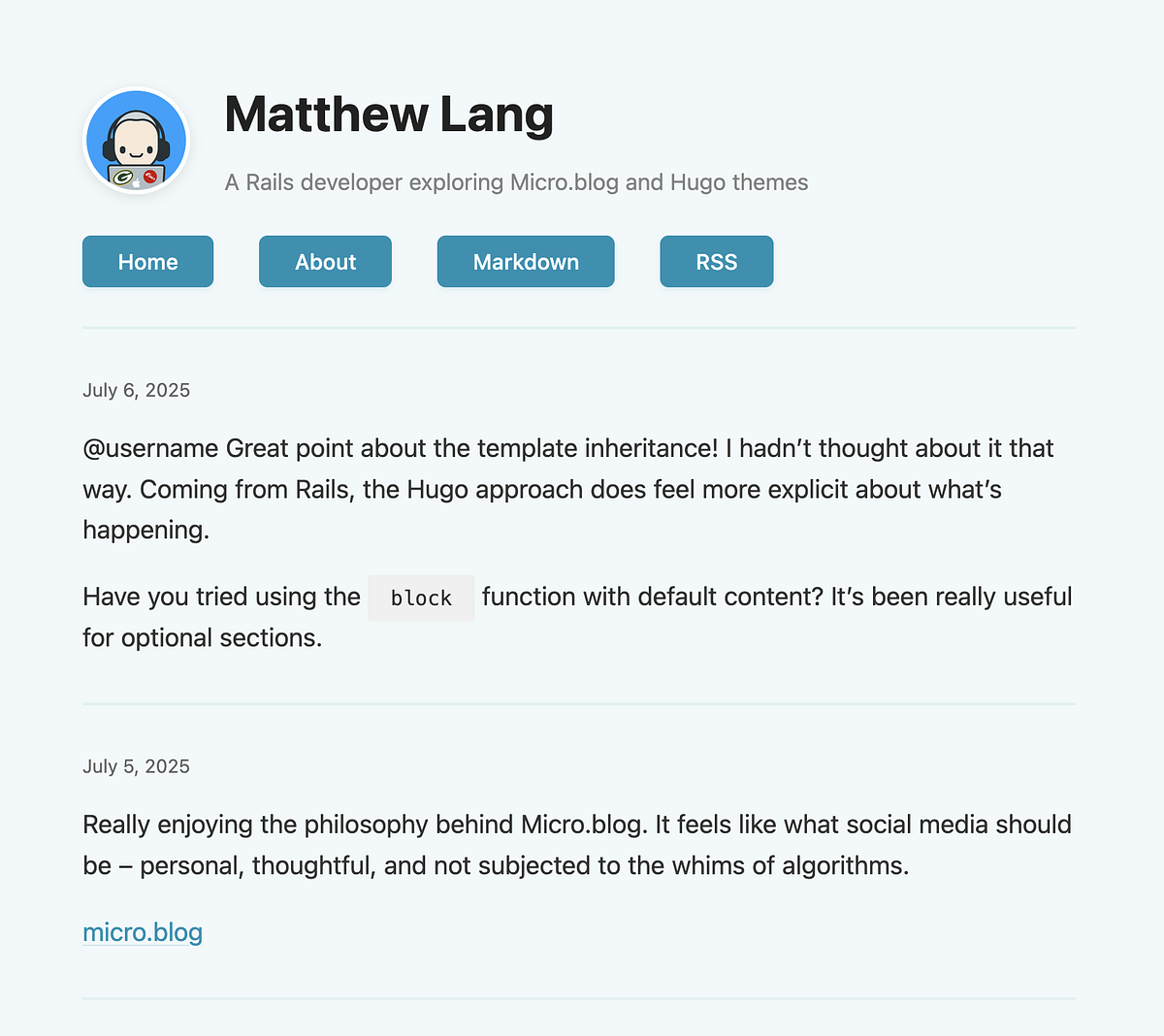
A first pass at my own Micro.blog theme. I have more CSS than I actually wanted, but making it readable with just enough CSS was the goal for today. I now need to determine what to add or edit to enable it to work with Micro.blog, so I can upload it.
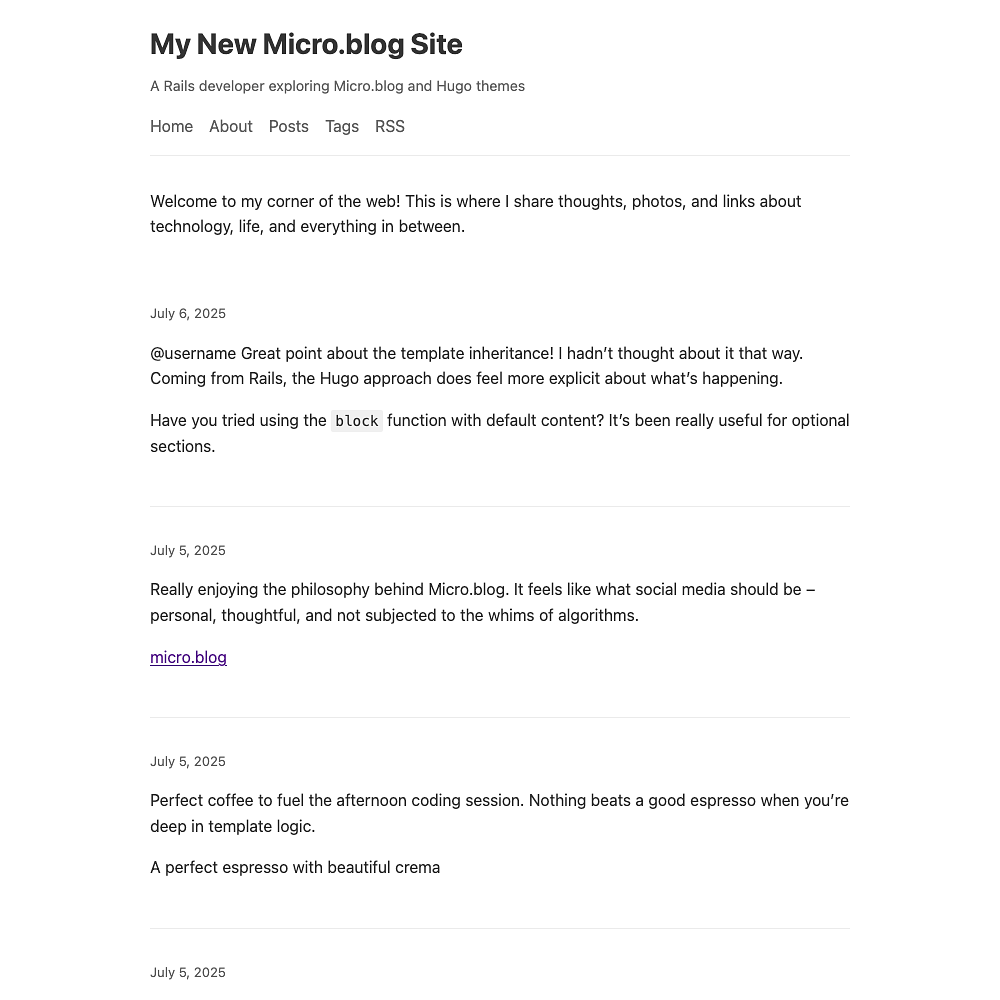
First steps with my new Micro.blog theme
In my foolish quest to build my own Micro.blog theme, I spent some of the evening learning about Hugo and how its theming works. It is not dissimilar to Jekyll in many respects, and I think I have enough to start working on my own theme.
Initially, I’m going with a really basic theme—no colours, frameworks, or complex layouts—just a single column with basic text elements. This will allow me to see what the minimum I can get away with for my theme is. That’s the easy part.
The hard part—it’s definitely not one of my strengths—is putting together a design for a second theme. Web design is not my strong point.
I want to make something that isn’t wildly unique, but has enough to stand out from the rest of the Micro.blog themes. I might let this one simmer away for a few days and check out a few other blogs I like and see what can be done.
This weekend though, the plan is just to have a basic working theme.
The idea of building my own Micro.blog theme is still gnawing away at me. As if I don’t already have enough on my plate.
A particularly tough email written tonight. One of those times where you need to write something, but you’d rather not. This had to be done though.
Apologies for being vague, but just had to get this off my chest.
Micro.blog cup, tea edition.

Joan Westenberg’s post on going viral has this little gem that could be considered a mantra for those who want a more sustainable path to building something.
Build for the minimum viable audience. Create work that matters for people who care. Focus on depth over distribution. Let your ideas spread through trust networks instead of trending algorithms.
Good post on ditching the algorithms of social media for RSS feeds.
I had no idea that Reddit allowed parameters in its RSS feeds so that you can filter the feed.
I’m going to start building out my photo collections into pages. I’ve started with photos after the ice storm in Toronto in 2013. I’ll also gradually build a collections index, but this is a good start.
Is anyone else on Micro.blog not getting notifications for mentions? I can’t remember the last time I got a notification for a mention. Very frustrating.
This is a reminder from Nicholas Bate that sometimes is not forever, and there is always time.
There are plenty of things I wish I had done in 2024, and I can still do them in 2025.
I downloaded Glass after seeing it mentioned in my Micro.blog timeline. I like what I see so far, so I will give it a go over the next few weeks and see if it’s something I want to keep going long-term. I do enjoy taking pictures and posting them online.
I managed to migrate a few older photos into my blog archive. Barring one rogue post, 2020 is now complete. I will try to finish 2019 in the next couple of weeks.
Updated my blog with a new colour scheme. Winter blues is the theme for the next few months.

Molly White’s blogroll page is a treasure trove of RSS feeds if you’re looking to escape from the algorithm-based timelines of the big social media companies.
Going to start blogging again
I’m going to start blogging again.
Not the titleless posts I have been posting for the last couple of years, but the longer posts that need a title. The posts need to be split up into sections. The posts that have a call-to-action. The posts might just be rambling for the sake of it. The posts that venture an opinion. The posts that tell you something you already know. The posts that tell you something you don’t know. The posts that I will deem not worthy of publishing, but I do it anyway.
It’s not a ground-breaking start, but it’s a start.
Congrats to the Pixelmator team on joining Apple! I’ve been using Pixelmator for years and have nothing but praise for its simplicity and design.
While this is excellent news for Pixelmator, I wonder how long Apple will allow Pixelmator to exist as it is.
I’ve seen many posts about people cancelling their Washington Post subscriptions, but I wonder if cancelling your Amazon Prime is the way to go?
The best thing those readers can do is cancel their $139 annual Prime subscriptions, if they have them, and invest that money in the journalism they say they want and need.
I like The Atlantic’s point about hitting Bezos where it matters: Amazon Prime subscriptions. Newspaper subscriptions allow for more independent journalism; we shouldn’t deprive ourselves of that.
Still scrolling through Reddit’s /r/coolguides group thanks to @Annie’s earlier post. So many good guides!
Hat-tip to Jamie Thingelstad for his blog. I’ve been reviewing it over the last couple of days, and he’s done so much with it. There’s so much here that I would like to do on my own blog.
I migrated a few more images from my old blog to the Micro.blog, so my photos page looks better. I also added a now page and uses page.
That’s it done. Micro.blog is now fully powering my little corner of the internet.
I’m tempted to go all in with Micro.blog again. It has enough features for me to consider ditching my own website, as well as a few new themes that are both nice to look at and customisable.
I made the switch over to @Mtt’s Sumo theme and already made a few wee tweaks. I’d like to see more themes like this available on Micro.blog.
Feedbin has added a few new changes if you consume newsletters using Feedbin including customisable newsletter email addresses and a whole new domain for these email addresses. Nice!
I really like the re-design of kottke.org.
Sad to see that YNOT in Toronto is closing its doors.
I have several of their products, including two pairs of pedal straps (still going strong) and two backpacks. I’m disappointed I couldn’t pick up another backpack, but it’s good that they’ll continue selling the pedal straps.
This is a good reminder by Nicholas Bate of the power of a list.
The list remains the most powerful task management tool: a simple, accessible and visible flight deck. One thing: use it not only to capture what you have to do but also what you wish to do. Don’t simply be reactive; be proactive.
What a blog should be
Words I wish I had read when I started this whole online thing.
And, that’s exactly what a blog should be — a reflection of your interest and attention over time. A reflection of who you are right now and where you’ve been. Blogs are living things that should grow at the same rate we do.
— This blog is 20 years old today by Patrick Rhone
I’ve chopped and changed domains and blogs so many times over the last 15 or so years that I wouldn’t be able to lay claim over any period of significant blogging.
It’s only now that I’m starting to make a bit of sense of where everything should be. Yip, I wish I had words like this when I started blogging.
Anyway, happy anniversary, Patrick!
A reminder from Nicholas Bate to re-set your personal compass.
Giving Omnivore a go as a read-it-later service after seeing it mentioned on Micro.blog. Like what I see so far.
The volume of RSS posts coming into my Feedbin account has dipped recently. It might be time to find more blogs to subscribe to.
Bah. Missed the start of the photo-blogging challenge for September.
Finally, I resolved a wee build issue with my custom theme changes here on Micro.blog. Switching the Hugo version down to 0.91 did the trick. Regular posting can commence again!
Trying something new here, all short and social posts will now come from social.matthewlang.me. Separating the social posts into their own domain will allow me to do something else with my own website. Don’t know what yet, but it means I can post a bit more in the way of short posts and photos.
In this era where job automation is increasing, Nicholas Bate reminds us to invest in ourselves.
Matt Gemmell reminds us that it is okay to write less.
Surely a productivity-themed blog without an RSS feed is, by nature, unproductive?
Over the last few weeks, my Feedbin account has been filling up with more feeds from blogs and communities I’ve started following. While I miss the Twitter of old, the silver lining is knowing that there is lots of great content to follow outside the birdhouse.
Feedbin just announced some interesting new features to support Mastodon. I am still on the fence about Mastodon, but it’s excellent that Feedbin is supporting it.
Better off without Twitter?
There is a lot of online chat about why losing Twitter might be okay.
I’ve read a few threads on Reddit, Micro.blog and Twitter itself that we would be better off without Twitter. It’s a convincing argument.
Twitter has become different from its early days of tweeting by text with 140 characters. The platform has grown into a platform for the world. It broadcasts news updates, provides coverage of sporting events and scores, updates on critical political events, and acts as a marketing platform for thousands of organisations and millions of people.
In the last few years, though, Twitter has become something else. A battleground. A place where discussions can often fall into threads of trading insults at each other. A place where people, governments and organisations can pedal lies with minimal accountability. A place where people can hide behind their avatars and threaten others without being held accountable. Twitter has tried to deal with these negative experiences over the years with content moderation and enforcing the platform’s rules, but it still happens.
I might be painting Twitter as a terrible place, but there are positives to Twitter. Although I’m not a frequent tweeter, the content from the people I follow on Twitter is of value.
I’m under no doubt that many others are happy with their Twitter experience. They follow the accounts they want to, scroll through their timelines and share and interact with others on the platform as they want to. If the world is better off without Twitter, will these people be better off without it too?
Regular bloggers and those who know their way about the web will largely agree that the world is better off without Twitter. They can continue writing and posting from the platforms they enjoy using. What about the people who genuinely want the ease of Twitter and what it brings to them?
If Twitter were to disappear, I’m sure I would find alternative means of following others through different platforms and means. What about those who are not so Internet savvy? They might need help finding an alternative means of following others, which leads me to think that we’re not better off without Twitter. Well, not at the moment. The web is still an excellent platform, and this could change.
Nicholas Bate has a plan if you are serious.
Not quite fully on DigitalOcean
Over the last few weeks, I’ve been migrating several Rails applications to Hatchbox. I’ve still got a couple of applications to go. Still, one last thing I wanted to do was migrate my blog over to DigitalOcean’s Apps platform.
I’ve been using Render to host my blog for the last few months. While it’s free, and I have been okay with using it, I’ve wanted to minimize my digital footprint of the services I use. Over the weekend, I spent almost eight hours trying to get my blog to compile and run on DigitalOcean.
Sadly, my blog wouldn’t compile due to the Tailwind integration I am using. An error with the Jekyll PostCSS gem kept breaking the building of the website. I’m still digging into the actual issue, but it is getting parked until I have more time to look into it.
Invest wisely with NB.
Invest by being there when you are there.
All good investments, but number 5 is a good start.
Up early, well for a Saturday at least, for a little code and coffee combo. Fixed a couple of wee bugs on my blog and now spending some time on a re-write of a previous project.
Blogging once again
I’m going to try and kick-start the blogging process once again. I’ve lost count of the number of times I have tried to do this over the last few years. This time though, I’m trying something different.
Instead of trying to aim for longer pieces on a daily basis, I’m going to initially just keep it short. Around the 100 words mark.
So, expect some short ramblings over the next few weeks. Some thoughts, views, ideas and anything that I think is worth putting on the blog. I’m hoping this will lead to a steady stream of posts over the next weeks and hopefully a more active blog.
Another productivity essential from Nicholas Bate.
Finding the path again
Over the last couple of months, I’ve started to make some progress on many of the habits that I fell away from a few years ago. I’m reading again, I’m working on more side projects, and I’m starting to find myself blogging more again. Feels good that I have found my path again. I hope that it continues.
Do what Matt Gemmell does and write down your writing ideas.
It seems that Heroku is no longer the go to place for deploying Rails applications. I’m having some success with Render for my Rails and static websites.
Updated my website to be more a stream of posts now than categorised content. I’m pleased with the results and the change to something that now acts more like a weblog. What it should have been really from the start.
Tom Critchlow on building a digital homestead.
Tom’s site is a treasure trove of good stuff for budding bloggers. Worth checking out!
A few things to zero out with Nicholas Bate.
Nicholas Bate outlines some healing methods. Having done almost all of these, I can guarantee good results.
I’ve started getting into the habit of reading source code again. It’s been too long since I have done this, and actually did wonders for my confidence. When the code you write isn’t that far from other people’s code, you know you are on the right track.
Nicholas Bate reminds us that daily gets the right things done
I try not to post anything political here. However, I think, like many people in the UK, I have just reached a maximum tipping point with the Conservative government. Time for them to go.
I’m intrigued by Cal Newport’s Analog January Challenge.
I could certainly stay off the Twitter native app and website for the month, but I have a couple of Mailbrew newsletters that aggregate some Twitter lists for me. I wonder if these would still be allowed?
I was going to post a link to a bit of Facebook news but I’ve decided against it. They’ve been given enough air time on the webs. Who needs to digest even more of it? Definitely not me and I suspect, not a lot of you microbloggers.
So, I’ll just say, have a good day everyone!
More recommendations from humans please
This blog has been quiet of late. I haven’t felt the need to share much of anything over the last year. In fact, in the previous few years, I’ve bounced back and forward on the want to keep running this blog. The motivation to blog has waned, but it’s something that I still want to do. It’s a strange feeling to have.
One of the things that I enjoy about blogging is the passing on of information. In the past, I would often share links to stories and posts that I have found through my daily read of the websites that I follow. It’s an excellent way of passing on the good stuff on the internet. The old fashioned way. Without the vanity metrics of likes and followers. Without the need for algorithms to find you the right content.
I should do this more often. I should share more links to the things that I find interesting on the internet. Not because I want more followers or readers, but for the intention of passing something else on that I found fascinating as an individual. As a reader of my blog, you might like it; you might not like it. However, there’s one thing that I can guarantee you. Each of the links I share on my blog is a post or a story that I found interesting and recommend as a human and not as an algorithm.
Maybe that’s something that we could do with more of on the web.
One of the things that I enjoy about blogging is the passing on of information. In the past, I would often share links to stories and posts that I have found through my daily read of the websites that I follow. It’s an excellent way of passing on the good stuff on the internet. The old fashioned way. Without the vanity metrics of likes and followers. Without the need for algorithms to find you the right content.
I should do this more often. I should share more links to the things that I find interesting on the internet. Not because I want more followers or readers, but for the intention of passing something else on that I found fascinating as an individual. As a reader of my blog, you might like it; you might not like it. However, there’s one thing that I can guarantee you. Each of the links I share on my blog is a post or a story that I found interesting and recommend as a human and not as an algorithm.
Maybe that’s something that we could do with more of on the web.
An older post from Lifehacker in 2016 outlines the benefits and drawbacks of using plain text.
The best medicine in life needs no prescription.
I love this. Just posted by Patrick Rhone about a post by Kurt Harden.
Another week, another thing I forgot to put in the calendar and completely forgot. It's official. I need to write more stuff down. In fact, I probably need to write almost everything down.
How do you get what you want? Nicholas Bate knows.
Do you have all the essentials?
What you need to remember in a Covid world.
Lots of good stuff from Curtis McHale today. Being consistent in 2021, ideas from reading in 2020 and he's moving from Goodreads to StoryGraph. For me, Curtis McHale's blog is one of the best out there.
Just curious. Are any of my blogging buddies using Signal?
David Sparks shares the aftermath of the California wildfires.
Nicholas Bate’s 14 point productivity primer is a great place to start if you need to get back on track.
Is it time to go out on your own?
In a post-Covid world, maybe the time has come to go out on your own. Keep it simple initially: just you, no start-up capital and a desire to be beholden to nobody. Except you, of course.
Since the lockdown started, it’s clear to me that striking out on my own again is the best way to go.
Goodbye mattisms.dev
After a few weeks of not posting to my dev blog, I’ve decided that over the weekend I will delete this blog.
I don’t see the long term value in having this resource on a seperate domain or in collating the links for this blog. Instead of posting to a blog, I’m going to start collecting web development and Rails guides and resources on a number of pages on my personal website.
Don’t worry folks, I’ll keep posting here and any major changes in this web development content will be shared here as well.
Nicholas Bate with some basics for your marketing strategy.
New DualSense controllers revealed for PlayStation 5
Sony has revealed their new DualSense controllers for the PlayStation 5. A familiar look for the controller with the button layout, but what stuck out for me was the two-toned design.
Now, let’s talk about the colors. Traditionally our base controllers have a single color. As you can see, we went a different direction this time around, and decided on a two-toned design. Additionally, we changed the position of the light bar that will give it an extra pop. On DualShock 4, it sat on the top of the controller; now it sits at each side of the touch pad, giving it a slightly larger look and feel.
— Introducing DualSense, the New Wireless Game Controller for PlayStation 5
I look forward to getting my hands on these when the PlayStation 5 is released.
Productivity reminder from Nicholas Bate. The list is your assistant.
I like the idea behind the Iconfactory’s Tot app. Just a limited number of spaces that you can write in and using Markdown too.
Useful writing
I’ve been trying to find a way to reboot my writing habit for a couple of years now. The trouble is, most things I have written are on too wide a range of topics. When you’re covering a wide range of topics, it feels like you’re jumping from one subject to the next. I need to narrow these topics down.
Paul Graham’s latest essay on how to write usefully got me thinking about this again.
If you narrow the topic sufficiently, you can probably find something you’re an expert on. Write about that to start with. If you only have ten readers who care, that’s fine. You’re helping them, and you’re writing. Later you can expand the breadth of topics you write about.
I need to focus on one or two topics and start from there.
It’s great to see Feedbin have added an automatic option that will automatically switch between light and dark. What is really great though, is the per device settings. Finally I can use different settings on my iPhone that won’t change the settings on the desktop.
Blogs, blogs, blogs
Over the holidays I mentioned that I was writing a blog post that I would publish this week. Well, after a delay thanks to the flu, I finally hit the publish button on my return to using my main domain. My first post, about my focus for 2020, is a return to building up some long form content that I want to reside on that domain.
Is this the end of my time on Micro.blog?
Definitely not. Micro.blog is a wonderful blogging platform that I will keep on using. This blog on Micro.blog will be my social feed to the net. It’s the one place that I will post to daily. Short posts, photos and links will continue to pour out from here.
So what’s the point of the new site?
For a while I’ve been trying to find a way of supporting short and long content. I’ve tried mixing these two lengths of posts over the years and it’s never sat well with me each time I have tried it.
Now that Micro.blog is my daily social feed, I can now focus on pushing longer posts through my main site again.
Apologies for the radio silence over the last few days and the days to come. The flu has swept through our house. 🤒
I’m hoping to return back to normal blogging service next week.
What is your word for 2020?
Nicholas Bate has all the skills you’ll need for 2020.
Life reminders continue with Nicholas Bate.
Nicholas Bate reminds us to keep our lists under control.
Micro.blog has arrived as a recognised community. We have a Font Awesome icon!
Honoured to have made Kurt’s 25 blogs list again.
Despite my ups and downs of blogging, it’s good to have made this list once again.
I think I made it through Micro.blog’s Microblogvember. It’s been fun to do and has helped keep me posting. I aim to keep it going through December.
Are your inboxes making you anxious?
CJ Chilver’s reminds us that we can reduce our anxiety by reducing the number of inboxes that we have.
There’s a lot of productivity advice out there about what to do to organize and process your many inboxes. But the best rule is often forgotten: have as few of them as possible.
I still use Feedbin on a daily basis to filter for the important stuff, and I even follow a few accounts on Twitter using it.
The biggest benefit I get from using Feedbin is that I’m in control over what I choose to see and read. That’s a big positive in a time where platforms are pushing algorithms that decide for us what we should read.
I’ve spun up a Ghost blog on a small DigitalOcean droplet. No idea what I’ll do with it yet, but the install process was very straight-forward. Good to know.
If I could do the whole career thing again, then I would love to be able to write for a living.
Filter and focus
Nicholas Bate reminds us of the purpose of a list.
The purpose of the list is to filter and focus. The list is that to which you give attention. If it’s not on the list you say no, politely. The list drives you the proactive wolf rather than the hang-back sheep.
Ghost 3.0
Ghost 3.0 now includes memberships and subscriptions.
As of today, Ghost is the first totally independent product out there with publishing<>subscriptions deeply integrated at the core, allowing anyone to build a recurring revenue subscription business.
I used Ghost for a while for my blog. Eventually the cost was something that I couldn’t justify and so I switched. However, with Ghost’s new memberships and subscriptions, they’re definitely going to attract the attention of many content publishers.
Another great update to Bear, the notes app. Back in the day the best thing I used for managing notes was Backpack. This is probably the next best thing to Backpack for me.
The email shake down
I loved this post from the Signal vs Noise blog about trading off tracking people through email for content.
Not everything needs to be tracked. Not everything needs to pay off. It’s perfectly fine to do things because it’s fun, feels good, is interesting, tickles your brain, or just helps someone out.
— [Let’s stop shaking people down for their email addresses] (https://m.signalvnoise.com/lets-stop-shaking-people-down-for-their-email-addresses)
The benefits of hard work.
Feedbin for iOS is now available on the App Store.
Great to see Feedbin now have their own native app for iOS that matches the website, feature for feature.
Nicholas Bate reminds us to do the right things.
Great to see Rails 6 will be shipping with multi environment credentials.
Nicholas Bate reminds us that there is always time for a new plan.
Nicholas Bate reminds us to do it better, even when it’s just those everyday tasks.
Thought experiment Thursday with Niklas Göke’s blog, Empty Your Cup.
Where have all the good programming and development blogs gone? Maybe I’m not looking hard enough, but I struggle to find good programming blogs to follow that post on a regular basis.
Fan-made version of Star Wars scene 38
Also, I wonder if we’ll get a new version of A New Hope with this included as an option?
“We were inspired by the Vader scene in Rogue One,” Christopher Clements from FixitinPost says in an email to Fast Company. “We felt like the fury and power from that hallway scene should be present in the Vader/Kenobi duel that happens very closely in the Star Wars timeline. It was essential to update the emotion of the scene given the history we are now aware of between these two. Telling the story of these two was our main goal when setting out to create Scene 38.”
This fan-made, nerd-approved edit of an iconic Star Wars scene took 2.5 years to make
Split-screen editing on the iPad? Wow. The iPad is fast becoming a serious alternative to a laptop.
Always disappointing when you find a blog with good content and there’s no RSS feed.
Nicholas Bate with the definitive marketing strategy.
I try remind myself daily that I need to reduce my phone usage but it hasn’t really happened.
This post on how your smartphone should be like your toothbrush might help though.
Pete Corey’s Minimum Viable Phoenix is a great starting point for those looking to learn the Phoenix web framework.
Interesting programming problem I solved this morning. Rewrite a regex expression so that it doesn’t use any escape characters that would break the Yaml file it is being saved in.
Also, added Regex101 to my list of great online tools for web development.
Yes to the bigger picture and more to say yes to by Nicholas Bate.
Change the game up with NB’s power rules.
Good advice from NB that can apply to more than just business.
Start the plan to make 6 months from now so much easier.
Deep work and goldfish
A study commissioned by Microsoft found that since the year 2000 – or about when the mobile revolution began – the average human attention span dropped from 12 to 8 seconds, which places us just below a goldfish, which tends to stay focused for an entire 9 seconds at a time.
Wow. In almost 20 years we’ve become less focused than a goldfish.
I get ticked off by Slack as a platform, but not for what it is, but how it’s used. Instead of restricting channels to specific actions or topics, Slack allows any channel to be openly used and abused without user’s even knowing that they are distracting others. Why have one firehose channel when you can have ten?
I do miss the days of freelancing where I could get in a few hours of deep work in the morning and then catch up with clients and meetings in the afternoon.
We need more illustrated books
Maybe it’s the books that I buy, but I don’t see many books with illustrations in them. In books the illustration is a visual indication of where the story is but in the case of older books, I would say the illustration is much more of a labour of love.
These illustrations for “The Tempest” by Arthur Rackham are a great example of this.
I only know of Arthur Rackham as it was his illustrations that were included in my edition of “A Christmas Carol”. There is something about his illustrations that set them apart from other illustrated books.
I would love to see more illustrated books in stores.
The basics from Nicholas Bate. Glad to see that I am striving to get back to all seven of these.
Thinking about bringing back my weekly digest posts. For no other reason than, I just want to write more and blog more.
Nichola Bate’s productivity boosters continues.
Planning for March with Curtis McHale
I’m loving Patrick Rhone’s new podcast, Rhonecast.
Nicholas Bate yet again delivers. This time, some pointers to dealing with the new crazy world of work.
Benefits of the daily diary
Good advice from Derek Sivers on keeping a daily diary:
It works best as a nightly routine. Just take a minute and write at least a few sentences. If you have time, write down everything on your mind. Clear it all out. But if you miss a night, make time the next morning to write about the previous day.
— Benefits of a daily diary and topic journals by Derek Sivers
I also like his idea for topic journals.
For each subject that you might have ongoing thoughts about, start a separate “Thoughts On” journal. Whenever you have some thoughts on this subject, open up that file, write today’s date, then start writing.
— Benefits of a daily diary and topic journals by Derek Sivers
Don't just think it ...
Write it says our man in Arizona.
For those interested, I’m still working on a startup screen and Heroku deploy button for Commonmarks. I’ll post an update when I’ve finished these additions.
I’m not sure what to make of the new status feature on GitHub. I barely use the status feature on Slack, so why would I set my status on GitHub?
What would you do with an empty day?
What did you learn in 2018?
The new world order of JavaScript
There’s no denying that JavaScript is an excellent language for the web, especially the front-end of any web application. Without it, we can’t enjoy a user experience that challenges native applications.
However, I am not convinced that JavaScript is a language that is suitable for all parts of an application’s stack, all the time. There are benefits to using JavaScript depending on the requirements, but it feels like JavaScript is becoming the go-to language for everything.
Heydon Pickering’s post is an excellent read about this issue and full stack development and how this role is changing with the larger set of JavaScript tools and frameworks available, but it’s his point about separation of concerns that resonated with me:
We need to revisit the separation of concerns principle. We simple can’t afford for people to have to know everything just to do something. It’s good that we conceptualize designs in terms of self-contained components now, but that can be a mental model without being a technology-specific land-grab.
— Reluctant Gatekeeping: The Problem With Full Stack by Heydon Pickering
It wasn’t that long ago when front-end developers and designers worked with back-end developers on applications. There was a separation of the two roles and their focus, and each side had the knowledge to carry out their role. Front-end developers would work on HTML, CSS and JavaScript, crafting functional yet beautiful user-interfaces. Back-end developers would work on business logic and background processing.
With the rise of JavaScript though, we’re seeing a convergence of tooling onto a single language, and the roles of front-end, back-end and full stack developers becoming less about knowing the respective field and more about knowing JavaScript.
The new world of web applications is moving to JavaScript, and that’s great for the web as a platform. We can now build applications that rival that of native apps using a single language.
However, when faced with programming language choices in the stack, should developers be quick to default to JavaScript?
Private repos for developers on GitHub’s free plan is a great move by Microsoft to match the likes of GitLab. I’ll need to check to see if I need that $7 Pro plan now.
Keep it simple.. Another great productivity booster from Nicholas Bate.
Love NB’s reminder about productivity balance.
When you add regular events to your diary, ensure you subtract one or two.
A blogging style guide. Love. This. I can see me spending the weekend reading this and its suggested actions.
Nicholas Bate’s simple productivity boosters continues with scheduling ahead.
Lately, I have been seeing web development articles with intriguing headlines that have me clicking with anticipation to read them. The article itself though usually ends up being a hastily written post that barely covers what I expected from the headline.
How to back up your Bear notes. Good thing I do all three of these. Just to be safe.
Honoured to once again find myself in amongst a wonderful collection of bloggers.
Many thanks Kurt.
Less and slow for a better quality of life says Nicholas Bate. I couldn’t agree more.
Reviewers say iPad Pro a serious challenger to laptops.
Well, until they add the capability to write and compile code locally, it will never be a true challenger to the laptop in my eyes.
Nicholas Bate asks, what can we remove?
My favourite notes app just turned 2 and continues to be an essential part of my day.
Still contemplating the portfolio career
Six years ago I wrote a snippet about a portfolio career. This is still the end goal for my career.
Splitting my time into smaller part-time roles would be a great way of still keeping my programming skills but also being able to explore other roles in different industries. I have an idea for that other role, but it requires a few other things to be done before I can realistically make it happen.
When it comes to blogs, Kurt Harden has one of the best there is. A wide range of topics, daily bite size posts and best of all, he just tells it like it is.
Definitely a blog to aspire to.
Nicholas Bate goes beyond the to do list. Always an essential part of my daily surfing on the web.
Great post by Julia Evans about what a senior engineer does.
I’ve been giving this a lot of thought recently as I move toward full-time emoloyment again. While a few things do crossover from my time as an freelancer, I do see it as a different role.
The power of the timetable. Who thought that something so simple could be the ultimate time management tool?
Disappointed to see Path closing down, but to be honest, it’s been a long time coming.
The only upside is that they are finally providing a way to export your content from the service.
After some thought, I’ve decided to skip setting up another Micro.blog account for coding. It’s another domain, another channel, another potential headache.
Any suggestions on a name for my new programming blog? I’m setting one up just to catch notes and findings as I work. Nothing language specific, trying to keep it general so I switch between languages.
Now seems as good a time as any to not only reboot the blogging habit, but also a number of other little things that have slipped by in the last few months.
The Micro.blog site is the only place where I can compose a reply and see what I’m replying too at the same time.
I wish more Micro.blog clients did this for replies.
I remember a similar app for iOS that did something similar to Edit. As good as Bear and Ulysses are, sometimes you just need a place to write without the bells and whistles.
The MDN web docs is becoming a daily visit in my quest to just understand and write plain-old JS instead of jQuery.
Nicholas Bate’s Essential Tools of Excellence continues with the fixie. It’s the one bike that everyone should own.
After a couple of weeks of heads down work for a client, I decided last night to find some solace in some simple work and clean up the @penmuse website.
I’ve removed the fixed sidebar and opted for a centred two-column design that keeps the site simple to use.
Great to see a company like FastMail use the GDPR rules as a way to protect all their customers and not just those in the EU.
I would love to make use of the micro-casting plan on Micro.blog, but I’d be too concerned about speaking clearly. Public speaking isn’t one of my strong points.
Back to blogging again. Good to get something out in the internets again.
Publishing a blog post today that’s been collecting dust for a couple of weeks now.
Might be great, might not be, that doesn’t matter. What matters is it’s out there.
Did I just write a reply in the style of old Donald himself?
Lacking direction?
Reset your personal compass with NB.
Nicholas Bate offers up some nudges to get you writing.
Ask Micro.blog
I’m wondering if this is something that might interest the users of Micro.blog.
I want to ask a question to Micro.blog users, but I don’t want the question to appear on my blog. Much like my replies don’t appear on my hosted blog, I would like to ask a question to the community and for everyone to see it on their timeline. Just not on my blog.
I know there are Slack groups for this type of thing, but perhaps Micro.blog is just as great a place for this type of thing.
Does that make sense?
Micro Monday shout-out to my writing prompt generator on Micro.blog, @penmuse.
Write daily
Nicholas Bate with a run down on being happy. Writing daily is just one simple part of it.
Write daily about what is working so that you observe, notice and appreciate it.
— Basics 7: How to Be Happy by Nicholas Bate
Better writing fundamentals by Nicholas Bate.
More jagged thoughts from NB
A refreshing thought from Nicholas Bate.
We feel we need to add. In fact so often we need to simplify, to reduce, to let go of. We actually need to subtract.
I’ve been playing with Wordpress again over the last few days. So much more going for it than any other blogging platform I’ve used. Wonder if it’s time to move from Ghost to Wordpress?
Considering some blog changes
I’m considering a few changes in the way I blog.
Micro.blog for personal stuff, quotes, snippets, links and the like.
Ghost for longer posts on working, ideas, products and writing.
It should be noted that Micro.blog was the trigger for this whole thing. A streamlined way of publishing small or large updates and then syndicating them through to other social networks and blogs. Damn it’s good at that.
I’ve started to think that my Ghost blog should be more of a professional site than anything else. I think that’s what it’s lacking. Longer posts that I’ve taken the time to write.
Curtis McHale’s blog is a great example of a professional site used for such a purpose.
My blogging habits have changed. From posts that are a mix of personal and work on the one blog, to using two blogs for a mix of both. Now I’m seeing that one blog is more for personal stuff and the other is for things I’m working on and working towards. The work stuff, the professional stuff. The boundaries aren’t clear on this at the moment though, but I think they should be.
@patrickrhone has a similar setup. A professional site and a personal micro-blog.
I’m 90% sold on the idea. The thought of moving more content around isn’t appealing though. It would be worth it in the end though. Right?
Atom still trying to play catchup with the likes of Sublime Text. I can’t see it ever happening.
Nicholas Bate reminds us of the basics when we’re stuck.
I completely missed the part of GitHub’s project tracking feature that allows you to track projects in other repos as well. Might be the game-changer for managing my own projects.
GitHub’s Projects feature is increasingly becoming an alternative to using Trello, but Trello’s native apps still make it my preferred project management tool.
Choose a word or three
Nicholas Bate picks one word, Mike Vardy picks three words.
Whatever number of words you choose for 2018, work with them, live them, breathe them. Even just a few words can advocate powerful change for the better.
Disappointed to see that the Grammarly blog doesn’t have an RSS feed.
Frustration is a blog post that doesn’t link to the products that it recommends.
Bear just keeps getting better
New themes, autocomplete for tags and of course TagCons!
Once you get a decent tag collection going, it can get harder to find the right one in your Sidebar. To help you do less scrolling and more finding in Bear 1.4, we added over 100 TagCons — small icons for some of the most popular tags we could find.
Nicholas Bate’s What we know about 2018, the complete list. A must read in preparing for the new year.
Outlined a couple of blog posts this morning that I’ll publish this week.
Business without email
Proof that your business can survive without email.
In short, Schwarz is a classic craftsman. If you want to ask him about his trade, however, you’ll have a hard time getting in touch. In 2015, he stopped using (public) email. And he has no intention of going back.
— The Woodworker Who Quit Email by Cal Newport
As a freelancer I’m wondering if a newsletter is worth putting into place. Another thing to maintain and run. Why can’t I just rely on a blog with a contact form?
Attention vs Currency
Is attention no longer a viable form of currency?
We’re told every day as creators online that attention = prosperity. But no one’s attention online lasts long enough for that to be true anymore (if it ever was).
— The Value of Attention by CJ Chilvers
Social media might make you famous for five minutes, maybe even a few times over, but what about the times when people’s attention is elsewhere?
Nicholas Bate has Monday’s covered. Do you?
Mondays can be approached slowly or quickly or even from an oblique angle. But always approach them with coffee, a plan and total lack of fear.
Jagged Thoughts for Jagged Times, 253 by Nicholas Bate
A reminder from Nicholas Bate that the Internet serves both the good and the bad.
False news on what a politician said. Dubious claims on the power of a particular asian fruit.
— Jagged Thoughts for Jagged Times, 250 by Nicholas Bate
Taking stronger action
Gregory Brown is closing his Twitter account (@practicingdev).
In 24 hours I’ll be shutting down this Twitter account for good. I am OK, and will resume blogging at practicingdeveloper.com. A few months ago I tried to take a break from Twitter and (once again) failed. I don’t like that feeling, so need to take stronger action.
I’ve been following Gregory for a few years now. I like what he writes about and subscribe to his blog.
I have mixed reactions on his decision to leave Twitter. I’m sad for others that follow Gregory on Twitter but happy that he’s taken this step and will continue blogging.
I’ve often thought about deleting my Twitter account but I’m not quite ready to do it. I’m quite happy to let Micro.blog cross post what I need from here to Twitter for the time being. I think the time is coming though. The day when I say goodbye to Twitter.
Another day, another blog post written. That’s three in a row. Need to get a couple of topics in place for tomorrow and Friday.
A lot of love for Cardhop on the blogs today. Going to have to give it a try at some point.
I often struggle with content ideas for my freelancing blog. I should look towards my expertise more than anything else.
It doesn’t matter how narrow your expertise is. If you know better than anyone how to parse New York City subway schedules, I want you to write about it. If you’ve taught your cat to care for a Tamagotchi, I definitely want you to write about it.
— Write an excellent programming blog by A. Jesse Jiryu Davis
Been a while since I did this.
One more technique I found helpful is keeping a “content ideas” file on my phone. Whenever a random idea pops into my head when I’m at the gym or about to go to bed, I go and add it to the file.
I think it’s time to keep a list of content ideas again.
I have to say. The unique way in which micro.blog allows posts and conversation in the form of replies is a brilliant idea. I was unsure of it at first, but having spent some time with it over the last few months, it’s clear to see it’s a great feature.
I’ve returned to blogging with a post about why I think web analytics are not a good fit for my own websites.
I must say, it feels great to be writing again. I really enjoyed pulling this one together.
Published the last edition of my own newsletter last night. It wasn’t working out for me. Glad to have the support of fellow bloggers.
Saying no is saying yes to other things …
Cheers @patrickrhone
No newsletter and micro me
Yesterday was the last edition of my newsletter.
I won't go into all the reasons why I've stopped the newsletter but it really boils down to one thing that Patrick Rhone kindly reminded me of last night.
Saying no is saying yes to other things...
On other news I've embraced Micro.blog a bit more and have been posting frequently there. If I'm sharing any links or smaller posts they'll be found on my micro-blog which you can subscribe to through RSS or even follow me on there as well.
What about here then? I'll be reserving longer posts for here and they're going to be coming over time.
The value of importance ...
... is knowing what is important.
Don't attempt everything. Do what's important. No, not everything is important.
— Jagged Thoughts for Jagged Times, 237 by Nicholas Bate
Thanks Nicholas!
Gave up trying to remove those last few Instagram posts from my microblog timeline. Just going to have to leave them there I guess.
Productivity is ...
... defined by Nicholas Bate.
Productivity is no longer simply about 'the things to do', it is about tough, balanced, focused decisions on what not to do.
— Jagged Thoughts for Jagged Times 236 by Nicholas Bate
Survive and thrive ...
... with the personal resilience guide from Nicholas Bate.
Erasing the past
Kurt Harden is concerned about the erasing of American history.
The first is that it strikes me as an effort to erase history. That never goes well. And I write as an Ohioan with absolutely no sympathy for the the Confederates memorialized in bronze, copper, or stone. The statues represent our past and they offer different reminders to different people.
Erasing history by Kurt Harden
I agree with Kurt on this one.
By removing these statues, the American people are removing part of their history. Yes, these statues represent a side of America that many would like to forget but it's in these statues and the history they represent that we see the progress that has been made.
So following the footsteps of TextExpander and Day One, the writing app Ulysses is now moving towards a subscription service.
I've wrote in the past about subscription services. I get why people and companies are doing it. Subscriptions provide a more stable revenue stream and allow consistent development of the product.
If I was a keen writer and I used Ulysses on a daily basis then I imagine that I would take out the Ulysses subscription. For just under $5 a month I'm getting a great writing tool that I can use on all my devices.
$5 isn't a lot of money, but when you're working on the Internet on a daily basis, it won't be the only subscription service you'll have. You'll have other subscriptions for other products and services that you use and these all add up. With all these subscriptions, they can quickly mount up.
I used TextExpander for a few years until they announced that they would be moving to a subscription plan for their users. Many seen as it as a good move for TextExpander to support the business and I agree with that. What I don't agree with though is the pricing. Paid monthly, TextExpander is only 83 cents cheaper than Ulysses. Two vastly different products, but very similar in pricing. Are they priced right? Who knows. All I know is that I refuse to pay a monthly subscription service for a product that I only use on a single device.
I'll be interested to hear what Curtis has to say on this. I know he's been a long time user of Ulysses but we emailed each other recently and he did say he was cutting back on subscriptions. Will he cut back on this? I'd like to say he'll stump out for the subscription, but I'm not entirely convinced.
Lastly I also just remembered that Ulysses is available on SetApp. It will be interesting to see if Ulysses remains on Setapp as it only costs $9.99 per month and for that you get access to an increasing number of apps for OS X as well as Ulysses.
Update 2017-08-10: It looks like SetApp user's don't need to worry as Ulysses will be unlocked on your other iOS devices if you have already picked Ulysses using SetApp. Good to know!
In addition to those “big” arguments from above, there are bunch of smaller advantages, too. One example: if you use Ulysses via the Setapp subscription, we will now automatically unlock the iOS app as well. And the way we modeled and priced our subscription plans, now much closer resembles the value each plan provides, than a “pay once” model ever could.
— Why we’re switching Ulysses to Subscription by Max Seelemann
Slack: Necessary evil?
I've been using Slack for a few years now. I use it more for work than anything else. I am part of a number of different client teams and it's through these that we do most of the day to day communication. I have to be honest it has become something of a necessary evil to have, but it is an easy way to stay in contact with clients. For clients that have only a handful of employees then I recommend that we just stay in touch with phone calls, emails and of course whatever project management tool that works best for the client.
Benjamin Pollack's post about his issues with Slack are good points and with more people turning to apps like Slack, it's worth remembering that Slack isn't a great tool and should only be used if there is a genuine need for it other than, "Hey I need this right now!".
Perhaps the greatest argument against using Slack isn't the filtering of communications or the notifications.
It's the version of Markdown that Slack uses for it's messages. It's just not Markdown.
5. Its version of Markdown is just broken
I’m going to use up an entire heading purely to say that making *foo* be bold and _foo_ be italic is covered in Leviticus 64:128 and explicitly punishable by stoning until death.
— Why I Hate Slack and You Should Too by Benjamin Pollack
What grieves me more is that there isn't a week goes by where I don't end up sending a message formatted incorrectly because Slack has it's own version of Markdown.
Slack isn't a necessary evil but teams should consider Benjamin's points before deciding if Slack is worth using.
Give me email and a phone any day of the week.
Attended Nicholase Bate’s Deep Productivity seminar in March and and it was worth every penny. Highly recommended. blog.strategicedge.co.uk/2017/06/d…
A change of working ...
... is what you need.
More insightful thoughts from Nicholas Bate.
Decision time ...
... with Nicholas Bate.
Did that thing where you write a series of related words that results in something of value. Will publish today. #amwriting
Small wins
4) One thing about blogging with Ghost is that there are little in the way of automated tools and extensions.
5) I’ve still not found a way of quickly posting to my blog and while that isn’t the main issue it is one part of the bigger problem.
6) I’m going to start a last attempt to post regularly next week. If it fails then I think it might be time to retire the blog ..
3) I want to blog because I enjoy it. It starting to wear on me though.
1) I used to be a consistent blogger. Frequent blog posts, sharing links from others and many other good stuff would be part of my blog.
8) Any advice or thoughts on #bloggingburnout?
The basics of productivity
For serious tweet-storming on Twitter.
I love this idea for an app as I hate trying to condense down a single thought into 140 characters.
Hell, it might even get me using Twitter again!
Blogroll updated
Added Annie Mueller to the list.
Who's on your blogroll?
Subscribe improvements ...
... over at Feedbin.
I love using Feedbin. Such a great RSS reader and the fact that they keep adding to it and improving it just keeps making it better to use.
Oxford bound
Driving down to Oxford this afternoon for tomorrow's Deep Productivity seminar with none other than Nicholas Bate himself.
A great chance to meet and a great opportunity to learn.
If you're attending, say hi!
Medium memberships
Medium announced it's paid tier called Memberships. I'm not convinced though.
Sure it's great that Medium are finally charging for their product, but there isn't enough value here.
You can count me out.
Bravery in brevity
CJ Chilvers looks at the importance of being small and why avoiding the need to grow can be a good thing.
I've written before about my love of small books, but these past few days I've re-discovered a love of small blogs, small newsletters, and small products in general. Small could mean brief. There's bravery in brevity. Small could also mean minimal, a first step towards something larger.
— The Importance of Being Small by CJ Chilvers
Coffeeshop etiquette
Some essential coffeeshop tips and etiquette from the peeps over at DNSimple.
When you order your first drink ask for it straight away. Having a good relationship with the staff is important so give a good tip. I usually give 40%-50% on the first visit. That really helps get a good start with the people working there.
— Working in coffeeshops by DNSimple
I need to breakout from the home office a bit more often now that the good weather is just around the corner. Paisley only has a couple of good coffee shops worth working in though.
Chain of thought
Lately I've been thinking a lot about marketing.
While making my afternoon coffee I was running some editing changes through my head on a post I'm writing. And then it struck me.
If you're not writing, you're not marketing.
I've struggled with marketing my freelancing business in the past, but I certainly could start making a step in the right direction by writing more for my freelancing business.
My kind of blogging
The no-pressure kind. Manton Reece explains.
I love that blogs can scale from the trivial to the important. The microblog post about what you had for breakfast. The half-baked rant about something you’re passionate about. And sometimes, the rare essay that really hits the mark and makes people think.
— No-pressure blogging by Manton Reece
I've been struggling to blog more in the last couple of years. Partly that's down to me trying to produce too high a level of content. I should just blog what comes to mind. It won't all be great, but every now and again there will be a post that really stands outs.
Ghost on Indie Hackers
We launched Ghost about 4 years ago with a $300,000 Kickstarter campaign. Today, it's a sustainable healthy independent business with $750,000 annual revenue and a team of 10, and users including NASA, Square, Vevo, Sky News, Mozilla, Zappos and so many more.
Proud to be a Ghost user and looking forward to seeing what else the Ghost team can add to an already great blogging platform.
Weekly plan bars

I've been having a successful run with the bullet journal and implementing Mike Rhode's daily plan bar but as a weekly view rather than a single day's view. Daily plan bars go on the left while a list of tasks for the week goes on the right. I'll do a better write up of this in time complete with a more annotated description.
Campfire chat
I know, from reading my friend Kurt Harden’s blog, that we may not see completely eye-to-eye politically. But, a fact of which I’m absolutely certain of is that we could sit down around a campfire with two fingers of whiskey and a decent cigar each and come around to more that we agreed on than disagreed.
— Campfire Diplomacy by Patrick Rhone
What a great idea. I just wish I lived a little closer for this little pow-wow.
Less - the 2017 edition
by Nicholas Bate.
Award for best planet ...
... goes to planet Earth.
Rooted productivity
Cal Newport touches on single root commitments and productivity.
The solution to these issues is simple: maintain a single root commitment, that you’ll stick to no matter what, which will in turn help you get the most out of all the other productivity commitments that come and go in your life.
To be more concrete, create a single page document that describes the key productivity rules, habits, and systems (which I’ll summarize as “processes” in the following) that you currently follow in your life.
— On Rooted Productivity by Cal Newport
Get what you want ...
Medium still isn't for me
I've wrote in the past about the blogging platform Medium and how I have issue with such a high volume of people writing under one roof and how the lack of
Here's what I wrote at the start of last year:
Access to the network is easy but I can't help but wonder if in the future they'll get it wrong and piss off a good chunk of their user base. I'd rather not take that chance.
Well Medium did get it wrong. The ad model isn't working for them. That and fifty of their staff have been dropped. What looks like a cost-cutting exercise is what they're calling a change in their business model. What that business model will be is unclear at the moment.
One option Medium has is to charge users for the privilege of using Medium. If Medium wanted to charge me to use Medium then I would be all for it. I love products that look for money up front before you can use their product. How else are they going to survive as a business?
I like the idea behind Medium but the recent change in their business model (or even lack of one) has me wondering how long they'll be around for. Not a nice thought, especially when it concerns a platform that many use to publish their thoughts and ideas. I'd rather not see it go under, but it needs to start adapting and fast.
Medium still isn't for me though. I'm happy to blog away from my own little corner of the Internet.
Announcing my monthly newsletter
I'm starting a newsletter this year.
Yes, I'm a bit late to the newsletter thing and yes this is probably another newsletter that you don't need, but here me out before you make any decisions.
On the 19th of each month I'll send you a long form piece of writing about my thoughts on a topic that will usually revolve around technology, productivity or products. If you like my blog then you can expect content along the same lines, just in a longer form. Each month, I'll also include a link list of interesting titbits from the Internet that have caught my attention and I think are worth passing on.
Interested?
First edition drops on the 19th of January and is entitled, "Back to basics".
Building some goals for 2017?
An honour ...
... to be included in a list of such fine and esteemed bloggers.
Many thanks Kurt.
Nicholas Bate reminds us that Mondays are for those who take action.
Are simply there to sort the leaders from the followers, the serious from the not-so-serious and those who are taking action from those who are waiting. Love your local Monday.
Who Are You Following?
I can't remember if I mentioned this in a previous post but in case I didn't here's an update.
I will be starting a monthly newsletter in January. The idea is to publish a long form essay on a single topic each month.
I'm fully aware that there are already hundreds of newsletters out there. It's for this reason I'll be limiting it to just one a month. Your time is probably already scarce and I don't want to take up too much of it.
More details and a sign up form to come in December.
The Don't List

The makers of Telegram have launched a blogging platform called Telegram.
Yes, it could be used by nefarious internet trolls, but I would like to think that it will be used in a more positive way.
Somone convince me this blogging malarkey is worth doing.
comes from two simple realisations. NB explains.
AI For Your Todo List
Todoist has just anounced a new feature to their task management platform, Smart Schedule.
Smart Schedule uses predictive modeling to help you easily plan out your tasks for the day and week to come. It learns your personal productive habits, and takes into account patterns across all Todoist users, to predict the best possible due dates for your tasks.
That means those 50+ overdue tasks you have hanging around can be quickly rescheduled en masse, while new and unscheduled tasks can be easily assigned to the best due dates. In this way, Smart Schedule makes it much easier to stay on top of your to-do list and roll with the punches when your day doesn’t go as planned.
— Introducing Smart Schedule, a more intelligent way to plan your day
I stopped using Todoist a number of weeks ago due to the fact that I was just going through the motions of ticking off boxes. It got to the stage where I was micro-managing myself.
This is an interesting move in the market of task managers and no doubt there will be a few other task managers following down this road.
I'm still finding my feet with consistent blogging but there may be something to what Patrick Rhone is doing with his Rhoneisms.
My personal site is just that. Personal. I don't blog for the traffic, the page views, or as part of some grand plan to build the next big thing in tech. This is my site and shouldn't be constrained to schedules and plans. I have other sites that do that.
This site should just be a steady stream of thoughts, links and images. The first two I've been quite active on posting but there's been a lack of image content here. I'm hoping to rectify that soon with my own take on Patrick's Rhoneisms.
The first three pages ...
Avoiding my timeline today, so opting to use the Twitter widget in Notifications Centre to post today.
The last year has been a real struggle here on the blog. Inconsistent posting and a lack of direction is to blame. Or so I would think.
Over two years ago I was churning out a post a day on this blog and not just random stuff either. There was a general theme of topics around writing, technology, freelancing and a few other things. Not a day went by without hitting that publish button.
Today though it seems I've lost that daily nudge to just write.
When I was publishing daily I started to think that I needed to start scheduling posts ahead of schedule. It got me thinking about structuring my blog and managing it a bit better.
Truth is I simply made the blogging process even more complicated. It's taken me over a year to see this.
My blog is a marketing tool, but it's also my little private corner of the Internet. What should it be though?
As a personal site it should be nothing more than a scrapbook of links and posts entered around the topics that have my interest at the time.
No more scheduling of content, no more obsessing of schedules. If I want to create a site around a particular group of topics with more of a structure then I'll just create a new blog and structure my writing for that.
In the meantime though, I'm going to loose the reins of my blog and see where it takes me again. I'm just going to blog more.
Curtis McHale has the three step process for marketing your business. Blog, podcast and meet people.
The primary thing you need to do is blog. Write for your own site at least weekly. You write because when people have issues, what do they do? An internet search. And search engines index your writing. People will land on your site and start to get to know you. Getting to know you is the start of the sales process.
— A 3-step marketing plan for your business by Curtis McHale
The one thing I think I couldn't do is podcast. I could write all day if I had the chance. Meeting people certainly isn't an issue, but I think putting your voice out there is something that will take me a while to do.
Leo Babauta at Zen Habits has the lowdown on how to write every day. And it all starts with a reason.
Most important: Have a great reason. The rest of this doesn’t matter if you skip this step. Answer this question: Why do you want to write every day? If it’s because it sounds fun, sounds cool, sounds nice … you’ll abandon it when you face discomfort. If you want to do it to help someone else, to make the world a better place, to lift someone’s spirits, to reduce your pain, to find a way to express your deeper self … then you can call on this deeper reason when things get difficult.
— How to Write Every Day by Zen Habits
Essentials ...
... from an essential blog to follow. Of course it's Nicholas Bate.
Need help writing a book?
Wally Bock has you covered with your first six steps towards a published book.
Long before any writing starts, most authors spend a great deal of time preparing to write. At this point, they usually don’t have a specific idea about what they want to write, but they do have some ideas and a few hunches about what might work.
This is the stage where you do some research. You probably already have some good sources and you’ve probably spoken about the ideas you want to write about several times. Try to get some more information. Dig down. Don’t worry about being comprehensive. It’s almost certain that you’ll need more research once you start writing.
— How the Book Gets Done by Wally Bock
A Wordpress theme that doesn’t display the title for each post in the posts index and each individual post page. FFS.
Low tech productivity
tips by Nicholas Bate.
Back to school continues ...
... with projects. Pick one today and start. Simple.
It's back to school ...
... for everyone.
Instapaper acquired by Pinterest
Products and companies get acquired all the time. The concern that many have is that Instapaper will eventually be pulled as a product. Not a crazy theory considering that many tech acquisations do this.
I'll keep using Instapaper until that day but there's room now for a similar product that will continue to run on it's own. Any takers?
Write that book
Find a reason and write.
The oldest trick in the book?
Or is it just common sense?
During his 15 minutes with each executive, Lee explained his simple method for achieving peak productivity:
- At the end of each workday, write down the six most important things you need to accomplish tomorrow. Do not write down more than six tasks.
- Prioritize those six items in order of their true importance.
- When you arrive tomorrow, concentrate only on the first task. Work until the first task is finished before moving on to the second task.
- Approach the rest of your list in the same fashion. At the end of the day, move any unfinished items to a new list of six tasks for the following day.
- Repeat this process every working day.
The strategy sounded simple, but Schwab and his executive team at Bethlehem Steel gave it a try. After three months, Schwab was so delighted with the progress his company had made that he called Lee into his office and wrote him a check for $25,000.
— This 100-Year-Old To-Do List Hack Still Works Like A Charm by Fast Company
Quality control
Finally starting to see some positive moves from Twitter.
Be great if they could make it easier for the majority of us to verify our accounts as well.
More than just a list
If you want it done, it must be scheduled. If it’s not scheduled, it’s just another item on your wishlist that will never be completed.
— Time To Kill Your Todo List by CJ Chilvers
Words by CJ Chilvers that for a few minutes had me questioning my own todo list's life expectancy. CJ’s words make sense but what he is advocating isn’t killing your todo list. Well maybe he is but I see it in a different way.
You see the todo list isn’t the problem. The problem my friend is you.
If you’re using your todo list in the most effective way possible then you'll be doing two things:
- Continually reviewing your todo list
- Syncing your todo list to your calendar
Rather than thinking of your todo list as just a list of things to do, think if it as more than a list. It's a capturing point, a staging area, a place where things go before they are scheduled to be done.
Your todo list items should only be in this staging area for a short time until a window of opportunity opens up in your calendar. Then you can schedule the item at the most appropriate time.
As with most processes, it’s not the tools that are to blame, it’s how you use those tools.
I do a weekly review to ensure that I don’t have anything in my todo list that is stagnating. If it’s been there for a while, I delete it or schedule it for the most convenient time possible. That way it gets done.
My todo list is also linked to my calendar so that when I give a todo item a date and time it appears in my calendar.
My todo list isn’t just a list of things to do, it’s a capturing point, a place to review and a log of just about everything I have done. It’s more than just a list. It's an essential part of my workflow.
The easiest way to get your head round this is to work from your calendar rather than your todo list. Your todo list just tells you what to do. The calendar tells you what to do and when to do it.
Hint: Did you know Todoist can feed your todo list to your calendar? It also includes a link back to your task so that you can mark it as complete when it's done.
The love-hate relationship with Medium
I'm still on the fence about Medium. Despite having an account there and no stories posted I still get people following me.
Sure I get what Medium is trying to achieve by making blogging easy for everyone but I'm still on the fence about such a high volume of people using one platform.
Mark Lowenstein highlights a few of the benefits and drawbacks with Medium.
Medium offers very little in the way of guidance or tutorials to help one get discovered. There is nobody one can talk to, unless you’re an established brand or company who wants Medium to host your content. I’d bet many writers would be willing to pay a modest fee, or sign up for a premium membership with Medium, for some help building an audience/following and getting their content discovered.
Discoverability is a problem many people face on Medium but I don't think this a problem with Medium directly.
When you start writing on Medium, you're writing with (and against) thousands of other people. That's a lot of competition, so why not blog elsewhere? It's your decision.
Post scheduling in @TryGhost. Excellent!
White-board for the win?
Of course. Get the big picture.
Finding Yourself Lost?
I've been faced with this problem over the last couple of weeks. Read on for the answer.
When you are wondering what to do, when you are stuck, caught between a rock and a hard place, the devil and the deep blue sea...
— What to Do? by Nicholas Bate
Time for a Business Health Kick
The observant among you will have noticed another lull in my writing here. It's been a frustrating few months trying to get back to a steady rhythm of blogging. I truly miss the days from a couple of years ago when I was writing and publishing on a daily basis. Those were good times.
There are a number of reasons why this has happened and I won't bore you with the obvious ones like "I'm too busy" and "I'm too tired". Instead I thought I would take a look at the not so obvious reasons.
I don't have the thousands of avid readers that others have but there is a steadily increasing number of readers here. Page views and visitors have been going up over the last two three years. A good sign that I'm doing something right. And yet ever since I noticed the amount of traffic my blog has been receiving, I've noticed that the frequency with which I write to the blog has been decreasing.
Stage fright?
You might call it that. I've lost track of the amount of posts that I have started writing and then abandoned. It's frustrating to start writing something and then trash it and go over the process again and again. I find that half the battle is not in writing something but writing something fit to publish.
The second reason is the choice of topics. For a long time I was writing daily about apps, web development, freelancing, productivity and a few other things. Trying to find something to write about in these areas has been a struggle lately. I'm starting to wonder if I am restricting myself in the topics that I could be writing about. Do I need to start looking further afield? Maybe. Or maybe I need to look back on what I wrote in the past and refresh it? Lots of things change and the topics that I wrote about three years ago could have changed.
Who knows.
All I know is that the mere act of reflecting on the lack of writing has prompted me to write something for the blog. And that is a start in the right direction once more.
A nice reminder from NB for the weekend.

Write more
with Nicholas Bate.
The Turn It Off ...
... Turn It On Again 22 didn't roll off the tongue as easily.
Still Freelancing at 60?
I love this post from Adrian about what he's learnt from his time as a developer and where he sees himself going next.
Take conscious decisions in your life. Be aware of your actions and their effect. Do not blush or be embarrased for changing your opinions. Say “I’m sorry” when required. Listen. Do not be a hotshot. Have integrity and self-respect.
— Being a Developer After 40 by Adrian Kosmaczewski
The big four-o for me is just around the corner. I can't freelance for another twenty years, or can I?
Remembering the Glory Days
The Awl remembers the glory days of Google Reader.
Instead, our websites now keep tabs on us, the better to target us and hold us down and turn us into money, like so many caged broiler chickens, puffed up with soybean meal. Doesn’t feel good, does it?
— O Reader! My Reader by The Awl
To be fair it's not all that bad. People are still blogging and the demise of Google Reader as seen a growing market in RSS readers which is great for everyone. The glory days might still be ahead.
Be Even More Successful
What Do You Miss?
Subscribing to @problogger’s RSS feed again. Feels like 2010 again.
Recommendations please for good blogs around the following topics: Web Development, Agile practices, Ruby, Rust and writing.
Cheers!
I've found it hard to maintain a steady level of posting. Seems like I'm in a continual state of rebooting.
I don't always have an acceptable reason why this happens, but I'm glad to identify a few of these reasons by Adam Keys.
Let's be consistent ...
... with Nicholas Bate as our guide.
Lots to do ...
... on Planet Earth. Let's start with the first one.
Celebrate more often: you've got a place on the planet, the one consistently rated the best in the known universe. Don't let a day go by without remembering that. That irritating e-mail is just a tiny grain of sand in the enormity of it all.
— 22 Things to Do on Planet Earth by Nicholas Bate
21 more things to do courtesy of NB.
It's All You Need
Anyone got any pointers to finding topics to blog about from a web dev perspective?
Axe Review Minus Zombies
An axe review with no mention of its use for taking down the odd zombie.
Rick Grimes would not approve.
Thanks NB!
Revision Notes ...
Thanks NB!
1Password for Families
AgileBits have announced their new plan for families.
It’s never been easier to share 1Password with your whole family. There’s no sync service to set up, vaults appear automatically, and there’s an Admin Console where you can invite people and manage sharing with your family.
Every family member gets their own copy of 1Password, and their own personal space to store private information. With this, you can give them the tools they need to stay safe without taking away their independence.
1Password itself is an excellent tool, but this just makes it so much better.
Ghost are Moving
Ghost's plan to relocate their business to Singapore is a blow to innovative internet businesses in the UK.
Why locate your business in the UK if it's going to suffer EU under a tax regulation that was designed to catch out the giant technology companies?
Nor do the numbers lie. According to the EU VAT Action campaign, HMRC has admitted that 78% of the VATMOSS returns being processed in the UK only bring in 1% of the total revenue they get from this scheme. HMRC have gone so far as to eject 3000 of those small digital businesses out of the MOSS system because their tax revenues are so tiny that they are essentially not worth processing. Yet the scariest number in this whole drama was the Campaign’s finding that only 1% of impacted businesses are even aware of the MOSS requirements. That 1% is fed up struggling under the burdens of a regulation designed to go after multinational corporations whose sweetheart tax deals were brokered by EU politicians in the first place.
— Digital platform Ghost leaves the EU thanks to #VATMOSS by WebDevLaw
Ghost made the right decision in relocating and I wish them all the best in their new digs.
Chicken Nuggets and Twitter
The perfect analogy of the relationship between Twitter and the user's of Twitter.
I don't think it's terrible or the end of the world. Life in a silo where you and I are the product. McDonald's doesn't ask the chickens whether they like the options for Chicken McNuggets. A similar thing. The main difference is the chicken probably couldn't say. Humans have opinions, feel disempowered, not heard, not loved, bored, and we like to be consulted. A good shitstorm provides temporary relief for all these ills. So for a while, venting, then life goes back to the normal humdrum.
— Twitter's new timeline? by Dave Winer
Feedbin's Great New Feature
Feedbin just won the Internet. Email newsletters direct to your Feedbin.
What a great feature!
Spring Semester is Here
And so is productivity revision time with Nicholas Bate.
How Belle Beth Cooper Uses Todoist
Belle Beth Cooper's in-depth write up about how she manages tasks and projects is recommended for those looking to get more from Todoist.
This week I subscribed to the writing blog of Wally Bock. Love what I've been reading so far from him.
Recommended!
Four Essentials for a Winning Proposal
Curtis McHale continues his look into winning proposals with a look at four essentials for any proposal.
Real business owners who want to take their business to the next level aren’t interested in airy-fairy notions of how your work will help their company. They want tangible, concrete evidence by which they can measure the success of a project.
— Defining Deliverables, Outcomes, Metrics and Values by Curtis McHale
Still the best blog for freelancers in my book. It's an essential every day read for me.
I’ve been re-discovering a few blogs I used to follow years ago but moved away from. Nice to find them again.
Remember Blogrolls?
You know what I miss? I miss blog rolls, where authors would list their favourite sites on their blogs.
— Relative Sanity (@relativesanity) January 3, 2016I miss them as well, so I've added one. It's a work in progress, so I've started off with my essential daily reading. Expect more updates over the next couple of months.
Happy New Year!
That's it. The end of another year and the start of a new one.
Start as you mean to go one they say and I intend too. This blog has been lacking in activity of late but that will change.
I just also want to say thanks to Nicholas, Michael, Kurt, Curtis and Patrick. Without my fellow bloggers I wouldn't have the readership that I have now.
Onwards and upwards for 2016!
It’s been a joy to use Ghost for blogging over the last few months. Managed hosting, simple interface and makes your blog pleasant to read.
Want to be an Expert?
Follow the seven steps from Nicholas Bate.
There's no shortcuts or life hacks to this. Just honest work, but it's the best way.
Honoured to be once again included in Kurt Harden's 25 Blogs Guaranteed to Make You Smarter and to be amongst other great bloggers.
And yes Kurt, maybe a meet up is on the cards in the near future.
Goodbye Carousel and Mailbox
Dropbox has decided to call it a day on their photo management app Carousel and the email client Mailbox.
Building new products is about learning as much as it’s about making. It’s also about tough choices. Over the past few months, we’ve increased our team’s focus on collaboration and simplifying the way people work together. In light of that, we’ve made the difficult decision to shut down Carousel and Mailbox.
— Saying goodbye to Carousel and Mailbox by Dropbox
To be honest this isn't going to have any impact on me. I didn't use either of these services, but what's interesting is that we're losing another good email client to a tech giant. I didn't use Mailbox myself but it's clear from the many messages and comments that lots of people used and they rated it very highly.
I remember using Sparrow for a few months as my email client before they were acquired by Google. I loved using it but upon the news that it was being acquired I quickly switched back to using my previous email client.
It's unfortunate that great software applications are acquired and then disbanded or boxed away inside the tech giants. I can't comment on the companies and individuals that are acquired in this way though. I would find it hard to say no to any sizeable amount of money for a software product that I owned.
... the full story by NB.
Another great post by Curtis McHale. This time on what your ideal life would be.
Here's a hint. It's not lounging on a beach every day.
There is a problem with that question of how you’d spend your time, even though it’s a good starting point. Money isn’t really a predictor of happiness and an awesome life.
— What is the "ideal life" anyway? by Curtis McHale.
Nicholas Bate sums it up another way which I rather like.
Chase quality of life, not standard of living. The former is what most of us actually want.
— 7x7 Money Management by Nicholas Bate
Hearts or Stars?
The latest update to Twitter has seen the replacement of the favourite action with a star to a like action with a heart. Do I care? Not really.
The majority of drivel that is pumped through Twitter these days has me wondering if it's worth spending my time on it. Don't get me wrong there are a few great people who tweet there, they just don't tweet all that often. It's probably not a bad thing to be honest, I could do with stepping back a bit from Twitter.
Got a Plan?
The Path to Resilience Continues
... with Nicholas Bate.
Write Like You Talk
I try to write in this style for longer posts. People have commented on this in the past but I never figured it to be a big thing.
It seems to be hard for most people to write in spoken language. So perhaps the best solution is to write your first draft the way you usually would, then afterward look at each sentence and ask “Is this the way I’d say this if I were talking to a friend?” If it isn’t, imagine what you would say, and use that instead. After a while this filter will start to operate as you write. When you write something you wouldn’t say, you’ll hear the clank as it hits the page.
— Write Like You Talk by Paul Graham
Feedbin Gets Image Previews
My favourite RSS reader has a great new feature, image previews.
Blog migration to Ghost has went rather well. Pleased with it so far.
... with Nicholas Bate.
Yip, definitely time to do things differently.
by Tanmay Vora. Amazing stuff!
A quick story about Steven Pressfield and the power of saying no.
After an incredibly difficult year of wrestling with those inner demons and avoiding all temptations, he did it. He finished his first book. It wasn’t a success, but it didn’t matter. He had finally beat The Resistance. He went on to write many successful novels.
— Saying No to Everything Else
by Derek Sivers
Hunter-Gatherer
... The complete list. One of NB's best in my opinion. Definitely in the top five.
A good three step guide to de-cluttering from NB.
New brand. New website. New apps.
Todoist has been my task manager of choice for a long time now and it will continue to be so thanks to a service that just works.
How to Read a Book
There's reading and there's reading. Find out the difference.
via Sandbox Rim
Ignore the Trivial Many
More wise words from NB.
There is another way: work from a 3 by 5 card which highlights your vital few, high-payoff activities. Ignore the trivial many. You can't do it all: the predator is lurking, ready to pounce on the fatal human weakness; trying to do it all and being addicted to the unprotected and swampy by-ways of irrelevant minutiae.
— Jagged Thoughts for Jagged Times 154
by Nicholas Bate
Hunter-Gatherer for the Digital Age
Thanks to everyone who emailed and DM’d to keep my blog going!
I've been struggling to find the motivation to write here. I've had my finger on the digital implode button for a couple of times. I don't think that's the answer though.
Happy Blogiversary to Cultural Offering
8 years and still going strong. Well done Kurt!
The Richness of Slow
There I was doing my morning pages on the subject of selecting tools to work fast when we want to be working slower with a clearer purpose. Next thing I know I'm reading Curtis' post on the same topic. Enjoy the wise words of Curtis.
Why default to fast when slow and involved has so much richness?
— Why Do We Default To Fast?
by Curtis McHale
from our man in Arizona, Michael Wade. Read on for the minimal plan to project success.
Write enough ideas and plans and you'll eventually scribble something that is remarkable.
— The List
by Execupundit
Need Fresh Ideas?
You Don't Need
Nicholas Bate with more thought provoking lists of wisdom.
An argument that working faster is better.
Slowness seems to make a special contribution to this picture in our heads. Time is especially valuable. So as we learn that a task is slow, an especial cost accrues to it. Whenever we think of doing the task again, we see how expensive it is, and bail.
— Speed matters by James Somers
I'm not sure about this, I tend to find that I'm better when I work at a more sustainable and slower pace.
Read, write, ask, plan, move, start and hold fast. It's all in NB's break out guide.
War of the Words
All I can say is thank goodness for books.
Be Future-safe
A very nice reminder of why I choose to host my own blog rather than opting for a service like Medium.
Stop Hurting the Web
From time to time friends ask me what they should use if they want to start blogging, and for a while I was considering adding Medium to my list of suggestions, especially for non-technical writers. But I can’t support this kind of anti-web architecture.
— Dear Medium: Please stop hurting the web by Avdi Grimm
I want to like Medium but it's fast becoming just another walled garden.
Don't wait for the new year for a bold new start. Start today with Nicholas Bate and reap the benefits.
Hint for NB: Would love to see these as a deck of index cards.
Amazing piece about the changes in the Internet since the glory days of blogging.
The centralization of information also worries me because it makes it easier for things to disappear. After my arrest, my hosting service closed my account, because I wasn’t able to pay its monthly fee. But at least I had a backup of all my posts in a database on my own web server. (Most blogging platforms used to enable you to transfer your posts and archives to your own web space, whereas now most platforms don’t let you so.) Even if I didn’t, the Internet archive might keep a copy. But what if my account on Facebook or Twitter is shut down for any reason?
— The Web We Have to Save by Hossein Derakhshan
The Medium Debate Continues
I'm still not a fan of Medium for blogging, but that's just my preference. It is a great place for reading though.
Where's the Value In Writing?
For the last two weeks I've been writing my morning pages. The fact that I have managed to keep this going for two weeks is a good sign and I'm glad to be doing it again. The content of the writing itself isn't important, well not at the beginning anyway.
What eventually happens though is that I do find something to write about after those first few paragraphs. The writing then becomes more focused and I start to see where my morning pages are going. It doesn't always become something of value, most of the time it's just a stream of thoughts on the page but every now again there's an idea or thought there than can be the basis for a blog post or an article.
In doing this I've started to realise something
When we make something easy, we reduce its value.
Writing a word is easy. Anyone can do it, but the value of the word is almost worthless. Without context or surrounding words to form a sentence, the word is nothing but a word. It's worthless.
Writing a sentence is just as easy for most of us. Even writing a paragraph should be easy for most of us. And that's when we start to see a glimmer of value. That's when your writing can become something of value. Beyond this where do we go?
Writing a letter, a blog post, a long form article or even a book. As the number of words needed to fulfil each form of writing is passed, the next form of writing becomes harder and harder to do. At the same time though, the value of that piece of writing increases.
Writing enough words to make a book. That's real value. Assuming your writing is coherent and is of a high enough quality for someone to take the time out to read it. That's real value, but it's also difficult to do and that's the trick with writing.
If you want your writing to be valuable then it needs to be more than a word, a sentence or even a paragraph. Shorter forms of writing should be difficult to do but not out with your grasp. Anything longer than this will definitely be difficult to do but still possible.
Writing is difficult to do, but that's what is going to make your writing stand out from the writing of everyone else (or even their lack of writing). You've taken the difficult road to writing something of value.
One study found that taking notes on a computer leads us to transcribe lectures or talks verbatim, which doesn't help us understand the material as well. This happened even when study participants were asked to avoid verbatim note taking—they couldn't help it. Even worse, the participants who took verbatim notes on their computers worsened their test scores by studying their notes later.
— How to Take Effective Notes by Zapier
Are You Bulletproof?
The McDonalds Burger Bike Tote
A nice idea, but I would rather go for a proper bike ride up the hills and make my own burgers when I get home. Healthier and better tasting.
The Inside-Out Seven
Another classic NB list for on the wall above your desk.
- The brand evolved organically from outstanding customer responsiveness rather than stilted by-lines and 're-fresh' logos.
— Inside-Out Seven by Nicholas Bate
Read on for the full list.

Golden Gate Bridge Construction
I've never seen pictures of the bridge while it was being built. Quite amazing.
The Serious 11
Serious ambitions need a serious checklist.
Thanks NB!
Three In Three Sketchnotes

Three point guide to selling from NB. Can it be that simple?
... with the incomparable Nicholas Bate.
Always Be Learning From Experiences
Learning tends to come from acquiring the knowledge of topics that we're not familiar with. This is why as kids we all went to school. At a young age we have limited knowledge of how to read, write and count. Through years of education and study we eventually acquire enough knowledge to allow us to learn and understand each of these topics. We can specialise in this new found knowledge by going to college or university or moving into the workplace and getting a job.
What about what we already know?
There I was this morning setting up a new database for an application I've been working on for a client when I noticed that the application's scripts to setup the database wouldn't run due to a dependency on data in the database that was always assumed to be there. Simply put, I couldn't create the database from these scripts.
So my knowledge of the application has changed and I have learned something new. What I have learned isn't a new topic, just a tiny part of a topic I already know. My experience with the database scripts has taught me that basing the build process of the database on data that is already assumed to be there is wrong.
While we tend to seek out to learn from new topics, we forget that we can also learn from experiences. At time we might think that the knowledge we have is correct, but it's only through experiences that we find out whether it is correct or not. In this case I have raised my concerns with the client about the build scripts for the database and proposed a solution to correct it in the future.
Always be learning. Whether it's from new topics we know nothing of or by fine tuning the knowledge we have through experiences.
Happy Blog-iversary
... to SwissMiss. 10 years and still going strong!
There's no excuse for the lack of blog posts around here recently. I've tried to kickstart my daily posts a number of times in the last couple of months but each time ends up in failure.
At first I had problem with ideas for writing. My ideas list had run dry and I struggled to fill it again.
Then when I had an idea for a post, I would quickly dismiss it on the grounds that it isn't worth publishing. I didn't have confidence in the idea to write about it to begin with, let alone actually get to the step of deciding whether it is publishable or not.
Now I'm so focused on other work that I am struggling to fit writing back into my schedule. I'm stretching myself in too many different directions.
None of these are valid reasons for not writing. They're excuses. I aim to do better in the future with regards to my writing.
I Should Be Blogging
I really should. My problem at the moment is that I have too many things on the go at once. Something will need to give.
If you're struggling to blog, read this post by Curtis McHale. It will be a reality check for some. A reality check that is needed.
I know I needed it.
The Next Level of Blogging
Curtis McHale talks about taking your blogging to the next level and hiring an editor.
Working with Diane I get something more though — I get someone to tell me when a post is just plain bad, and if it is, we take it back and re-write or scrap it altogether. She helps clarify my message so I’m communicating with my readers in the way I intend.
— Blogging and Quality Content
by Curtis McHale
Meanwhile at NBU
... they're teaching the things other business schools don't.
Cracking bike, cracking colour, cracking name. What more reason do I need to post this here?

via Cycle EXIF
The message is clear. Exercise often. It's just one aspect of clean living.
Fresh Ideas ...
... are everywhere. You just have to look.
Medium Adds Custom Domains
Medium's recent announcement that they will start allowing people to use their own domain names for their Medium blogs will be welcome to many, but is it enough to make me switch to using Medium for my blog?
Medium has attracted it's fair share of critics over the last couple of years including myself. A blogging platform where all the content is listed under the one domain. A constraint maybe, but this might be overlooked by the fact that the actual content of the posts on Medium can stand up on their own when the quality of writing resonates with a particular audience.
Despite my gripes with Medium as a blogging platform, I have read and bookmarked a number of well written posts on Medium. I've no problem with the content that people produce, it's more Medium's one size fits all approach to listing all posts under one domain and wrapped in one look.
I have owned my own domain name for almost ten years now. Along with a design, while not exclusively unique to my blog but definitely more unique than Medium's design, I can't see how I could switch to using to Medium as a replacement for my blog. Being able to switch to your own domain is great, but that alone isn't enough for me. Personalising your blog with a look that sets it apart from others is why I continue to enjoy using Octopress. I'm free to adapt and change my blog to whatever I see fit.
At the end of the day I can't say that Medium is a bad choice of publishing platform. It's not my idea of a good publishing platform but my needs and requirements are different from others. It is a good sign though that Medium is moving ahead with plans to allow users to host content on their own domains.
with Nicholas Bate.
Cold in Ohio
I love Ohio but it is cold. It is Ivan-Denisovich cold. It’s Jack-Nicholson-at-the-end-of-The-Shining cold; indoor-cat-who-became-outdoor-cat-glaring-at-me-from-his-blanket-in-the-garage cold. Never-warm cold. Feet-cold cold. Permanently-hunched-sholders cold. Kurt-Russell-in-The-Thing cold. It is colder than Robert Frost stopping by the woods on a snowy evening - he would not have stopped in this cold.
— That Cold by Kurt Harden
Thankfully Paisley in Scotland doesn't even come close to being this cold. I don't envy my fellow North American bloggers in times like this. The cold weather can get very wearing.
A fantastic piece on the drawbacks of using publishing platforms such as Medium.
In truth, Medium’s main product is not a publishing platform, but the promotion of a publishing platform. This promotion brings readers and writers onto the site. This, in turn, generates the usage data that’s valuable to advertisers. Boiled down, Medium is simply marketing in the service of more marketing. It is not a “place for ideas.” It is a place for advertisers. It is, therefore, utterly superfluous.
— The billionaire's typewriter by Matthew Butterick
Perfect time to be reading this again.
Even if nobody reads them, you should write them. It's become pretty clear to me that blogging is a source of both innovation and clarity. I have many of my best ideas and insights while blogging. Struggling to express things that you're thinking or feeling helps you understand them better.
— You Should Write Blogs by Steve Yegge
NB Knows What's More Important
Routine & Ritual. Get the critical stuff, the vital stuff, the oh-so-easily-neglected stuff embedded. Make it a ritual. Make it a routine. Make it a habit. Every other drink is a beaker of water. No 'if's, no 'but's.
— What's More Important Than Ever? 7 by Nicholas Bate
Read on for the remaining six nuggets of wisdom from NB.
I've always been the quiet type, often electing for the quiet corner of the room rather than being the speaker on the platform. Paul Dessert's guide to getting noticed as an introvert though has me thinking I need to shake up this behaviour if I'm to push my career forward as a freelancer.
Here's his take on going to meetups:
Seriously, do it. I know what you're thinking, "screw that, why do I want to talk with a bunch of random strangers? Most people that go to those are greasy salespeople". Guess what, you're right. Most of them are filled with people handing out business cards. Ignore them. Find people that are interesting. They don't have to work in the same industry as you, in fact, I'd suggest seeking out people in industries other than your own. You spend most of your time at work or school associating with like minded people, step out of that bubble and understand the needs and pains of others.
Want to know the secret to a good conversation? Shut the fuck up. Plays right into our wheelhouse, right! People LOVE to talk about themselves. Let them. Just listen and learn. You'll make new friends and gain a potentially valuable contact you can lean on in the future.
— The introverts guide to getting noticed by Paul Dessert
Which way?
A quick reminder to set your direction with NB.
Boxing Day: a day where you avoid anything too clever and start by reflecting on (1) identifying the boxes in your life and (2) checking what's inside them.
— Jagged Thoughts for Jagged Times 130 by Nicholas Bate
I already have too many boxes. Perfect timing to de-clutter.
Goals for Fans of The Beatles
Read from the best, read from Nicholas Bate.
Feedbin's New Updated Section
Feedbin has been my goto RSS Reader ever since Google Reader closed. I'm glad to see that development is continuing at a good pace with new features being added regularly, including the new Updated section that includes articles that have been updated after being published.

Excellent for keeping track of changes to articles.
Custom Assertions with Minitest
In the last few weeks I've been working on a Rails 3 application for a client. The test suite doesn't cover the whole application, so along with features being added for the client, I've been gradually expanding the test suite to cover the entire application.
The test suite itself uses Minitest and the test syntax. So far I've had an enjoyable experience in adding tests for each part of the application. This week though I faced an issue of duplication in my tests. The application includes a number of mailers. Each mailer has an erb and plain text template. In my first pass at testing this mailer I had some duplication going on with the different templates for each mailer.
assert_match(/Hi there #{person.first_name}/, mail.text_part.to_s)
assert_match(/Hi there #{person.first_name}/, mail.html_part.to_s)
This is just one of many lines in the tests that assert that the two mailer types include the right content. Wouldn't it be nice to wrap these two assertions into one?
Minitest allows you to define your own assertions but up until this time I made do with Minitest and Rails' own assertions. Turns out that adding your own assertions to Minitest is easily done. I included the following assertion in my test_helper file but you can include your own assertions in a seperate file if you want to and then include that in your test_helper file using require.
module Minitest::Assertions
  def assert_mail_match(expected, actual)
    ["text","html"].each do |mail_part|
      assert_match(expected, actual.send("#{mail_part}_part").to_s)
    end
  end
end
What we're doing is adding a wrapper around Mintest's assert_match method and pass in our expected value and the actual value. The method will iterate over the two mail parts in the mailer and assert that each format has the correct corresponding content.
We can now call the new assertion in our tests:
assert_mail_match(/Hi there #{person.first_name}/, mail)
Wrapping these two assertions into one makes sense. The template formats for the mailers is unlikely to change and the two different formats have the same content albeit with different formatting.
After a couple of years of using RSpec, Minitest has been a nice change to how I test the Rails applications I'm working on. Its syntax and single way of doing things means that I find it easier to write tests. Hopefully, I'll be able to share more insights into using Minitest in the future.
Always glad to be featured amongst some really great bloggers.
Build a Better Business for 2015 ...
... with Nicholas Bate.
The Tech Behind the Catch
It's that catch again. This time looking at the tech behind Odell's gloves.
Beckham’s are custom-made versions of the Nike Vapor Jet 3.0, which features molded fingers, a “strategic mesh,” and “MagniGrip CL” on the palms and fingers. MagniGrip CL is a sticky material made from a mix of neoprene and silicone designed to help receivers hold on to a ball.
— Odell Beckham’s Helping Hands—the Tech Behind the Catch by Nautilus
Whatever Odell was wearing on his hands, I've a feeling that his 10 inch hands are the main reason that he made the catch look so easy.
More ...
... with Nicholas Bate.
I haven't reviewed my bookmarklets in a long time. Definitely think there's room though for one or two of Carl's recommendations.
Finally. A parent with the sense to not hold their children's hand in everything they do. If the kid forgets their homework, tough. They'll learn soon enough.
Letting your kids fail is real parenting.
from Nicholas Bate.
The digital interrupt is relentless, often trivial, sometimes insufferable, cunningly finding new channels, often repetitive, poorly constructed and lacks sufficient courtesy to recognise that you are busy.
— Jagged Thoughts for Jagged Times by Nicholas Bate
This will be my first week without any social network interaction. It will be interesting to see what the lack of digital interruptions will do for me.
Van Gogh Bike Path
This Is How You Log Your Travels
GRÜN bike Integral01
There were a number of bikes that caught my eye this week, but this GRÜN bike won this week's place in the Fixie Friday archives with its distinctive colour scheme.

via FGGT
Team 256
What started as a monthly challenge is now fast turning into a social network daily ritual, which isn't a bad thing when it comes to the fast and furious world of social networks.
Back in September, I started a challenge of writing a 256 character post everyday on App.net. Aside from missing a single day's post I completed the challenge. It was a refreshing use of my time on a social network. Rather than simply typing the first thing that comes to your head and posting it, filling the post with 256 characters means you need to spend a bit of time editing, re-wording and ensuring your post is correct and uses all character space available. It's this time spent on getting the message right that makes my 256 character posts so different from every other post I make.
Social networks are often seen as a cheap and fast way of getting messages across to people, so few people think before they post. While they are great for short bursts of information, social networks are mostly places where masses of un-edited information stream by us every day. My #team256 posts on App.net are not wildly profound or better to read than other posts on App.net, but they do provide me with a chance to write something a bit more detailed.
What started as a monthly challenge has fast become something of a daily habit. I'm still keeping the habit going to post 256 characters a day on App.net and while I might have missed the last couple of days, I did look forward to writing my post for the day. I hope that it continues and gathers pace on App.net in the future.
Pixelmator for iPad
I love using Pixelmator on my MBP, but it's great to see it's now available on the iPad too.
via Tools and Toys
New Todoist for Macs
A new look Todoist for all you Mac people. Love this service.
NB is Timeless
No fads, gimmicks, or shortcuts. Just practical advice and hardwork.
The Real Life Thor
An amazing account of a USMC pilot who ejected from his F-8 Crusader over a thunderstorm.
As the parachute opened, he felt the familiar tug upwards. Except instead of a slow descent, he experienced a rapid ascent. The powerful updraft filled his parachute like a sail and rocketed him vertically thousands of feet at a velocity of nearly 100 mph. During his ascent, he could see hail stones forming around him. The lightning was described by him as “blue blades several feet thick” and incredibly close. The thunder was so loud, he could feel it resonating in his chest cavity and remembered this more so than how loud it was.
— Lt. Col William Rankin - Ejects Into a Thunderstorm by WeatherImagery
via Kottke.org
Need a Plan?
A New Todoist Karma
Many of you will know my love for the Todoist service, but it just got better. The Karma part of Todoist's premium plan just got an overhaul with daily and weekly goals, streaks and it's now much more integrated into Todoist so that you can see it from your iDevice.
Want to Blog?
Write Carl's question on an index card. Put it on your wall. Answer his question. Repeat daily.
I miss longer-form pieces. I miss the minds behind the writing. Anyone can share a link with a snarky comment. I want to read the words behind your thoughts. I want to read your why.
— Share by Carl T. Holscher
Be a Rock Star
Back to School with NB
Nicholas Bate's seven step planning list for the new term.
James Shelley has an important insight into the importance of journaling:
Writing a journal feels juvenile. That is the beauty of it. Even as you write the words, you cringe in anticipation of how an older, wiser version of yourself will probably ridicule you later. You can almost hear the self-criticism, faintly echoing in from the future. That’s why the thoughts seem childish as soon as you transcribe them into alphabetic forms.
— Journaling Feels Juvenile by Jame Shelley
Faster, Easier Writing
I've been following the tips from this post in the last week and I'm already starting to see the benefits.
Mastery takes time
Yesterday I mentioned I was embarking on a last attempt to master a different text editor. If I'm to succeed at this, then one truth I must face is that this will take time, just like mastering any new skill does.
I always find that learning something new starts out to be fun. I have a clear goal in mind of what I want the end goal to be and with that in mind I start. Whether it's a new programming language or an application, those first few days are where my positiveness is at a high. After a few days though, the stumbling blocks kick in. I don't feel as productive as I did before. Even though I know I'm in unfamilair terroritory, I start to wonder if this is in fact the right time to be learning something new. A few days further on and I've only mastered a small subset of this new topic or skill. Questioning myself again, I throw in the towel and abandon the learning process. I've done this so many times in the past.
The recurring mistake I've made in the past is forgetting that learning takes time. Mastery takes even longer.
For the moment I'm content to simply learn Vim. This means getting to a stage where for most of my day I can write and manipulate code without resorting to looking up keyboard shortcuts. Finding files, finding text in files, managing files in different panes, navigating a file, search and replacing within a file and basic text manipulation represent groups of keyboard shortcuts that I need to learn in order to use Vim effectively. I've given myself a month to learn most of these shortcuts. After a month I should be able to assess what I can and can't do in Vim. For all the things I can't do, these will become the focus for the next month of using Vim. Repeating this process for six months will evenutally get me to the place where I want to be. To have mastered Vim.
Learning can take hours or days, but true mastery can take weeks, months, even years depending on what you want to master. This is the key to successful learning and mastery, you need to put the time in.
Many of you will notice that my daily posts have tailed off somewhat in the last few weeks. Despite recent attempts to scale back on the frequency of posts, I'm still not finding that sweet spot that lets me write and publish. I had it last year, but this year it seems to have vanished.
I've got a holiday starting next week for two weeks. It's a clean break and a chance to kickstart the writing process again. I'm hoping to come back with a list of ideas, drafts in progress and hopefully by then I'll have published a few more posts to get me back on track again.
Let's see where it goes. See you on the other side.
Mike Vardy has been writing about his experiences with Todoist recently. If you're a fellow user of Todoist then I definitely recommend reading his recent posts on labels and conducting weekly reviews in Todoist.
Trade-offs
Nicholas Bate is on the ball again with advice on true productivity.
Trade-offs are hard, very hard because they are rarely perfectly resolved. To be comfortable with them we need to have time to have thought about them and time to communicate such thinking to those who are important in our lives.
— On Productivity and Life in the Gaps by Nicholas Bate
Every week it seems there's another new service or product online that aims to solve the problem of information overload. Why can't we solve this problem on our own?
Toastio announced their new service today. It touts itself as Twitter for email. It limits the length of emails you receive to 350 words. Anything longer than is bounced back to the sender asking them to send a shorter message. I don't see any benefit in this, but I could be wrong.
One problem I immediately see with this is that it's another inbox that I need to manage. I don't want another inbox. I have enough of them already. Everyday we interact with different inboxes that feed us with streams of information that we view at intervals. Some of us spend hours in these inboxes while the more efficient among us might just check these inboxes once or twice a day spending just a few minutes of our precious time.
There is a couple of solutions to this problem.
1. The All-In-One Inbox
If you're still wanting to get all the relevant information you need then the all-in-one inbox is the solution. A smart inbox that pulls content from any publishing stream and orders everything in order of interest. It regularly updates and orders the stream each day, determining what type of content it should display based on your current location and status.
Sounds like a rather far fetched idea doesn't it? Well it is. There's two problems with this idea. The first is that building a single inbox that handles a variety of data from different sources is a big challenge. The second is that not all data sources are easy to subscribe to for updates. I think it's fair to say that the all-in-one inbox isn't something that we are going to see anytime soon.
2. Limit Yourself
Don't despair, the second solution is within easier reach. Limit yourself. Limit the number of inboxes you have, limit the amount of data coming into those inboxes and then limit how often you check those inboxes. Do this regularly enough and you'll spend less time in your inbox and more time working, creating or doing whatever it is that you do.
There's one thing about Toastio that I do like. The 350 word limit on emails. I've seen this in a number of different forms over the years but perhaps the one I remember the most is five.sentenc.es. The idea here is that your adhere to a five sentence limit on your outgoing email. While this isn't feasible for all your outgoing email, the idea of limiting the length of an email is one that we can all do with.
Why don't we do it though?
Well, aside from the fact that most people would give up on it faster than a New Year resolution, it would force people to re-think the email they're sending. For some people that's just too much like hard work. Rather than pausing for a moment to think about what to write, they would rather put their every thought and opinion in a email spanning 500 words when only 150 would have done it. So even asking people to write less and think more isn't going to make your inbox go down. No reasons why you can't make it your own persoal limit when sending emails though.
And that's the last thing about limiting yourself. Limit your outgoing data. Limit your email length, limit your social network time, limit your time aimlessly surfing the net. Limiting yourself in this way gives you more time to get stuff done. The important stuff.
Selling advice ...
... from the trenches.
A Startup Plan ...
... without VC's, funding, rock star programmers or a hip office.
It can only be Nicholas Bate.
Nicholas Bate once again with advice on becoming wealthy
Hint: It's not about working your ass off.
Are you a team player?
Carl Holscher is.
We all have strengths and interests. I have been the Mac Guy. But I need the Excel Guy and the Photoshop Woman to be successful. We all have our strengths. And when our knowledge falls short we use the teams’ knowledge.
— Team by Carl Holscher
Need to Improve Your Business?
Start here with Nicholas Bate's summary to building a better business.
Apps Are Not Solutions
A nice reminder from Productivityist that apps are tools just like other tools and need to be revised every now and again to see if they are working for you.
When I first started blogging I thought I could simply keep on writing and the ideas would come. For a while they did and I would keep future ideas on a backlog so that I could return to them another day. Now though it seems that those ideas are not coming as fast as they did in the past. It took me a while to realise what the problem was.
My problem was that I set myself the goal of publishing more often than I could write. Yes I could publish small posts that required little effort but is that what I want to do? Minimum effort? I won't learn anything from just simply firing out a barrage of poorly written blog posts.
What I want to do is improve my writing. That means spending more time writing, editing and proof reading. I want to review my writing a few times to ensure that I am completely happy with it. This takes time, not a lot of time but definitely more than the time it takes me to write a small blog post.
Writing takes time. Good writing I mean. The kind of writing where you write a draft more than once. You sweat over the little things like word choice and grammar. You spend time on each paragraph, sentence or even word.
Writing does take time, but the rewards of better writing far out weigh that of those hasty blog posts that I used to write. It's taken me a while to learn this but it's came at a good time. I'm hoping that this is a time where I can improve on my writing over the next few months.
We'll just need to wait and see.
More & Less
Nicholas Bate has the balance in productivity.
I Don't Have One
A reminder from Carl Holscher that opinions on everything aren't a necessity.
For the last couple of days I've been trying to resolve a bug in an application I'm writing for a client. As I was testing and re-writing the component a first time, a thought jumped into my head, "I' shouldn't be doing it this way. It feels wrong".
A second re-write later to the component backed by tests and my conclusions were correct, I was doing it wrong. It's hard to explain if you're not a developer, so I won't go into the details, but it boils down to best practices. I initially implemented this component one way when I should have implemented it another way. It's taken me a bit longer to get there, but get there I did.
Should I be hard on myself at the fact that I didn't think of this initially? I don't think so. It's easy to be pointed in the right direction when you're part of a team with a shared pool of knowledge. When you're working on your own, you can't be always switched on to the best practices for everything that you do. Practice it enough though and it will stick eventually.
Where's Your Own Backup?
We IT folk love having backups of data, but what about backups of ourselves?
Carl Holscher describes more.
Effective 7
Being effective is a seven point plan.
Thanks NB.
Good News for Everyone
The complete list from NB.
Build a Business ...
... a better business, with Nicholas Bate
Need An Escape Plan?
Nicholas Bate has some pointers to get you started.
Need a Productivity Boost?
Nicholas Bate has 7 productivity boosters to get you on the right track again.
Time to regroup
The last few weeks have seen my writing tail off from the schedule I would have preferred to keep. It's meant that I've resorted to writing posts on the day they are supposed to be published. Hardly ideal, but those are the breaks in life.
Right now seems like a good time to take a break for a few weeks over the holidays and regroup. I'll still be posting links to here and maybe the odd written post once a week, but I'll be relaxing my writing schedule until the start of next year.
See you all on the other side!
Don't Self-Destruct
Nicholas Bate identifies the seven ways to self-destruction.
Tip: Identify and eliminate these destructive patterns.
I'll be honest, I'm not a completely confident person. For those that know me personally this will come as no surprise. Right from when I was a kid, I struggled with answering questions in class, school debates and generally making my voice heard. Even after over 15 years of education and many different job and roles in the workplace, those confidence jitters still get to me. When it comes to public speaking, I avoid it entirely if I can.
It doesn't get any easier when I'm writing either. As I type this, my hand is itching to select all I've written and delete it.
When I am working on a post to publish, I just don't have the courage of my convictions. I've tried in the past numerous times to put my thoughts together on a number of topics but in the end I've just deleted the post and looked for something else to write.
Half the battle I face is actually articulating my thoughts into words, written or spoken, so that they present an argument or reasoning that others will not react with offence. The other half of the battle is following up those words with replies or explanations to others. If you're going to voice your opinion on a topic then you need to be able to back that opinion up and explain it.
It's only in the last couple of years that I've managed to start making progress on building up my confidence when it comes to public speaking. My stint in an agile development team done wonders for my confidence. I found that daily stand ups and retrospectives were great opportunities to voice my thoughts within a group. I'm still not there when it comes to public speaking, but I'm gradually chipping away at it and building up my confidence.
Am I ready to do a talk at a conference? Hell no.
A local meet up or user group? Maybe.
As for the writing side of voicing my thoughts, it's definitely easier than speaking. I do find it much easier to just write. Whether those words get published is down to me and whether I feel confident publishing those words. I'm happy for the moment to let just a trickle of my writing find its way here on my blog. It might only be one or two posts a month that test my confidence but with each one I'm raising the bar slightly.
Nicholas Bate is giving away some great resources for free or at reduced prices.
Don't miss out!
Habits That Didn't Stick
I've tried to start a number of new habits over the last few months, some of them have stuck, some of them haven't. Here's the ones that didn't stick.
- Reading 2 books a month - Not really an unrealistic habit but perhaps should have been changed to 'read at least two books a month'. I've scrapped this in favour of just having a list of books that I can work through when I can. Some books take longer than others, so why timeframe it? It detracts from the enjoyment that a book brings. Try this instead - Just make sure you have a couple of fiction books beside your bed and keep reading them. When you finish one, replace it.
- Logging something I learned everyday - I did keep a separate Journalong file for this but some days you just haven't learned anything significantly new. Instead I just log these as they happen. No sense in making a daily habit of it.
- Mind mapping - I really wanted to start mind mapping again but the truth is I see little benefit in it now. I think mind mapping has its uses but it's just not on my radar now of things I want to keep doing. Yes I realise that as a past mind mapping blogger this is probably considered blasphemy but opinions change.
The thing is when you set out to start a new habit, it doesn't always work. If you really want it to work, you'll set aside the time to do it and keep on doing it. It will eventually stick.
If it doesn't, then just let it go. When a habit doesn't stick, it's not defeat. It's just your way of saying, I don't need this.
What's Your Personal Laws?
A brilliant idea. A bit like a manifesto, but I would say I was more likely to follow a law than a manifesto.
Build a Better Business ...
The Most Honored Photograph
An amazing account of how an American photoreconnaissance team, in a battered B-17 called Old 666, carried out a mission to gather intelligence on a Japanese base on the island of Rabaul.
During the first fighter pass the plane was hit by hundreds of machine gun bullets and cannon shells. Five crewman of the B-17 were wounded and the plane badly damaged. All of the wounded men stayed at their stations and were still firing when the fighters came in for a second pass, which caused just as much damange as the first. Hydraulic cables were cut, holes the size of footballs appeared in the wings, and the front plexiglas canopy of the plane was shattered.
— The Most Honored Photograph by LensRentals
via Kotte.org
Blog Heroes #7 - Steven Pressfield
If I'm being honest, I can't exactly remember how I stumbled across Steven's blog. It was a few years ago at least. Anyway, ever since I subscribed to Steven's blog, it's been a treasure of writing tips, practices and great books by Steven.
The first book I read of Steven's was Do the Work. I also read a second book by Steven, Turning Pro. When I first read these books I didn't appreciate their value, but over the last year, I've returned to them more and more found them to be extremely valuable. As for Steven's other books, I have them on a list to read for next year.
Steven's blog is essential for anyone who wants to write. Steven tells it like it is and doesn't sugar coat any of the writing process. It's a hard journey for those involved but he isn't shy in saying that it is a rewarding journey with a great prize at the end for those that are willing to put in the work.
Another great blog to follow if writing is your thing.
What's Your Swing Like?
I've seen some whacky swings at the driving range, but most of the time the swing has the desired affect. The ball hits the intended target. Steven Pressfield is definitely onto something here.
The concept of the Authentic Swing is that each of us is endowed from birth with our own gift, our own style, our own unique talent and point of view. Our job is to find it and bring it forth.
— Furky swings Authentic Swing, shoots 59 by Steven Pressfield %}
Steven's new book looks to be another addition to the list.
Getting Things Done with Curtis
Curtis' post gave me the kick I needed yesterday.
You are choosing to do other things instead of the goals set out.
— No time for whiners by Curtis McHale
I admit, I haven't made a lot of progress on a couple of projects since the summer, and I am choosing to do other things first. In some cases not the right thing. It's definitely something I need to rectify.
A Great Future ...
... is predicted by Nicholas Bate. I look forward to it.
The Small Things Matter
Last week I talked about why I was bored of the hype surrounding the release of Apple's two new iPhone models. I said that the debate surrounding Apple making progress was really a waste of time.
Then there’s the analysis and opinions of millions of people on whether this is Apple at their best or not. A million pointless questions being asked and everyone has their own answer. Not that it matters of course, because Apple will do what Apple want to do regardless of the views and opinions of others.
I then went on to write about my thoughts on a picking my next gaming console later in the week. So how can I say that the debate around Apple is pointless and then proceed to write about my first world problem of picking a games console?
Well aside from the fact that I just wanted to write about the similarities with the consoles, I had a decision to make and writing about it seemed to be the best way for me to clarify what I was looking for in my next games console. The thing about this is that the decision I am making matters to me as an individual. It's a small thing yes, but it matters to me.
The small things do matter and they warrant some of your time. Whether it's five minutes or an hour. We can't spend all our time focused and debating on the big issues of the world, we still have our own lives to get on with. So give yourself some time off from the big stuff to think about the small things that matter to you.
Jame Shelley is spot on with his observation on the value of curating.
Giving Draft Another Chance
I'm writing this blog post on the web application, Draft. It's been a while since I used it. I stopped using it a while back in favour of Byword, but the problem with Byword is that it just isn't sticking as an app that I like using. Functionally it works like a dream, but there's something about it that I don't like.
So I'm giving Draft another go and already I'm enjoying using it. Yes it does do a few things extra than Byword, but that's not why I am using it again. Is it the preference for a web application over a native application? I don't know, it could be.
All I know is that if you're not happy with the tools you have then you should find the tools that do make you happy while you work.
Just Write About It
Every time I write a post for my blog, I ask myself this question:
What if the majority of my readers already know what I'm writing about in this post?
I've purposely held back on a number of ideas for blog posts in the past due to this. I get myself into the mindset that the idea for the blog post will be invaluable to the majority of my readers and therefore I dismiss the idea.
However loooking over my analytics for previous posts I have written that I have questioned but went ahead with, I have been surprised by the number of times the posts I thought would quickly disappear into the archives are still being read by more than a hanful of people every day. Even though I had the belief that the post would only be relevant for a limited time and to a limited number of people, these posts are still drawing in new readers every week.
So my advice to you is this. Even if you think your readers won't find any value in your idea for a blog post, write that blog post anyway. Chances are that someone will find value in your blog post rather than no-one.
Blog Heroes #3 - Kurt Harden
I first started following Kurt's blog, Cultural Offering, on the recommendation of Nicholas Bate a few years ago. What I love about Kurt's blog is that his is more of a journal than anything else. Political stories, current affairs, sports, family life and of course the occasional shots of what's being cooked on the grill. A true slice of life on the American side of the pond.
You just need to take a look at the categories that Kurt has listed on his blog to see the diverse range of topics he blogs about. There's everything here. And that's the key thing I love about Kurt's blog. Diversity. I like specialist blogs, I really do, but Kurt's blog really stands out because he just posts what interests him.
Always a pleasure to read and always different. That's Kurt Harden.
Blogging Tips from Experts
16 blogging tips from experts. Well worth the read.
The Latest Addition to my Feed Reader ...
... a blog on note-taking.
Thanks Curtis ...
Everyday Decisions ...
with Nicholas Bate.
Break time
Today marks the start of a three week holiday for myself from my daily posts. The last few months have been a challenge in trying to post something every weekday. It hasn't always been easy, but it's been great fun.
Don't fret though, I'll still be posting links, fixies and other goodies through the week if that takes your fancy. I may even post some holiday snaps of sunny Toronto.
Regular daily posts will resume on the 5th of August. See you on the other side.
The First Hour ...
... is the best hour to write for Curtis. Maybe it is for you too?
Feeding our Reading Habits - The Book
Alex Kessinger has compiled all his blog posts on the future of feed readers into one handy little book. The full document is here but there's also downloads in the form of a PDF and a Kindle book.
It's great that Alex has done this as feed readers really are an underappreciated tool. I'm actually glad to see that Google's Reader platform being turned off. It's opened the market for more feed readers that each have their own thing to offer.
Mondays are better ...
... with Nicholas Bate to guide us.

Protection ...
... for all that's part of you with Nicholas Bate.
A good idea: The text playlist
I originally read about Leo Babauta's text playlist at the start of the year. The idea is that you keep a list of articles that you read on a regular basis and keep them in easy reach. I was sold.
I wanted to create my own text playlist but the problem I had was that I had hundreds of articles to pick from. My Pinboard account gets links saved to it daily and at the last count I was at just over 1300 saved links. Where do I begin to build my list? Searching through my Pinboard links was going to take time.
I let the idea of a text playlist slide for a while until I came across an article that I wanted to add to my playlist and over the last few months I've browsed through a few tags on Pinboard looking for articles that I've frequently read in the past.
At the start of the week I had a breakthrough. Stef Lewandowski's article on creativity was my first article on the playlist and today I recalled a few other articles of the same high quality that I wanted to add. I love this idea of a highly valued list of articles that you can refer back to on a frequent basis. I like to think of it as my "Best of" from my saved links in Pinboard.
So without further ado, I give you my text playlist.
NB is back ...
... and armed with productivity tips that get you brilliant at the basics.
I hereby give you ...
My new blogging rule
To zoom in more on the detail. There's millions of topics to write about if you look close enough.
Time to leave Twitter?
It's a well known fact that if you're a reader of my blog, you'll know that I love the App.net service. A subscription based network for those that want something more than just ads in their timeline. Since taking up residence on App.net, I've found that I am no longer as active on Twitter.
These days I check it about once a week. Only out of habit really. Previously I was following just 50 accounts on Twitter and today I cut that number in half. I'm now following just 25 accounts. The plan over the next few weeks is simply get this following count down to zero and then delete my account.
I just don't get as much value from Twitter these days. I don't find client work on Twitter, I don't use it for marketing myself as a freelancer (that's what my website is for) and it's been a long time since I marked anything as a favourite there. Really it's just another placeholder for me on the web, but is it really that important to have a Twitter presence now? Once I delete my account it will be gone forever. I might be lucky enough to get my username back if I sign up again but the chances of that happening are remote.
Anyone else out there considering giving Twitter the chop?
Your blog as a business card?
Sure. Why not? Your blog is your digital footprint in the world and it is more easily found than physical business cards.
Starting a re-design
After reading Matt Gemmell's post on designing blogs for readers, I decided to assess my own blog for a re-design.
Here's the parts of my blog I'm not that happy with at the moment:
-
I used another template for my site that was similar to the default Octopress theme. They're fine themes to use but I've always wanted to design a theme that suits my requirements.
-
The side bar is a busy place. Perhaps too busy. While I do want to have extra information like links to other accounts and other information, I feel this information would be better suited at the bottom of the blog. This way the reader isn't distracted during the reading of my post.
-
The fonts used in the current theme make it difficult to differentiate headings from paragraphs. Easy to fix, but I don't want to put a band-aid on the current theme. I want to start from scratch.
With this information I've decided to put together a new layout for the site over the next few weeks. I'm putting a couple of products to the side for the moment. For the next few weeks I am really busy with client work, so I want a side project that doesn't demand too much of my time. This will fit the bill nicely.
Quick to change and always adapting. Nicholas Bate knows how the smart organisation works.
Don't be a design whiner
Curtis McHale offers some advice for those that are just a little bit too quick to write off change.
Be a better leader ...
... with Nicholas Bate.
Energy management
Realise your own energy distribution with Nicholas Bate.
An App.net application idea
Over the weekend I was looking for a replacement for Google calendars. I was sure that I would be at least using Apple’s Calendar service and iCloud, but I wasn’t sure what other tools would be great to support this. So I asked my ADN friends for their recommendations. Within minutes I got a few from people with their favourite scheduling apps and tools. There was a clear favourite but I wanted to wait for more responses. I left it to the next day for more people to reply. The next morning I reviewed all the responses that people had sent to me.
As a thank you, I composed a single post the next day just saying thanks to all of the people that replied to my question. They didn’t need to reply to my question, but they did and I’m thankful for the responses they gave me. Trawling through the responses was a bit of a chore but I managed to get everyone’s name in one post and sent it. It would be nice if you automate this kind of thing.
It gave me an idea. An question and answer management tool for App.net. It’s probably not on the priority list for many users on App.net, but for those that are looking to streamline the question and answer process and make it easier I had a vision for a small service that would do the following.
- It would allow you to compose #askadn questions with optional hash tags for preferred answers that people should give.
- It would aggregate the results and keep totals for each response by looking for preferred hash tags in replies or by looking for recurring words in the replies that are given.
- It would compose thank you posts for all the people that took part. If all the respondants don’t fit in a single post, the thank you post could be split into a number of posts to thank groups of respondants.
It’s just an idea, but the reason I am putting it here is that someone else might already be in the process of building something similar to this idea. Maybe no one is building it, but perhaps someone will. If no one builds it, then I will.
I’m just throwing this out there.
Too busy consuming?
Don't be.
Owen Williams covers the reasons why your opinion matters and you should write about it:
Yes, there are probably a few thousand other content creators out there airing their own opinions on whatever topic you're talking about, but if your opinion is sound, quality and unique then a community will eventually gather around you.
— Too busy consuming to create by Owen Williams
101 moments ...
... with Nicholas Bate.
The advantage of plain text
Today I spent an hour getting a script in place that will convert the Wordpress backup of my old Squarespace blog to Markdown posts so that I can pull them into my Octopress blog.
The script itself is almost there but one thing I noticed was how inherently easy it is to work with plain text.
For years I've had the chance of working with a number of different file formats. Some good, some bad. The good ones though were always the formats that contained little or no markup. Not only do they contain less markup, they also require simpler tools to work with them.
Plain text has that advantage.
One thing I will consider in the future when signing up to products and services on the web is how simple the data format is when I need to export data from that service. I'd rather not be wrestling with a difficult to work with file format when simpler formats already exists.
A new system for reading
Getting informed is a means to an end, not an end in itself. And life’s too short for bad information.
— A new system for reading by Roberto Estreitinho
Roberto's post was the catalyst for me to step back from subscribing to so many sources of content. Glad to be doing a cull now.
Do you blog for you or your readers?
Content is king. I hear this a lot when people refer to what drives the popularity of their blog. Which is okay when your blog is targeted as a specific audience, but does the same rule apply when your blog is personal?
Let me re-phrase that. Is your blog for you or your readers?
I've been very much of the mind that my blog has an audience. Not a specific audience but an audience all the same. My audience likes what I write. Since moving to Octopress though, I have been struggling about what to do with the content of my tumblelog. My heart says to include all the content here, but my head says no.
My tumblelog is a mixed bag of stuff including fixies, tech news and an assortment of links to my favourite posts on the blogs that I like to read. I like posting these things as it's what I like, but I'd still like to continue with a daily essay style post.
One way to maintain two audiences but in the same blog is to provide another RSS feed for readers to subscribe to. One feed will default to only the daily posts that I write while another feed will provide the full assortment of posts to enjoy. This way I hope to blog for myself but also keep the interest of readers in mind by not polluting their feed with posts they don't want to read.
If you continue to enjoy the daily posting routine of myself then stick with the current RSS feed. If you want something more varied then why not think about subscribing to the full assortment of stuff I'll be posting? The new feed will be ready early next week and of course I'll be posting the details here.
Combine my blogs?
For a while now I've been running an essay style blog and a tumble log. They've both got a fair number of subscribers, but one of the complications I have is that in moving my blog somewhere else is that I need to decide whether to bring both blogs over separately, combine them or just bring my essay style blog.
Combining the blogs might mean that I lose readers, but then the offset is that I am brining two audiences together and hopefully they will like the bringing together of content.
Maintaining separate blogs could be a pain, in fact it is a pain. I think I'd like to simply maintain the one blog for the moment.
Bringing my essay style blog over is the most appealing one but letting go of my tumble log might be a bit difficult to do. It's quite personal to me as it contains topics and stuff that interests me personally. However it is only a blog after all.
Want more business?
Then tune in every day to Nicholas Bate. I especially like the last one on the routes to more business list:
Never, ever, ever allow yourself to doubt that you can get a bigger slice of the pie.
What do I need to anticipate?
What do I need to do better?
What do I need to do differently?
Read the rest of NB's great series, jagged thoughts for jagged times.
To categorise or not?
I’ve been blogging on and off for the last few years, but more recently I’ve been publishing something just about every day. Whether it’s a little bit of writing or a nicely built fixie, I’m publishing something every day. When I started blogging, I was fanatical about categories. I categorised everything. Everything had it’ place. Now though, not so much.
My tumblelog has a number of categories in it, but these are because the posts I make here are themed. On certain days of the week, I’ll post something in a particular context, Fixie Fridays for example. Categories work for this example because it’s part of an ongoing series of posts.
Since the start of the year I have published a little bit of writing every week day. All of these posts have been filed under the same category, Personal. As the writing varies from day to day I find it hard to file it under a specific category. From tomorrow I am just going to stop categorising my writing. Why pigeon hole something when it won’t fit? It’s one of those small decisions that I can do without.
In Great Company ...
... once again. Proud and honoured to be featured in Kurt Harden's annual 25 blogs guaranteed to make you smarter again.
Exploring the freemium product
So Journalong has been tried and tested as a fully paid product, but I’m just not getting people using Journalong, so I’m moving the product towards a freemium product. The paid side of the service is still going to be $10 a year with all the trimmings, but the free service will be restricted in the settings that you can adjust. The free account will allow you to journal multiple times a day.
This isn’t the only change I’ll be making for Journalong in the next few weeks. It’s become apparent that writing with Journalong is somewhat restrictive due to the constraints of the textbox that you write in. It’s not focused and it’s only takes up so much of the page. What I really want is a full screen, no distractions, text entry. Just me and my journal entry.
The freemium changes will come in the next couple of weeks with the new journal entry screen to follow. It will be interesting to see if these changes can generate more interest in Journalong.
Getting it ...
... with Nicholas Bate.
Wishlist Wednesday - More blog posts in reserve
My attempt to blog every weekday on my blog hit a snag today. I didn't have anything scheduled for today. No worries though. I'll simply start again from tomorrow and ensure that I always have a couple of articles in reserve for days where I just can't think of anything to write about.
Building a Better Business ...
... with everyone's favourite mentor, Nicholas Bate.
Ultimately we need to get big, get niche or get out. There are no magic recipes for success. But staying specialist, staying niche is close. And becoming generalist and starting to sell on price alone to compete is a road to self-destruction.
— Build a better business 4 by Nicholas Bate
Using multiple networks as a marketing tool
Having multiple social networks can be a real headache if you're trying to manage them all at once. When I created my App.net profile and made that my new home, I stopped posting to Twitter for a few months. Also I have only just re-created a LinkedIn account in the last few months. Recently I have stuck with posting only to one network, but with Twitter and LinkedIn sitting in hibernation, I thought it might be a good idea to use them. With the freelancing way of working now in full swing, I am toying with the idea of using Twitter and LinkedIn to share updates to my availability for contracts and interesting links from the web development world.
Using these networks to market myself as a freelancer is a great way of using these networks without me just abandoning them for one network. The truth is that these days people are rarely exclusive members of one single network. I know there is people who share all their updates across all networks, but I think that is counterproductive. This can take up a lot of your time, especially when you start getting replies from different people on different networks.
What I will be doing is continually posting to App.net anything that I wish, but for my Twitter and LinkedIn accounts, I'll be sharing blog posts on freelancing, web development and availability as well as sharing interesting links on web development using Ruby and hopefully other languages. I'm getting the tools in place I need to make this happen, namely a Buffer account and perhaps some triggers setup on IFTTT if needed.
Hopefully this will result in more leads for freelancing work and also increase my reputation in these networks as a web developer who is passionate about what he does. We'll see how it goes.
You Are Your Number One User
I did try and build Journalong according to lean practices but at the end of the day I wanted something that I would be happy with and I have it. Next year I'll be adding more features to Journalong, but only if they make me happy as a user.
As a matter of fact, the first true user of any product will be its creator. It was then I concluded that once your product works well enough for you, you haven’t failed. Once it makes you happy, it’s a success.
— You are Your Number One User by Jared Erondu
Nicholas Bate is leading the revolution ...
Don’t Sell Your Solution
Curtis McHale's blog is definitely one to watch for 2013. His post on not selling your solution is a mistake I've seen too many people make including myself. The solution is simple:
To that end, sell yourself as a problem solver.
Thanks Curtis!
Scotland Opens First Privately-Financed Incubator
TechCube is a world class space for technology startups in Edinburgh. It provides affordable office space, services and community support for companies trying to tackle big problems. Situated two minutes’ walk from the University of Edinburgh and directly adjacent to the Meadows, TechCube is at the heart of Edinburgh’s rapidly developing startup scene.
— Scotland Opens First Privately Financed Incubator by The Wall Street Journal
It's great to see Scotland on the technology map once more. I'm really looking forward to see what TechCube produces in the next couple of years.
via Snook
Saddle up for 2013 ...
... with Nicholas Bate.
Why no one is reading your corporate blog
Not surprised at all that so many corporate blogs are very rarely updated.
I've seen too many company blogs that are simply half-ass attempts are trying to keep them up to date. More worrying though is the number of company websites that don't even have a blog.
— 7 Reasons No One Reads Your Company Blog... by Successful Blog
Hit it, don’t quit
The bottom line: pick a few things to do well, do them, and don’t quit.
Great advice from Adam Keys.
Do you want freedom from the cubicle?
Then check out Nicholas Bate.
From cubicle to freedom ...
... with Nicholas Bate.
E's guide to freelancing

From Cubicle To Freedom
Yet again, I feel like NB is watching over my shoulder. Highly relevant for me given the circumstances.
Some productivity winners ...
... with Adam Keys.
No fancy hacks or software here. Just straight forward tips that anyone can do.
Wishlist Wednesday - More writing ideas
I've managed to write 3 posts over 3 days for my blog, but the writing well is running dry with ideas.Anybody want to see something on the blog that I haven't written about before? Contact me.
Why we need side projects
I've always had a side project going for the last few years. Whether it was a blog, a bit of code or some writing, there's always been something there for me to do. The reason why wasn't really clear to me until I read this:
The Grind is the problem that you beat yourself up over solving every single day. It’s the job you’re in, or the business you’re building. The Grind gets our best hours, our fullest attention, and the whole of our willpower.
Which leads me to the this question: If the company or organisation you work for allowed a percentage of time to work on side projects, would the grind become less of a grind?
— The Grind and Why We Need Side Projects by Rocketr
The slow boiled frog ...
... that is every Twitter user at the moment.
A well written post by "love him or loathe him" DHH on how Twitter now amounts to nothing more than a corporate advertising stream backed by a ludicrous amount of funding.
That funding has to be paid back and unfortunately Twitter's users are the ones that are going to pay the price for it.
With every story like this I get closer and closer to deleting my account. I'm so close now to just hitting that 'Delete' button.
Last week seen a spike in traffic to my blog. Looking at the stats, I noticed that most of the traffic was coming from Hacker News (HN). It turns out that Curtis McHale submitted my Simple Tools post to the HN board. He's a braver man than I am, because I would never post my own stuff to HN.
Why? In a word, fear.
Not because of the content or opinion of my own writing, but the way in which I present that content or opinion. Fear that my writing isn't good enough or doesn't communicate my opinion clearly. I'm not a particularly confident person, but the confidence diminishes when it comes to my writing and my code. "What if it's wrong?" is always at the front of my thoughts when I'm writing or coding.I hate failing at something. Well it's actually more like fearing it. I took a step one day and said, "I'm gonna ship this for the world to see". It was the first step towards building up some confidence. Having a web product out there is a great boost to your confidence if you're a programmer, designer or wannabe entrepreneur. It has helped me to build my confidence but I don't feel that it is enough.
My next step is produce more publicly available writing and code for the world to see. I need to commit to writing more often, coding more often.For writing it means blocking out 30 minutes a day to write. Putting something on the blog every day. Allowing people read more about what you have to say. If it's garbage, they'll let you know.
For coding it means a better understanding of the code I am writing and making that code publicly available. Releasing more libraries for other developers to use and let them point out bugs and enhancements.You can only learn your craft from making mistakes along the way and learning from these mistakes. Want to be a better writer? Write more. Want to be a better programmer? Write more code. The confidence will come along the way, or so I am often told!
As for posting my blog posts to HN, I'll leave that to Curtis to do for me while I chip away at the fear with another piece of writing.
Honoured ...
... to be featured in Kurt Harden's annual 25 blogs guaranteed to make you smarter.
Thinking ...
The same old 7
Sometimes I think NB is watching me from afar.
An idea is brewing
Start a new coffee shop that prides itself on not only making better tasting coffee and food and provides a better customer service, but also pays their UK taxes.
A change of network
Barring a few replies out of common courtesy, it's now been three months since I stopped posting to my Twitter account and moved over to App.net. So what's the change of scene been like?
It's good to hang out some place else, and while I may not have the following that I had on Twitter, I'm happy to post here for the foreseeable future. App.net doesn't have the numbers that Twitter has, so at the moment I'm following most of the same people I follow on Twitter. Not many of these people are actively posting on App.net, but it's forcing me to consider following others that I might not have considered before. Not a bad thing really.
The big change though that sets App.net apart from Twitter is that there is no free account. Yip, this is a paid service that you are using and you're probably thinking that a service that doesn't have a free account would be restricting itself, but this is precisely why I like App.net. Not only does it ensure the healthy and continued development of a product paid for by its users (or customers if you prefer), it also provides a barrier that many people aren't going to cross.Twitter's free service means that anyone can sign up, and while that's all well and good for everyone, I'm not looking for a service that allows just anyone to connect with you.
The subscription fee that App.net charge ensures that there is little chance of accounts being created on the App.net network that currently pollute the Twitter network. Spam accounts, celebs and retail companies to name a few. I don't follow any of these type of accounts on Twitter, but knowing that there is little chance of these kind of accounts polluting the App.net network means that the quality of posts by it's users should remain higher and in turn be a much more interesting place to hang out.It's early days though, but I for one am enjoying my change of network.
This is just an idea for a new blogging platform, but i love the idea for the simple fact that your posts are written using Markdown.
Two sentences is all it takes to keep a journal
Seriously, who can't write two sentences every day? That's all it takes to keep a journal for yourself going. Just two sentences. What's stopping you from keeping a journal?
The $5 SaaS
Is $5 the magical number when it comes to pricing your product in the SaaS market?
Here's my current list of subscriptions:
- Github - $12
- Instapaper - $1
- The Magazine - $1.99
I have other subscriptions as well that are on an annual price that I haven't listed here, but it's safe to say that most subscriptions fall in and around the $5 mark. Don't just set a price though, do some background work on your product and market and get feedback on what your customers are prepared to pay. It might surprise you.
via Ahmet Alp Balkan
Outlining Books Faster, Revisited
The FBO V3. Allows you to make notes from your books without writing in the margins of said books.
Is this the end of the todo list?
Jeff Atwood uses his brain, Curtis McHale has thrown away some of his list and I've completely deleted mine. Is this the end of the todo list?
Invent the right thing
This doesn’t mean new problems shouldn’t be tackled and new techonologies should not be invented. It applies mostly to reinventing wheels. That is, a project starts with level 1, not level 3 or 4. Apply a technology and improve it before you push the edge. In fact, you must push the limits of an extant technology before level 4 is the right answer. No skipping allowed.
— The Real Adam Invent The Right Thing by Adam Keys
A solution to a problem or level one according to Adam's post. That's how it all starts and that's how Journalong started. I needed a way to keep a journal in my Dropbox without needing a fancy app or special editor to write the journal entry.
I suppose you could say we're at level two at the moment based on Adam's levels. It integrates with Dropbox and uses it as a storage facility for your journal. As for level three, I don't think I'm at the stage where I can call Journalong a better journal than say Day One, but it's different. It's minimal. And that's what I wanted when I initially scratched the itch for a plain text journal.
Maybe one day, I'll take Journalong to level three, but for the moment it works and that's enough for now.
The best Kindle Paperwhite review I've read so far
I gushed over the new Kindle Paperwhite when it was released a few weeks ago, however after reading Scott Hanselman's review of it, I'm glad I've not been able to buy one yet.
It's fine. OK, it's "fine." But let's be serious for a second. Every technology site is gushing about this device. They're saying this is the e-reader to end all e-readers. It's glorious, it's perfect. Friends, it's not. And this is from a Kindle Fan.
— Amazon Kindle Paperwhite 3G WiFi Review by Scott Hanselman
Read the rest of Scott's review if you're considering the Paperwhite. Scott goes into more details than many of the so-called technology sites.I can see me holding on to my Kindle Keyboard for as long as it's serving up my books. I too like the physical buttons for page turning and the keyboard does come in handy for taking notes on books (which I do a lot of). I don't know how I would get on with a button-less Kindle.
This post has it all. Tolkien, words stats and a smattering of programming fu.
Immerse yourself ...
... with Nicholas Bate.
A better shared space
The trick, I think, is to make a better shared space for a remote/local team than the physically shared space they already have. A space that is just as fluid, fun, and useful as a physical space and
available anytime, everywhere is more compelling because it affords its occupants (aka team members)
more hours in their day (no commuting, flexible hours) and permits all sorts of non-traditional work locations (coffee shops, trains, sofas at home, a summer trip to Europe).— A Better Shared Space by Adam Keys
Locking in your team to a particular time and place is a real constrain on getting the most from them. And it's not just about location and time. The way your team communicates over different locations and timezones is just as important.
Given the vast number of SaaS products on the market that allow teams to manage projects, clients and meetings, why do teams and companies find it so difficult to let go of the traditional "everyone in the office between 9 and 5"?
How To Build ...
... a Blog Readership. Hats off to Dan Shipper for a great post on blogging. Definitely today's required reading.
Batten down the escape hatch ...
... with Nicholas Bate.
Getting the right customers
One thing that has continually bugged me about the Journalong journal entry screen is the social widgets that I put on there. They serve no other purpose than to inform the user about how popular Journalong is within each social network. When you are about to write your daily journal entry, the last thing you want to see is the tweet count for Journalong.
I also believe it's a pointless measure of success and amounts to nothing more than a popularity poll. I'd like to think that the customers Journalong is attracting, base their decision to subscribe on getting value from a plain text journal they can write to from anywhere.
So last night I removed the social widgets from Journalong and it's already looking like a much nicer place now.
What is Markdown?
Lifehacker has all the resources you'll need for using Markdown.
There's hundreds of apps out there that are prepared to lock in your data. But why sacrifice access to your data? Look at moving away from these apps that lock in your data and start using plain old text files for your to do lists, logging, writing and blogging.
Plain text and Markdown is much more flexible and you can use a wider range of tools to manage all your Markdown documents. Add a cloud storage service like Dropbox and you can have your files with you everywhere you go!
Capturing ideas on the go
The notes are for you. Don’t worry about your handwriting, the spelling, or what someone else will think. These are your notes. If a thought occurs to you, write it down, pat yourself on the back, and go about your business with a smile. Later you can leaf through your notes with a puzzled expression on your face until you stumble across that gem, that little something that has value, and feel the sense of relief and triumph.
— Scribble notes are nuggest of gold by Who Writes For You
Which is why I always carry my Moleskine everywhere with me.
Nice blog layout ...
... by Elliot Jay Stocks. Blog posts grouped together by year with a description for each year. Easy to find a post in the archive you've already read, but also good for finding interesting posts you haven't read yet.
via Curtis McHale
Give me Nicholas Bate's get real kit over the oh-so tempting one any day.
Because everything you use and do on the web doesn't need to be freaking instantaneous. The slow web is definitely the way forward.
Don't Use
via Nicholas Bate & Swiss Miss
Wishlist Wednesday - And What Do You Do?
More much needed career advice recommended by Nicholas Bate.
Wishlist Wednesday - New tunes
Muddy Waters and the Rolling Stones? It's definitely going on the wishlist. Thanks Rob!
Art of the day

Let the waters roar
The Hammock Papers. Because you never know when you'll need the words to that naval song.
Wishlist Wednesday - A bigger Dropbox
Dropbox just announced better plans. Really tempted to move a few more things to the cloud.
A Winning Formula 7
Nicholas Bate is at again. This time it's his winning career formula. You might want to mix some strategies for success in there as well.
Being brutally honest with yourself
I love reading posts like this. It's that moment when people wake up and say, "Fuck it. I'm doing things better from now on".
Be brutally honest with your self. Write about it and tell the world. Then just think about the first time someone asks you "How's that whole 'make things and be awesome' thing going?".
What are you going to answer with? I know what I would want to answer with.
BackOfAnEnvelope: Profitability
And if you are struggling with your start-up and you're thinking of discounting then don't. NB has you covered:

via Nicholas Bate
Bike tools in your handlebars ... yes please!


Brilliant tip from Ryan Davis about communicating clearly in the workplace whether you're from a technical or business background.
Don't wait ..
.. for anything. Take action with Nicholas Bate.

This Harris tweed frame looks really good. Would it be too much to ask for tartans as well?
It's a busy universe

This image contains over 200,000 galaxies and yet this image only represents a small percentage of space. The numbers just boggle the mind.
Start the week productively with Nicholas
Another fine list from the man himself.
Glo bars

Fast Boy Cycles TF5

500 Words before 8am
This is a great habit to get into, even if you're job or career doesn't demand much writing.
Starting your day as a producer means that your information consumption has
meaning: the rest of the day means consuming information that is relevant to what it is that you're producing. Waking up as a producer frames the rest of your habits.— 500 words before 8am by Information Diet
Is your organisation growing up?
There are those who do grow up. Discussions about coffee machines, hotel allowances and bonuses recede. The 'country club' atmosphere which has grown unhealthily in abundant times can be dropped quickly and a focused 'war room' mentality swung into action.
— On Growing Up and Rites of Passage by Nicholase Bate
Another insightful snippet from the master of business, Nicholas Bate.
I know it's not always this clear-cut, but it's sad to see so many businesses taking the easy option out and cutting costs (usually at the bottom of the company ladder) rather than exploring new revenue ideas and possibilities.
Find Your Thing And Do That Thing ...
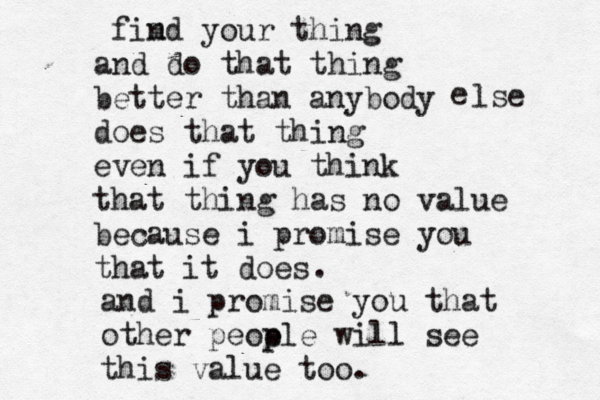
Seperating creative and critical thinking with an incubation period
Productive Brainstorming Requires that you Separate Creative Thinking from Critical Thinking
I had first hand experience of this productive brainstorming at the weekend when I was collecting some ideas for a journalling application. The problem was that each idea I had was quickly followed through by my more critical side asking "How would that work?". As soon as I had an idea I would quickly invalidate it by thinking that it would be too difficult to implement. You're not going to get any ideas by doing this.
Looking back I should have simply put my ideas down first without giving them a second thought about how they would be implemented and then let them incubate.I do this quite a lot with a blog on mind mapping, but it's something that I had forgotten about at the weekend when I was trying to be creative and generate some ideas.Let your ideas grow in your mind for a while before applying the critical thinking to them.
I would recommend at least a few hours or even a couple of days between creative thinking and critical thinking.The time when your ideas are in an incubation period can give you a chance to reflect on your ideas. This isn't time when you should be thinking about the critical aspect of your ideas, instead it's just a time for the ideas you have, to sit and do nothing.While they're doing nothing you might trigger a thought to a more refined idea. Then again you might not.
You don't lose anything here but it does mean that when it comes to the critical evaluation of your ideas, you'll be familiar with each of the ideas you originally had and you'll be ready to apply some critical thinking to them.
The Dark Side Of IF
Don't do it. Don't dabble with If only. Ban it from your vocabulary for 2012.
Play with if.
You know it makes sense.
— The Dark Side of If by Nicholas Bate
Nicholas Bate's post pretty much narrows down my review of 2011. I had a couple of ideas for products but didn't act on them. I spent way too much time dabbling, trying to learn and really didn't get anywhere. With some positive news at home, I can now focus on getting these ideas off the ground.
The great thing about shipping is that if you can do it often enough, these problems of slipping features or making sacrifices in quality can fade away.
— Relentless Shipping by Adam Keys
I wish more products and services on the web adopted this thinking, but it would also be beneficial to make the development process transparent. Rather than waiting for a big feature announcement on the company blog, it would be nice to track features as their shipped.